
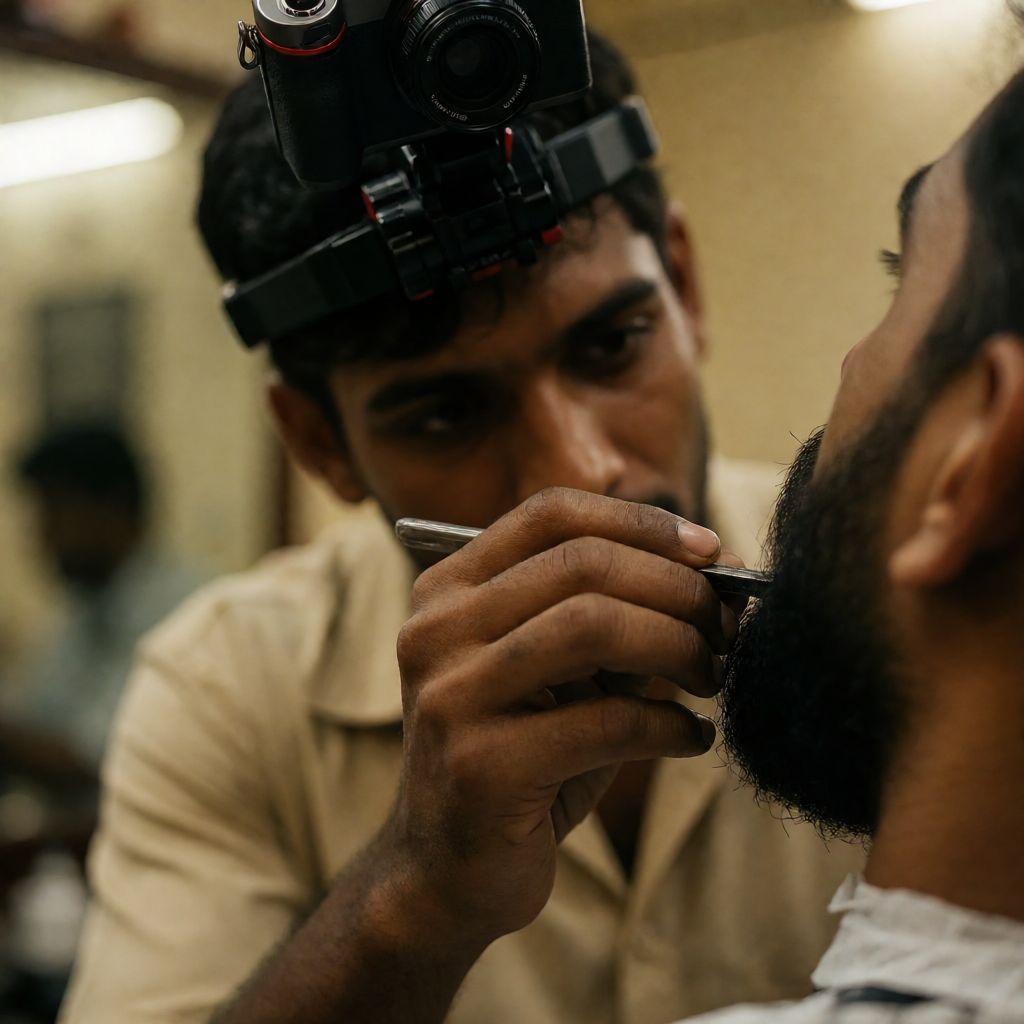
Mohammed Ashim is 22, and he has been cutting hair and trimming beards in Bengaluru for four years. The new habit is the unusual part: he straps a camera to his head and works with it on for five or six hours a day. The camera records only his hands and fingers — his clients’ faces are blurred, and the footage is of the trade, not the people in the chair. "The routine is simple, but you have to be disciplined about how you move," he told the BBC. The operations team that set him up told him his hands had to stay cleanly inside the frame, the lighting had to be sharp, and he could not tilt his head too abruptly while working.
The footage goes to a local company that has gathered hundreds of people doing the same thing — barbers, potters, candle-makers, garment workers. That video is sold to technology companies and research organisations that use it to train physical AI: systems that learn to move real limbs through the real world, not just to predict the next word. The company pays $5 to $10 for eight to ten hours of recorded work. That works out to roughly a dollar an hour at the top end; less than sixty cents at the bottom.
Why footage of a barber's hands
The first question anyone has when they hear this is who pays for video of a man cutting hair. The answer lives in the biggest open problem in robotics. Language models got their knowledge from the internet — a free dataset of disembodied text and images. But the internet holds no archive of embodied human activity. There is no dataset of a kitchen being cleaned. There is no record of hands that know exactly how much force to apply so a plastic bottle does not crumble, or so a steel glass does not shatter. You can simulate a great deal, but a physical task needs signals from fingers, wrists, elbows, shoulders, and dynamic force, and that data has to be captured from scratch, in the real world, across diverse and messy environments.
The capture has become an industry. Rashdan Technologies, an Indian data company, is one of the operators, and co-founder and CEO Shahil Baig describes the business like a commodity desk: "Every robotics company, every frontier AI lab, has a specific kind of data they want: industrial tasks, agriculture, household chores, small business work like pottery, garment-making, embroidery, candle-making. We go wherever the task is." The buyers are getting more demanding. What used to be a single small camera is now four to six cameras rigged around the head to cover the entire scene. Rashdan pays more for that tier, because getting someone to agree to a five-camera headset is a different conversation from getting them to agree to one.
The scale is larger than any single Indian firm. Manish Agarwal, founder of Humyn Labs — bases in Bangalore and San Francisco — says his company alone has 96,000 data collectors across countries in Latin America and Southeast Asia. Thousands of hours of footage get filtered, labelled, and packaged into formats labs can use, sometimes with hardware worn on the hands and fingers to capture physical contact. Agarwal also makes the strategic point that frames the rest of the story: India's role today is largely as a supplier of raw material. People strap on cameras, record themselves doing ordinary tasks, and the footage gets shipped off to labs abroad.
What the work feels like
The BBC profiled three workers, and they put numbers into the story that no executive summary would.
Ashim — the barber — says the money is good, but "the feeling of doing something this futuristic is what keeps me excited. I never imagined my razor techniques would be useful to a global tech company." Mohammed Arman, a textiles worker in Bangalore who has spent ten years stitching and cutting garments, is more direct. "For me, it's simple. This is survival. I have a family back home in Bihar, and every rupee I send back matters. If someone offers me extra money to wear a camera while I do the exact same work I've been doing for 10 years, I'm not going to say no. It doesn't cost me anything. I'm already doing the stitching, already doing the cutting." Jolly Arifur, a science teacher in Guntakal, wears a rig-mounted camera while doing domestic work at home — scrubbing, cooking, sweeping tile floors, folding laundry — fitted around a young son and seven months of recording. Two to three dollars an hour, three to five hours a day. "I'm managing both honestly, fantastically," she says.
The collectors say they are careful about consent. Rashdan records hands, not faces; multi-camera rigs blur faces; no names or contact details go into the handoff. That is the documented, charitable side of the ledger. The question nobody is asking — and cannot easily be asked — is what the footage is actually for. Everyone involved knows the destination: robots that do the jobs being filmed.
The asymmetry
Bino Paul, senior professor at the Tata Institute of Social Sciences in Mumbai, points out the obvious. For some workers AI is a useful tool; for others the machine that learns from their hands is the thing that automates the job. And if machines do start taking over, workers will have little they can do about it. "By the time workers realise what they have participated in, things may have gone too far," he says. He wants governments to build what he calls a socio-technical system — ethics upheld through human agency, "ensuring that AI delivers beneficence rather than maleficence."
Until then, the economics of the trade are settled. A few dollars a day, work everyone is already doing, footage sold to people who will build something that can take the work. And the market is set to get more crowded: Agarwal expects dozens more competitors to emerge in India this year. More supply, the same buyers, and the price of an hour of human skill starts to behave like what it actually is — a raw-commodity input.
What it means
The supply chain runs through the world's cheapest labour markets. Compute is the moat everyone discusses, but embodied data is the real bottleneck in physical AI, and it is being farmed in Bengaluru and Guntakal, and by 96,000 collectors in Latin America and Southeast Asia. The geopolitics of robotics will play out less in chip fights and more in labour markets — in rooms where the workers themselves have no seat.
The price tag is a preview of the end state. A stitcher's footage costs $0.50 to $1.25 an hour. The robot being trained on that footage is aimed at exactly that stitcher. Face-blurring is good PR, but it misses the point: what is being sold is the work itself — ten years of muscle memory, packaged at the price of a street snack. Privacy rules for the body, no rules for the livelihood.
India has a value chain to climb, or a floor to sit on. Raw footage depreciates fast — Agarwal says it, not the competition. More collection firms means less money per hour, and the durable position is the pipeline: cleaning the video, structuring it, validating it, and eventually writing the standard for what counts as high-quality training data. It is the same move the world made with textiles, from fibre to garment to brand. If India stays the footage supplier, it gets paid in rupees to teach the machine that eventually replaces the stitcher.
The real headline is the "no archive" line. Every model generation so far has been trained on data someone else produced for free — forum posts, code, photos, essays. Physical AI is the first frontier that has to pay for its training data, and the first people paid explicitly to educate a machine are low-wage, low-leverage, and structurally out of the loop on the end state. That is not a bug that a fine can cure; it is a design feature of how the next wave of capability gets built.
🔥 Hot Takes
1. Physical AI is the first frontier whose frontier is a sweatshop. Search trained on the free web; language models trained on the free internet. This wave has to be manufactured, and it is being manufactured at a dollar an hour by people the robots will eventually displace. The most futuristic industry on the planet runs on a gig-economy business model with a consent framework thinner than the blur filter on the footage.
2. "I'm not going to say no" is not consent — it is duress with a smile. Arman's line about every rupee sent back to Bihar should be in every boardroom that buys this data. When the training-data budget is measured in a family's survival margin, the transaction is the whole story, and nobody in the transaction is telling it.
3. Watch the standards fight, not the robot demo. Whoever owns the definition of "high-quality training data" owns the market, and Agarwal is saying it out loud: move up from footage to pipeline. If India — or anyone — does not argue for that value chain now, the argument is lost in the raw-footage price war, and the Global South will export its muscle memory for less than a dollar an hour.
The bottom line is simple and uncomfortable. The next wave of AI is not being trained on words; it is being trained on work, and the work is being done by people the technology is aimed at. Somewhere in Bengaluru a 22-year-old barber is holding his head at exactly the angle he was told to, keeping his hands in frame, earning sixty cents an hour for the privilege. His footage ships to a lab. The lab builds a machine. And by the time anyone asks whether the machine takes the barber's job, the footage that built it will already be spent — recorded, packaged, and paid for, in a currency no one in a boardroom would accept for a full day's work.