
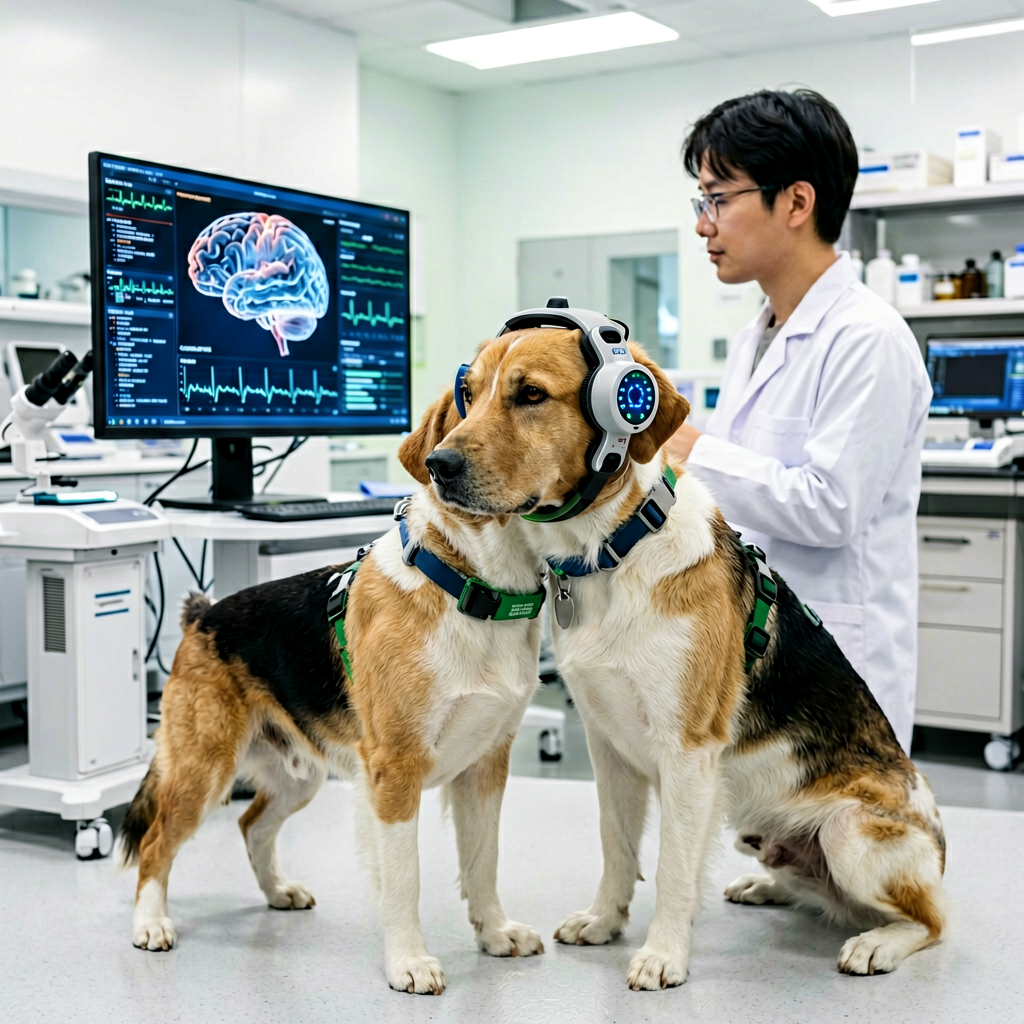
In a lab outside Bengaluru, three rescue dogs — Billy, Jessie, and Banu — clock in for work every morning. They don't scan MRI images or analyze blood tests. They sniff human breath through specially designed helmets, and when they detect cancer-related volatile organic compounds, they sit, freeze, or scratch to signal their finding. Treats dispense automatically. It sounds like science fiction, but this is the work of Dognosis, a startup that's combining canine olfaction with artificial intelligence to create what could be the world's most affordable early cancer screening tool.
The results, published in the Journal of Clinical Oncology, are startling: across 1,502 participants at six hospitals in Karnataka, the dog-AI system achieved over 90% accuracy in detecting seven major cancer types. For a country where 80% of cancer cases are diagnosed at late stages — when treatment is far more expensive and less effective — this could be transformative.
The Biology of Scent
Dogs have approximately 300 million scent receptors, compared to roughly 5 million in humans. Their olfactory bulb is proportionally 40 times larger than ours. When a person has cancer, metabolic changes alter the volatile organic compounds (VOCs) released through breath, skin, and bodily fluids. These chemical signatures are invisible to human senses but detectable by a dog's extraordinary olfactory system.
"Every disease has a scent," says Dognosis co-founder Dr. Abhijeet Singh. "We're not asking dogs to detect cancer directly. We're using their noses as biological sensors, then capturing and digitizing their responses with AI." The startup's proprietary DogSense brain-computer interface records EEG data, breathing patterns, and body language as dogs encounter breath samples collected via cotton masks.
The process is non-invasive for patients. Individuals breathe into a mask for approximately 10 minutes, the sample is sealed and transported to the laboratory, and dogs never directly interact with patients. At Dognosis's "Sniffspace" training facility, dogs learn through positive reinforcement to recognize cancer-associated odor patterns. When they respond correctly, automated treat dispensers reward them.
The AI Layer
What makes Dognosis different from previous canine cancer detection studies is the AI integration. Traditional research relied on handlers interpreting dog behavior — did the dog sit? Scratch? Hold still? These subjective signals varied between dogs and handlers.
Dognosis uses machine learning models (DogOS software suite) to analyze multimodal data: brain activity patterns, respiration rates, micro-movements, and behavioral responses. The system creates a digital signature of the dog's perception, converting biological sensing into quantifiable predictions.
"We're not just counting sits and scratches," explains Dr. Singh. "We're decoding the neural and physiological correlates of canine olfaction. The AI learns what specific brain wave patterns, breathing changes, and micro-behaviors correspond to positive detections across thousands of training sessions."
This digitization is crucial for scalability. Human handlers vary in skill and consistency. Dogs have limited working hours and require extensive training. But a digitized system could theoretically be replicated, validated, and deployed across multiple locations simultaneously.
Why This Matters for India
India faces a catastrophic cancer screening gap. The World Health Organization estimates that 60-70% of Indian cancer patients present with Stage III or IV disease, compared to 30-40% in developed nations. Late diagnosis means higher mortality, more aggressive treatments, and devastating financial toxicity for families.
Current screening technologies — CT scans, MRIs, PET scans, biopsies — are expensive, require sophisticated infrastructure, and are concentrated in urban centers. A rural patient might travel hundreds of kilometers and spend weeks waiting for a diagnosis that could have been made in minutes with a breath sample.
Dognosis's approach could democratize early cancer detection. The breath collection is non-invasive and requires minimal training. The dog-AI system could operate in basic healthcare settings without electricity-dependent imaging equipment. And the cost? Estimated at under $10 per test, compared to $500-2,000 for imaging-based screenings.
"We're not replacing biopsies or CT scans," emphasizes Dr. Singh. "We're creating a first-line screening tool that identifies high-risk individuals who need further investigation. In resource-limited settings, this could mean the difference between detecting cancer at Stage I — when cure rates exceed 90% — or Stage IV, when survival drops below 20%."
The Scientific Validation
The Phase II study published in JCO represents rigorous validation. Across six hospitals in Karnataka, the system demonstrated:>90% sensitivity for early-stage cancers,>85% specificity across seven cancer types (lung, breast, oral, gastric, esophageal, pancreatic, and colorectal),Consistent performance across diverse demographics and cancer stages
However, experts caution that promising results don't guarantee clinical adoption. "The methodology is sound, but this needs independent validation in larger, multi-center trials," says Dr. Priya Narasimhan, a biomedical engineer at IIT Bombay not involved in the study. "Canine olfaction is well-documented, but translating lab results to routine clinical practice requires addressing standardization, regulatory approval, and health economics."
Dognosis is collaborating with government medical institutions and pursuing regulatory pathways. The company plans Phase III trials across multiple Indian states before commercial launch, targeting deployment in primary health centers and mobile screening units.
Global Implications
If successful, Dognosis could reshape cancer screening globally. Low- and middle-income countries face identical late-diagnosis challenges. Africa, Southeast Asia, and Latin America could benefit from low-cost, infrastructure-light screening tools that don't depend on expensive imaging equipment or specialized radiologists.
The startup's approach also intersects with broader trends in frugal innovation — developing high-impact solutions with minimal resources. Rather than building expensive sensors, Dognosis leverages biological sensing capabilities that have evolved over 30,000 years of dog domestication, enhanced by cutting-edge AI.
"The West spends billions developing electronic nose technology," notes Dr. Singh. "We're asking: why rebuild what evolution already perfected? Dogs are the most sophisticated biological sensors ever evolved. We're just giving their abilities a digital voice."
What This Means
Dognosis represents a distinctive Indian approach to AI: leveraging biological intelligence, minimizing infrastructure requirements, and prioritizing accessibility over sophistication. While Western startups chase multimodal foundation models and autonomous agents, Indian innovators are solving fundamental access problems with elegant, frugal solutions.
The dog-AI cancer detector won't win design awards or generate viral demos. But if it achieves its promise — $10 breath tests that catch cancer early in rural clinics across India — it could save millions of lives and redefine what "frugal AI" means in practice.
As India positions itself as a leader in AI for global health, stories like Dognosis demonstrate that the most impactful AI innovations may not come from the most expensive labs, but from the most creative combinations of biology, technology, and necessity.
🔥 Hot Takes
1. While Silicon Valley builds trillion-parameter models, India is building a $10 cancer test using dogs and AI. The contrast couldn't be starker. American AI companies are chasing AGI through brute-force scale — more parameters, more data, more compute. Meanwhile, Indian startups are solving existential problems with elegant frugality: dogs that sniff cancer, AI that digitizes their noses, and breath tests that cost less than a coffee. This isn't about choosing one path over another — it's about recognizing that "advanced" doesn't always mean "better." Sometimes the most sophisticated solution is the one that actually reaches the people who need it.
2. The real AI revolution isn't in chatbots — it's in dogs with EEG headsets. Dognosis is doing something no American startup is attempting: merging biological and artificial intelligence in a way that creates genuinely new capabilities. The dogs aren't just "trained to detect" — they're integrated into a closed-loop system where their neural responses are digitized, analyzed, and refined by machine learning. This is symbiotic AI in the truest sense: human ingenuity + canine olfaction + algorithmic pattern recognition working as one system. The implications extend far beyond cancer — diabetes, infectious diseases, neurodegenerative conditions all have scent signatures waiting to be decoded.
3. India's frugal AI approach could save more lives than any GPT-6. Let's be clear: breakthrough language models are impressive, but they won't detect Stage I lung cancer in a farmer's breath sample. India's AI ecosystem is producing solutions tailored to its realities — resource constraints, scale challenges, and urgent health needs. Dognosis represents exactly the kind of innovation the world needs: not the most powerful AI, but the most accessible. If this technology scales and validates, it won't just transform Indian healthcare — it could become the template for AI-driven health equity across the Global South.