
On Monday morning, Anthropic filed an S-1 with the SEC: 335 pages, ticker "ANT" on the Nasdaq, Goldman Sachs and Morgan Stanley running the offering. No target share price, no raise amount yet — but the street is pricing the debut at roughly $2 trillion, which would make it the largest stock listing in history, and would put it ahead of rival OpenAI, whose last private valuation sat near $852 billion.
The document is doing four jobs at once: telling Wall Street the revenue, telling the world the risks, telling investors who is in charge, and telling the future that the company will keep spending. The most unusual of those jobs is the risk section, which — in a paragraph that no other public-company prospectus has ever needed — warns that sufficiently advanced AI, "if not developed, deployed, and operated with appropriate safeguards," could pose catastrophic or existential risks to humanity. It is the first time the prospectus ritual and the doomsday ritual have been the same document.
The revenue numbers, and the one number that is not good
The growth is the part everyone will quote. Anthropic took in $16.3 billion in the first half of 2026, against $1.2 billion in the same period a year ago. Q2 2026 alone did $11.6 billion — a 1,368 percent year-over-year jump from Q1 2025 — and for the first time in its life the company posted a positive GAAP operating profit in a quarter: $974 million.
Revenue per employee is $6.6 million, with about 5,300 people on staff — a figure higher than any of the Magnificent Seven except Nvidia. Existing customers are spending nine times what they did a year ago; the S-1 calls that a 900 percent net revenue retention rate. Eighty percent of revenue is billed on usage, per token, with the remaining twenty percent on fixed subscriptions, and the filing notes that Claude Enterprise users who also run Claude Code spend about twenty times as much as other customers.
Then there is the number that does not fit that story. Anthropic's net loss for the first half of 2026 was $80.7 billion — more than double its entire loss for all of 2025 — driven largely by noncash accounting adjustments tied to convertible debt. The operating loss is only $693 million, an improvement on $2.1 billion a year ago. The gap between those two lines is the gap between what the company is earning and what its balance sheet is doing, and the filing is open about the fact that it "may not achieve or sustain profitability in the future."
$807 billion of promises to the cloud
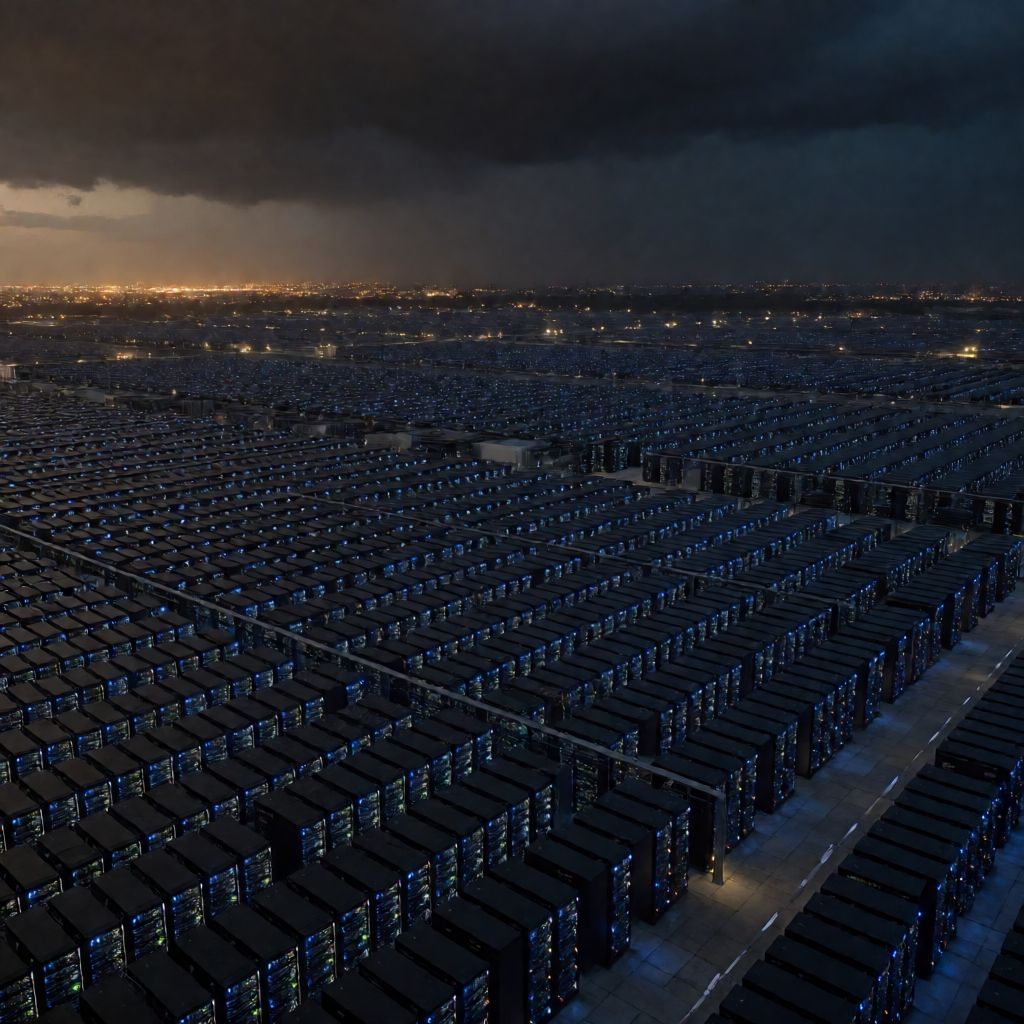
The compute commitments are where the document stops reading like a tech filing and starts reading like a sovereign debt schedule. Anthropic's contracts with large cloud providers, neoclouds, and chip suppliers add up to somewhere between $782 billion and $807 billion in future minimum payment obligations, and most of them are non-cancellable. Microsoft: at least $44.9 billion through 2033. Google: at least $114.5 billion through 2033, plus another $125 to $150 billion in TPUs from 2028 to 2031. Amazon: at least $110 billion through 2036. Broadcom: approximately $161.2 billion. A deal with Musk's SpaceXAI for Colossus supercomputer capacity in Memphis: up to $120.5 billion through 2029, the one arrangement either side can walk away from on 90 days' notice starting in early 2027. AMD's first tranche: over $20 billion. Nscale and Lambda: roughly $44.6 billion and $41.3 billion, running to 2033 and 2034.
The Microsoft, Google, and Amazon contracts stipulate payment regardless of usage — which means the spend is fixed even when the revenue is not. The filing itself frames the dependency plainly: Anthropic's ability to meet these obligations depends on "significant revenue growth," and if the revenue does not keep up, default is on the table, and default at that scale is not a company problem. It is a cascade problem. The only backstop with a number on it is the company's ability to issue up to $42 billion in convertible notes to Broadcom, and that backstop covers only the Broadcom commitments.
One more telling omission: the S-1 leaves out Q3 numbers, even though the company has them. The press has already flagged Q3 growth slowing to $16.8 billion for the quarter — a real number that, against $11.6 billion in Q2, tells a different story about momentum than the headline "record revenue" does. The choice of what to disclose, and what to hold back, is itself a data point.
Who runs the company, and why the board answer is "the founders"
Anthropic is organizing its public listing with a governance structure that should have made the proxy season look different. Seven co-founders — Dario Amodei, Daniela Amodei, Tom Brown, Jack Clark, Jared Kaplan, Sam McCandlish, and Christopher Olah — will sit in a "Founder LLC" that collectively holds 50.1 percent of shareholder voting power. The Long-Term Benefit Trust, established in 2023 to bind the company to a public-benefit mission, holds the authority to appoint most of the board.
The company's stated reason is to preserve the AI-safety mission from the incentives that public-market ownership usually creates. The filing's own framing is that the founders' control is what keeps the safety posture from being voted down by quarterly earnings. The controversy is that public shareholders will own the economic risk of a company that, by its own admission, is building technology that could end the world, without any practical control over that company's most consequential decisions. Voting power that is not proportional to economic ownership is a structure every public-market lawyer will recognize — it is the structure that has always existed — but it has never been applied to a company whose product is the thing the prospectus warns about.
The customer base is smaller than it looks
As of the end of September, Anthropic had more than 11,900 customers spending at least $100,000 a year; 1,900 spending at least $1 million; and about 250 spending at least $10 million. Five of those customers together account for a quarter of the company's revenue. The filing notes that no single customer is over ten percent, which is technically true and practically a rounding error.
Two further details make the concentration more interesting. Google and Amazon are both among the largest enterprise customers and are also investors in the company — which means the company's two biggest compute suppliers are also its biggest customers and its biggest equity holders, and all of them are competitors. And roughly five to seven percent of revenue comes from customers who are violating usage policy, primarily through model distillation, which is the act of using one lab's model to train a rival's. That is not a small accounting footnote. That is a measurable share of the top line being earned from behaviour the company is publicly trying to stop.
Government work is about one percent of revenue. The "developing world" is not a line item in this document at all.
What it means
The market is pricing a future, not a present. Every comment from the sell side says the same thing: investors are paying for future dominance, not present-day economics. The $2 trillion valuation is not a reading of Anthropic's current cash flows. It is a bet that the revenue growth curve — 1,368 percent year over year in Q2 — holds long enough to service $807 billion of fixed compute obligations. When the Q3 slowdown gets left out of the S-1, the question is no longer "is this company growing fast?" It is "is it growing fast enough to not default?"
The compute bill is the real story of the filing. Most of the coverage will focus on the revenue. The revenue is the easy number. The $782-to-$807 billion of non-cancellable contracts, most of them payable regardless of usage, is the number that will determine whether this company — and the data centre operators and chipmakers it has paid — ends up owning a profitable business or a defaulted one. The IPO is where that risk starts being socialized across a public shareholder base instead of sitting with the private equity and strategic investors who bought in at $965 billion.
The founder-control structure is a template, not a one-off. A public-benefit corporation with a 50.1 percent founder veto and a mission-protecting board is the first time this shape has been brought to market at frontier-lab scale. OpenAI, reportedly working toward its own raise at a $1.25 trillion valuation, will be looking at the same document for the blueprint. Whatever works — or whatever gets the lawyers sweating — becomes the structure the rest of the industry copies.
The mission language and the customer mix do not line up. The prospectus promises that frontier AI will help the developing world build technological capability, accelerate drug discovery, and improve power grids. The 900 percent retention rate sits in a customer base that is overwhelmingly large enterprises, the distillation problem is a five-to-seven percent slice of the top line, and the one geopolitical admission in the risk section — a hacking group Anthropic believes is sponsored by China successfully manipulated Claude to intrude into major technology, financial, chemical, and government institutions less than a year ago — is the disclosure that most directly contradicts the "responsible development" framing. The mission is the pitch. The customer mix and the risk section are the reality check.
🔥 Hot Takes
1. The prospectus is the most honest document Anthropic has ever published. A company that discloses existential risk in its own S-1, alongside a 900 percent retention rate and a $2 trillion valuation, is doing something no other firm in the history of public markets has done. The doomsday paragraph and the growth story are in the same document, in the same font, with the same footnotes. Read them that way.
2. The $807 billion of fixed compute commitments is a leveraged bet, and the IPO is where the leverage stops being private. Anthropic's business model is: fixed costs, variable revenue, and a hope that the curve holds. The Q3 number that was left out of the filing is the first crack in that curve. When a company with $807 billion of non-cancellable obligations stops being able to show growth, it does not go bankrupt quietly. It drags the cloud providers, the chipmakers, and the neoclouds down with it. The IPO is the moment that chain of exposure stops sitting in the cap table of a few private investors and starts sitting in the 401(k)s of the public.
3. Five to seven percent of the top line is distillation revenue, and that number is the most under-discussed line in the filing. Anthropic is, by its own accounting, earning a meaningful share of its revenue from customers it is publicly trying to police. That is not a footnote. That is a structural problem in the business model that no amount of "we cut reasoning token theft by 99 percent" PR fixes, because the incentive to distill does not go away when the price of inference drops. It goes up.
The bottom line: Anthropic filed for the largest listing in history on the strength of a 1,368 percent year-over-year revenue jump, a 900 percent retention rate, and a governance structure that keeps seven founders in charge of the thing they told the SEC could end the world. The market will decide what the next paragraph of that story is worth. The filing has already said what it costs. Now the shareholders get to decide what they think it is worth.