
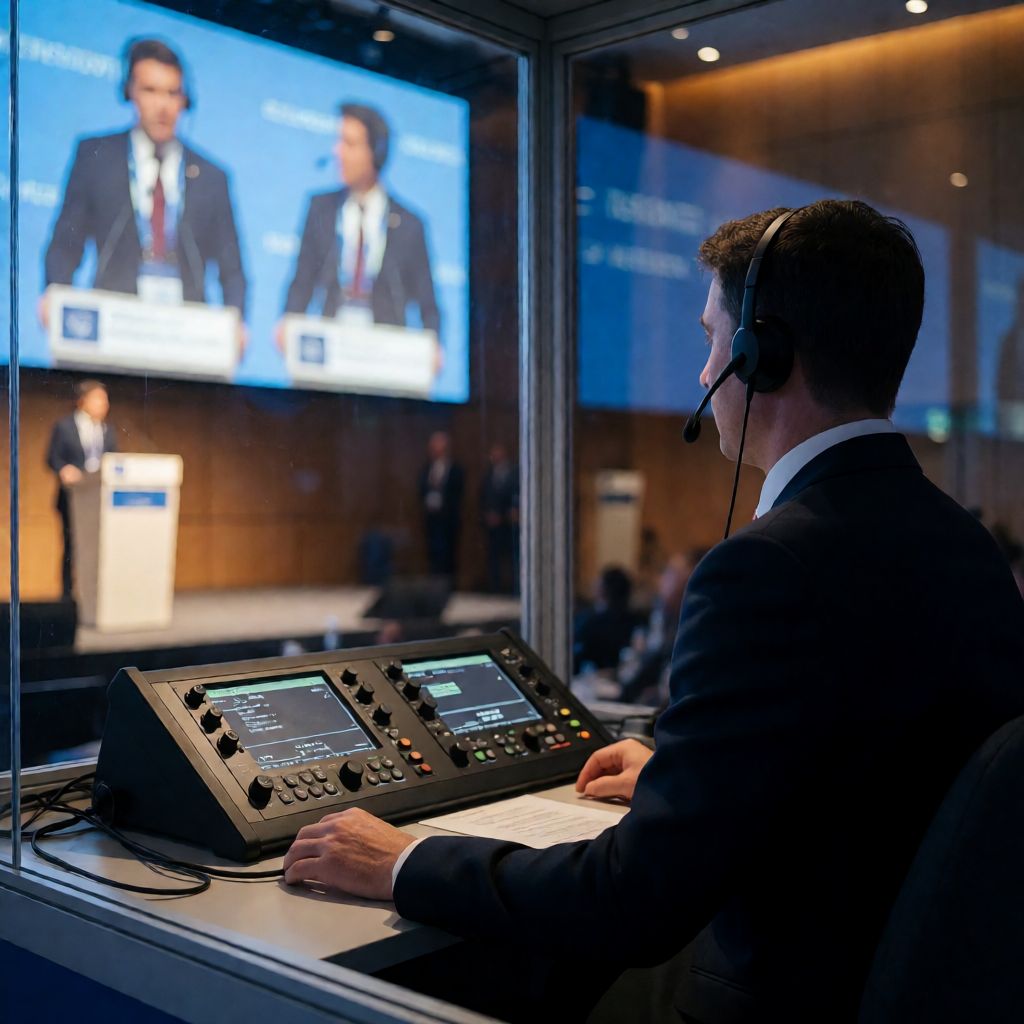
Tencent has released a model that performs simultaneous interpretation — the kind where the speaker is still mid-sentence and the translation is already landing — at a streaming lag of about three seconds, and it outscored four of the five commercial APIs it was measured against. The model is called Hy-SimulMT, it comes from Tencent's Hunyuan team, it is released with weights, an inference service, and training tools, and it can keep the original speaker's voice while translating, so that in a three-person interview you can still tell who is talking even after the language has changed.
The benchmark is the RealSI long-form audio test, where the relevant numbers are a quality score called GEMBA and a latency measure called StreamLAAL. Hy-SimulMT sits at roughly three seconds of lag — the lowest among the systems shown in the company's own comparison — with a GEMBA score above the other open-source models and above four of the five commercial APIs it was tested against. On the short-form benchmarks the picture is less clean: it leads on FLEURS, ACL6060, and RealSI-Sentence among the open systems, while Gemini's live-translation offering scores higher on FLEURS (92.4 to 90.3) and several others lead on CoVoST2. The model's own release is candid that these findings "apply only to the samples, participating interpreters, and evaluation settings used in this test."
What simultaneous translation actually is
The problem is not translation. It is the decision of when to start speaking. If the system waits for the speaker to finish, the translation is more accurate but the listener sits in silence for the duration of every thought. If it starts early, it has to guess the shape of an incomplete sentence, and sometimes it has to say something it did not know yet it would later have to correct. Human simultaneous interpreters have managed this trade-off for decades in rooms where the cost of a mistake is measured in treaties and in closing prices. The field's quality metric — GEMBA — and its latency metric — StreamLAAL, which measures streaming translation lag and is explicitly not the same as time-to-first-speech — are designed to capture that trade-off rather than just accuracy.
The comparison set in the release is a useful map of who is in this race. On one side: Qwen3.8-LiveTranslate, Seed-LiveInterpret2.0 from ByteDance, and XunFei's simultaneous-interpretation offering. On the other: Gemini 3.5's live translation, GPT-Realtime-Translate, and the open-source SimulS2ST-Omni and SeamlessStreaming lines. There is no European lab in the table. The simultaneous-interpretation race, as these release notes document it, is a two-block contest between Chinese open-weight and commercial systems and the American frontier-lab APIs — and the open-source row is beating the commercial one on quality at lower latency, which is a claim no American commercial product is currently making in this specific category.
The human comparison, and the one word in it
The release's most interesting section is the one where Tencent stopped benchmarking against machines and started benchmarking against people. The team collected eighteen newly published Chinese and English recordings, each about six minutes long, spanning ten domains — software and AI, medicine, manufacturing and energy, the natural sciences, agriculture and food, business management, law, education, culture and tourism, and sports and daily life. It then had six interpreters with years of professional simultaneous-interpreting experience — three holding CATTI Level 1 certificates, the highest tier, and three holding CATTI Level 2 — interpret the same recordings, and compared the model's output against the best of each certification group.
The result the company reports: translation quality on par with expert human simultaneous interpreters, while responding faster. The result two industry leaders quoted in the release are more careful, and the careful word is doing real work. Wang Weiwei, Vice Dean of the School of Interpreting and Translation Studies at Guangdong University of Foreign Studies, called it "a new milestone in China's AI simultaneous interpreting capabilities" and framed the shift as moving "from 'assisting understanding' toward 'usable communication' in low-risk settings." The final three words are the entire labour-market story. The profession is not saying the model is not good. It is saying it is good in a place that is not where the profession's hardest work happens.
The voice is the detail that outlasts the model
The release notes that speech generation and voice cloning require a configured text-to-speech service — a dependency the documentation makes explicit rather than hiding. The capability it enables is the one that will make or break the product: real-time voice cloning that preserves the speaker's vocal characteristics. In the English-to-Chinese demo, three different speakers produce three different translated voices, and the listener can follow who is talking across the language switch. That is a feature no human interpreter has ever offered — a human interpreter is, by definition, not the person speaking. The moment the translated voice carries the original speaker's timbre, the translation stops being a performance and starts being a channel.
And that is the moment a genuinely new problem enters the frame: the translated voice in your meeting is a clone of the person in the room. Consent, identity, and the simple question of who is speaking are now product questions, not ethics-fine-print questions, and the release does not address them. That gap is not a criticism of the engineering. It is the space the next regulatory and contractual layer has to fill.
The open-weights positioning, and why it matters
Tencent's Hunyuan team is one of the main Chinese open-weight brands — the roster that also includes Qwen, GLM, Kimi, and DeepSeek — and the release of a training tool alongside the inference service is a signal that this is not just a product feature but a contribution to the open-weights ecosystem the way our earlier reporting on the open-weight race and the price wars around it has been tracking. The Hy Translate app — Android and iOS — is the consumer surface, but the SimulTrain tooling is the developer surface, and that is where the real distribution happens. An open simultaneous-interpretation model that a meeting platform, a newsroom, a court reporter's toolchain, or a medical-education team can fine-tune and deploy locally is a very different object from a closed API with a per-minute price tag.
The two-block geography of the comparison table extends that point. If the open-weight systems from one bloc are beating the commercial APIs from the other bloc in a high-skill, high-trust professional category, the question the table quietly raises is not "which model is better?" It is "which bloc's open-weights ecosystem becomes the default substrate for the world's simultaneous-communication layer?" The answer to that question is not decided by a GEMBA score. It is decided by the app that ships, the training tool that gets adopted, and the developer that fine-tunes it for their own domain and never sends the weights back.
What it means
The latency number is the product. Three seconds is not a measurement. It is the threshold below which a translated conversation feels like the same conversation, not a delayed one. That is the number that determines which room this technology gets into. A meeting is three seconds. A courtroom is not. The release's own "low-risk settings" language — borrowed, pointedly, from the profession it is about to compete with — is where the deployment map ends today.
The comparison table is a strategic document. Every system in it is from two countries. No European lab is in the simultaneous-interpretation race as this release has documented it, and that absence is more informative than any GEMBA score in the table. The table is the open-weights bloc asserting itself as the category leader in a domain that has, until now, belonged to a small guild of human professionals and a handful of closed commercial APIs. The open row beating the commercial row is the claim. The bloc that owns the category owns the default.
The profession has already drawn its own line, in its own words. The two industry leaders quoted in the release did not say the model was not ready. They said it was moving "from 'assisting understanding' toward 'usable communication' in low-risk settings." That is a line the profession drew for itself, and it is the most honest sentence in the document: the machines get the meeting, and the humans keep the court, the negotiation, and the anything where the stakes of a wrong word are not recoverable. The CATTI certificate does not go away on a GEMBA score. But its scarcity premium is now measured in low-risk deployments it no longer owns.
The cloned translated voice is the feature that outlasts the model. The technology that will define this category in five years is not the simultaneous translation. It is the fact that the translation sounds like the person. That is a feature no human interpreter has ever had, and it is the feature that makes the "who is speaking" question a product, consent, and liability question at the same time. The engineering is shipped. The governance layer — the consent model, the identity semantics, the contractual basis on which a cloned voice can represent a person in a room they are not in — has not been written yet, and it will not be written by the model's author.
🔥 Hot Takes
1. The most important row in the release is the one that is missing. No European lab is in the simultaneous-interpretation comparison. The open-weights race has been a three-way contest — Chinese, American, and European — for the past two years. In this category, as Tencent's own benchmarking shows, it is two. The default substrate for the world's simultaneous-communication layer is being set by two blocs, and the third is not at the table. That is a bigger story than the GEMBA score.
2. The profession's endorsement is a self-defence, and it reads like one. "Low-risk settings" is not a compliment. It is the guild deciding, in advance, which parts of its own market it will surrender. The model gets the meeting and the newsroom and the classroom. The human interpreter keeps the courtroom, the negotiation table, and the anything where the cost of a wrong word is not recoverable. The CATTI Level 1 certificate is not threatened by this release. Its price is. The scarcity premium is now priced by the deployments the machine wins, and those are the ones that were never the profitable core of the profession.
3. A cloned translated voice is the feature that makes "who is speaking" a product question. The moment the translation sounds like the person, the interpreter — the human one, the one who has always been the voice — is replaced not by a better translation but by a voice that is not anyone's. Consent and identity questions enter the product at the same time, and the release does not address them. The next regulatory document to cover a cloned voice representing a person in a room they are not in will be more consequential than the model itself, and it will not be written by the model's author.
The bottom line: Tencent shipped an open, three-second, expert-grade simultaneous interpreter that preserves the speaker's voice, and it beat the commercial APIs that sell the same job on quality at lower latency. The profession it competes with has already drawn the line — in its own words, at the word that matters. The next question is not whether the model is good enough. It is who writes the governance layer for the cloned voice, and which of the two blocs at the table ends up owning the default.