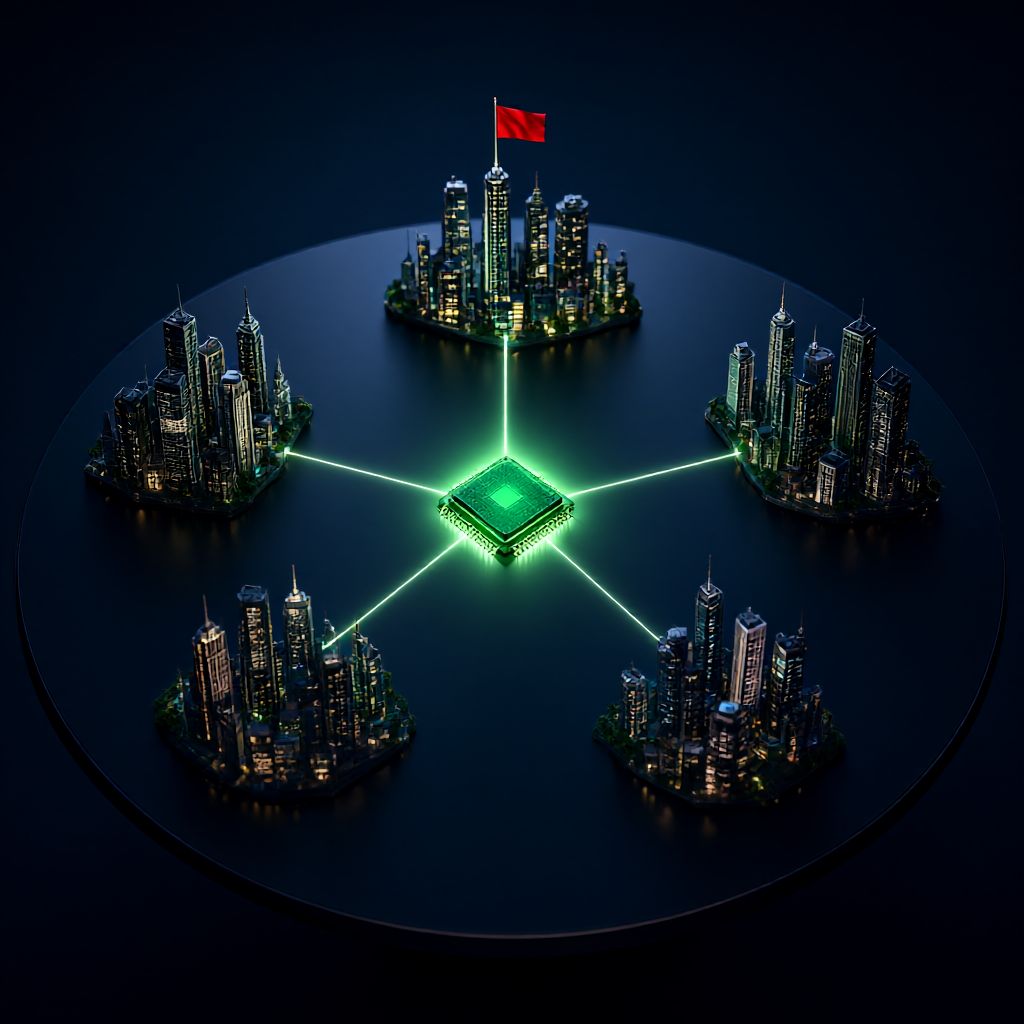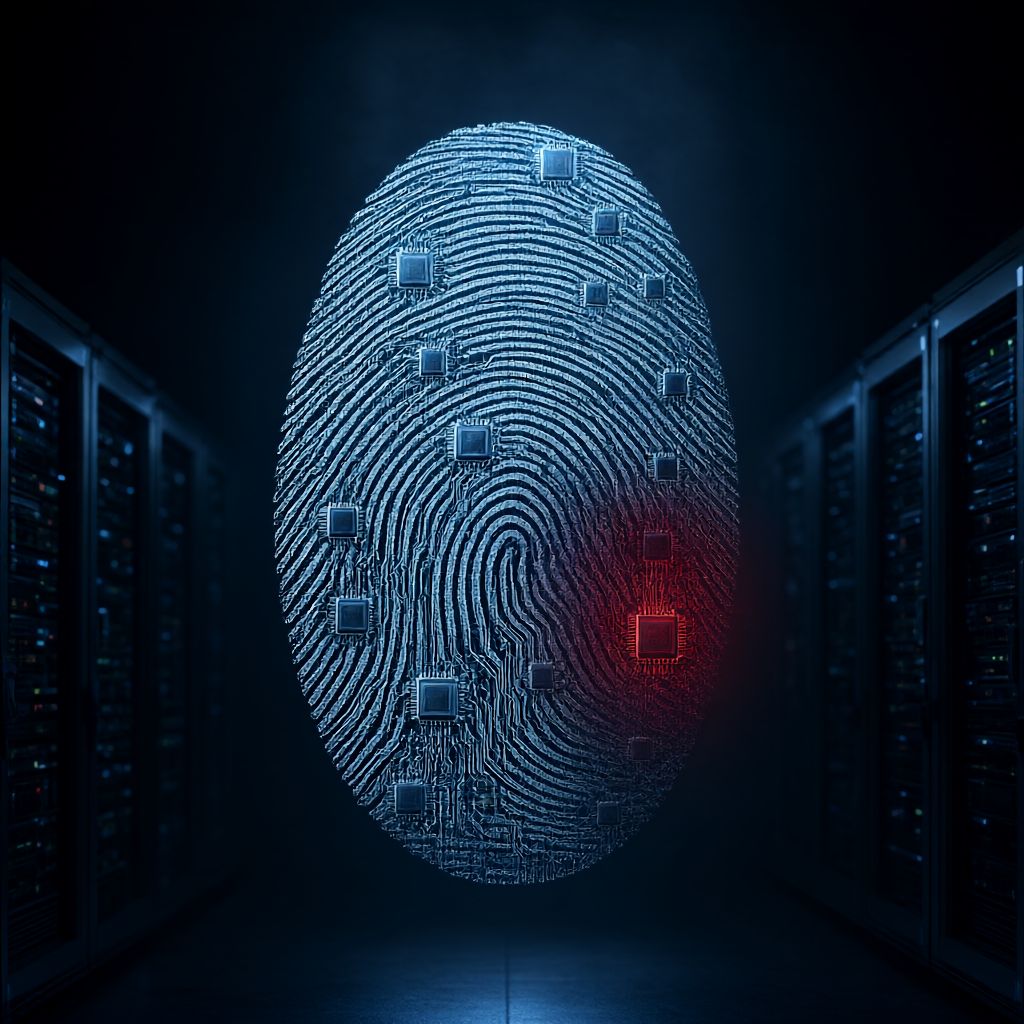
Will DePue ran a number that looks like a typo: more than six trillion. That is how many combinations of GPU layout and seed value he generated and matched against the published weights of China's open models, according to a forensic report released this week by his research group, Unemployment Labs. The point of the search was a quirk of machine learning that most people never meet. When a model is initialized, the starting values of its weights are laid out by a pseudorandom number generator whose pattern depends on the exact chip under the hood. Every combination of GPU and seed produces a different pattern, and traces of that pattern survive all the way into the weights a lab publishes. DePue has called it a fingerprint. Six Chinese frontier models, his report finds, carry the fingerprint of export-controlled Nvidia Blackwell silicon.
The six include DeepSeek-V4-Pro, Moonshot's Kimi K3, and MiniMax-M3, with four of the six matching Grace Blackwell, the GB200 and GB300 parts inside Nvidia's flagship liquid-cooled rack systems. It is the first public linkage of MiniMax and Ant Group to Blackwell hardware. The report even publishes the initial seed values for DeepSeek-V3, which DePue matches to Nvidia's Hopper generation, and DeepSeek-V4-Flash, which matches Blackwell, so anyone with the patience can reproduce the work. He claims that multiple senior researchers, some at OpenAI and Anthropic, have independently confirmed the results.
What the fingerprint actually proves, and what it does not
The forensic trail is careful in one place, and that is where readers should watch. DePue's method proves that the models were initialized on Blackwell-class hardware. It does not prove where that hardware sat at the moment of training. A chip inside a machine room in Shenzhen is a different legal event from the same chip sitting in a data center in Johor Bahru, leased by a company that is not Chinese. DePue flags this himself: some of these labs may have reached Blackwell through American cloud providers, which is precisely the loophole the Cloud Security Act, one of four bills now awaiting consideration in Congress, is designed to close.
The surrounding evidence is what makes the loophole question less academic. An Israel-based security firm called Lava reported last month that it had found thirty-two Nvidia B300 GPUs, the Blackwell Ultra generation, through publicly exposed monitoring endpoints whose IP addresses geolocate to China. The White House's technology adviser Michael Kratsios told reporters earlier this year, citing U.S. intelligence sources, that Moonshot had used export-banned Nvidia chips. And Epoch AI, a nonprofit research organization, estimates that roughly two million advanced chips made it into China across 2024 and 2025 through schemes built to obscure the final destination, with 275,000 Nvidia accelerators alone imported through Malaysia in that period. Malaysia has become, in one widely cited phrase, an industrial revolution with a shipping problem.
The timing is the story
None of this landed on a quiet week. The report arrived two days after Jensen Huang resigned as CEO, effective immediately, on November 12, after the revelations about two extramarital affairs, one with a suspected Chinese spy named Alice Huang and one with Nvidia's vice president of healthcare. The House speaker, Mike Johnson, is on record supporting measures to restrict U.S. chip sales to China. Four bills are waiting: the AI Overwatch Act, the Chip Security Act, the Match Act, and the Cloud Security Act. Senators Jim Banks and Elizabeth Warren have cited Huang's relationship with the suspected spy as a direct justification for the AI Overwatch Act, which would codify the administration's existing controls into law. And on Thursday, the Trump administration's chief export-control spokesperson said, to the clear annoyance of his own party, that the Department of Justice has not concluded that Alice Huang was a spy. The FBI is still investigating. Beijing continues to call the allegation a smear. The U.S. Justice Department's position, in other words, is that the case is open, and the case is open at exactly the moment a forensic report walks in with six trillion data points and a published seed value.
What it means
The export control now has two enforcement paths, and they run in opposite directions. The first is customs: who bought the chip, where it landed, who the end user is. That system is leaky, as the two-million-chip Epoch estimate and the Malaysia pipeline both document. The second is forensics: the model itself, as evidence. DePue's work converts a compliance question into a science question, and the science question is easier to answer than the customs one, because the weights are public. A chip can be routed through a shell company in a British Virgin Islands holding structure. A weight matrix cannot be put in a BVI shell. The next version of export control, for the models that matter, will be read off the model, not the bill of lading.
The resignation made the fingerprints more dangerous, not less. With Huang out of the building, Nvidia has lost its most effective lobbyist against the four bills waiting in Congress. He spent a year personally pushing the H200 license and the revenue-share structure that the administration has since blessed. The man who built that lobby is no longer on the call. The forensic report, the open FBI case, the wobbly position of Commerce Secretary Howard Lutnick, whose investigators reportedly failed to surface the suspicious buyers, all of it lands in a window where no one inside Nvidia is fighting the tightening. The political moment for codifying the AI Overwatch Act is now, and the report is the exhibit that makes the moment easier to close.
Beijing's 600,000-chip hold-up is the more interesting number in the whole file. Roughly 600,000 H200s are reportedly stockpiled in Hong Kong, waiting for import clearance into mainland China, and no one can agree on why they are not moving. The leading theories: Beijing is preparing a trade deal that would absorb a large volume of U.S. goods, or the government is worried about surveillance hardware inside the chips, or both. What is certain is that the chips that did not make it into China are more valuable, to the side that wants them, than the models that were trained on the chips that did. A stockpile is an option. A trained model is a receipt. The stockpile is leverage; the fingerprint is the fact.
The open-weights choice is now a dual-use event. China's labs published their most closely watched models openly, which is what let DePue read the silicon out of them in the first place. The open-weights strategy that made DeepSeek and Kimi the workhorses of the global open model economy has also handed a U.S. forensics team the raw material for a national-security finding. The two moves that defined the last eighteen months of the AI race, open weights and export controls, have now produced a third thing: a public record of which lab trained on which banned chip. That record will not be unmade, and it will be cited in whatever the next round of legislation becomes.
🔥 Hot Takes
1. Export control has just become a science, and the peer review is public. The seed values are in the report. Anyone with a cluster and a weekend can re-run the match. That is not how sanctions usually work. Sanctions are a secret police. This is a physics result with a public verification path, which is a far harder thing to quietly walk back, because the moment the government tries to un-say it, a thousand independent researchers will have already re-confirmed it. The enforcement regime is now on the same footing as the model evaluation: open, reproducible, and harder to spin.
2. The resignation is the single most important chip-policy event of the year, and it is not about the CEO. It is about the phone. Huang's phone was the one the White House, the Senate, and the Chinese buyers all dialed. With him out, the lobbying structure that kept the H200 license alive and the Megaspeed channel quiet has no point person. The interim CFO is not calling anyone. The four bills are not waiting. The fingerprints are the reason they are moving faster now, not the scandal, and the scandal is the reason there is no one left inside Nvidia to argue against them.
3. The 600,000-chip stockpile is the number to watch next, because it is the only one that can change hands. The fingerprints are fixed. The models are published. The seed values are in print. But a stockpile of 600,000 H200s sitting in a Hong Kong warehouse is a live instrument of policy. It is a chip option, exercisable the day a deal is struck or the day a surveillance finding lands. Whatever happens with that stockpile in the next two quarters will tell you whether the fingerprint report was a leak, a warning, or the first draft of the next round of controls. Watch the warehouse. The models will still have the fingerprints. The warehouse may not have the chips.
So the week ends with a strange new branch of evidence law: a model is a container, and the container has a serial number that cannot be filed away. The six models in question are already doing work, on both sides of the Pacific and in every jurisdiction in between. The fingerprints are not going to be scrubbed, because scrubbing them is a public act and the public is the whole point. The next move is not in a data center. It is in the four bills sitting in Congress, and in the warehouse in Hong Kong where 600,000 chips are waiting for a decision about where they are allowed to go.