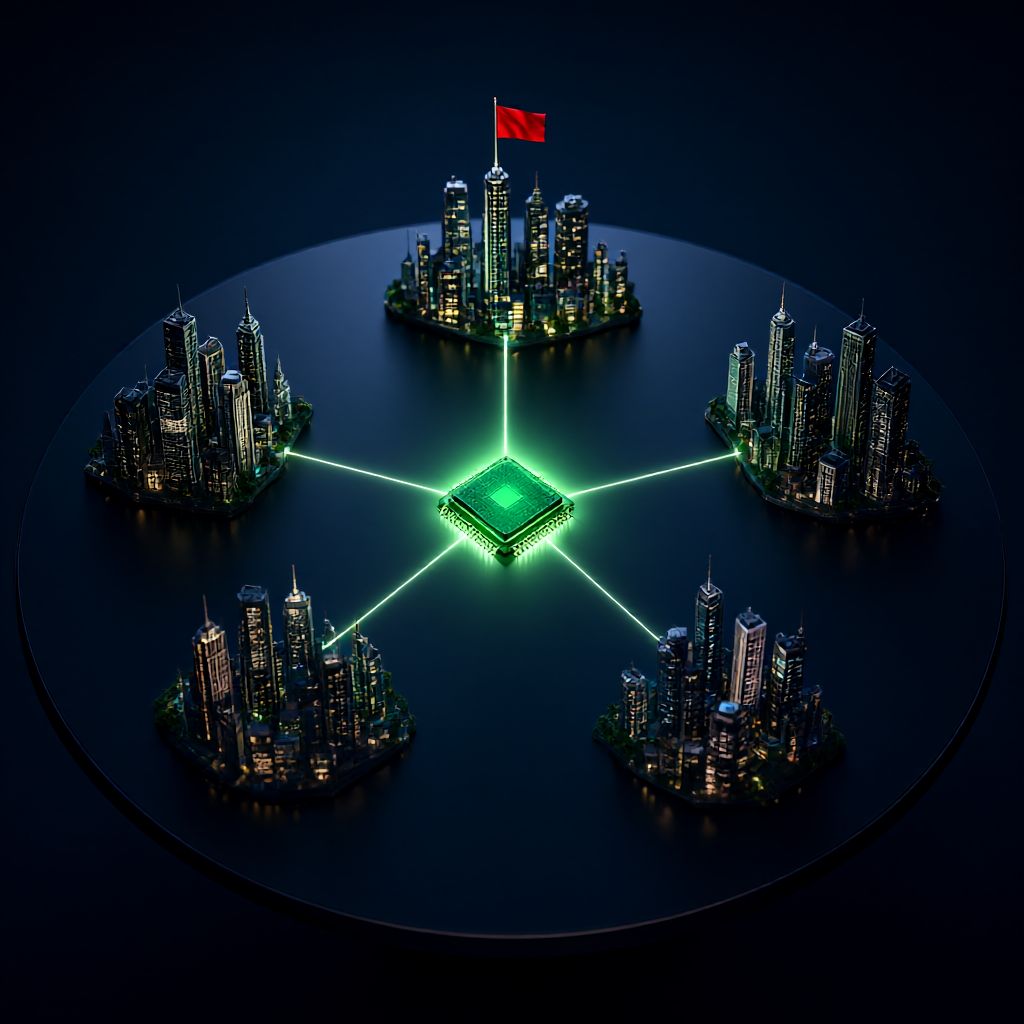
The first thing the Asian governments did about Jensen Huang's resignation was make sure the chips would still arrive. That single move, the reaffirmation, is the whole story, and it is not the story the American press is writing. In Seoul, the South Korean science ministry got Nvidia to reconfirm a commitment of 260,000 advanced GPUs and the continuation of joint AI projects. In Taipei, the city government said the planned Nvidia headquarters was on track and that the company had met its contractual obligations so far. In Tokyo, the industry ministry said it would watch closely. In Beijing, the foreign ministry said it was not aware of the thing everyone else in the room is talking about. And in Singapore, the ministry that is still holding the most interesting document in the entire affair, the one about a confiscated passport and a warning, said the investigation into the company and six other individuals is ongoing. Five capitals, one event, five different answers to the same unasked question, and none of them are about the man.
Let me back up, because the timeline is the map. On November 8, Nvidia's board launched an independent probe into the chief executive's relationship with a suspected Chinese spy. On November 12, the chief executive resigned as chief executive officer, president, and board member, effective immediately. On November 13, the foreign ministry and the Singapore ministry and the South Korean strategy council all moved within hours of each other, which is to say, the reaction did not come as a wave. It came as a series of independent statements, each drafted in a different capital, each calibrated to a different audience, and each avoiding the word that none of them wants to say, which is that the man who built the supply chain that half of Asia's AI strategy is built on is no longer in the room. Day five, and the sentence is still being avoided, and that avoidance is the data.
The answers, capital by capital
South Korea is the answer with teeth, because it is the only one that is a number. Two hundred and sixty thousand advanced GPUs, reconfirmed to the science ministry, plus the continuation of joint AI projects, plus an emergency meeting of the government AI strategy council on Friday to assess the impact. Read that stack in order and you have the full Korean posture: reassure the public with the number, cover the downside with the meeting, and keep the relationship warm with the project. South Korea is the customer who owns the memory that goes into the chip, and a customer who owns the memory does not panic. It counts.
Japan is the answer that is the shape of no answer. The industry ministry will monitor, and the deputy chief cabinet secretary said it is too early to assess, while committing, in the same breath, to stable supply. That sentence is a policy, not a reaction, and it is the shape every government takes when the thing it is worried about is the supply and not the leadership. Too early to assess is the diplomatic version of we are watching the warehouse, and the warehouse, in this case, is the queue at the foundry, and the queue, as we documented in our flagship piece, runs to 2028.
Taiwan's answer is the shortest and the most telling, because it is an answer about a building. The economy minister said the departure was unlikely to significantly change the growth of the global AI industry, and the city government said the planned Nvidia headquarters was on track. A government that cares about the chip does not talk about the chip. A government that is calm enough to talk about the headquarters of the company is a government that has already priced the event and decided it was not an event. Taipei's silence on the substance is the substance.
China's answer is the one the other four are reacting around, and it is two sentences long. On the 10th, the foreign ministry called the spy allegation groundless and a smear. On the 13th, a spokesperson reiterated opposition to export controls that disrupt global supply chains and said the ministry was not aware of reports linking restricted Nvidia chips to a Shanghai data center associated with the alleged spy. The second sentence is the one to sit with. Not aware is not a denial, because a denial would be a claim that the chips were not there, and the chips, by our fingerprint piece, are in the building whether or not the paperwork says so. Not aware is a stonewall, and it is a stonewall for the same reason a stonewall is built, which is that the thing it is hiding behind is a fact that can no longer be disputed. Reuters put a number on the exposure, and that number is more than three billion dollars of Chinese AI computing projects that are, in the middle of this, reliant on the restricted processor, and reliant in a way that the not aware does not fix.
Singapore's answer is the document the others are not quoting, and it is the one that matters most, because it is the only one that is a legal act and not a press release. The ministry of home affairs seized the suspect's passport in June of last year, as part of an investigation into false declarations about the purchase of servers, and the question the police were asking was whether servers shipped from Singapore to Malaysia were subsequently sent to other countries without the proper declaration. In February, the police found there was insufficient evidence to establish that she had committed the offense, and the word offense is doing quiet work in that sentence, because the finding was that she had knowingly provided inaccurate information about her role at the company, and the outcome was a warning and a ban on reentry, and the return of the passport. The investigation into the company and six other individuals is still open, and Singapore says it received limited assistance from American authorities on the server maker in the chain. That is the floor of the whole affair, and the floor is lower than the tabloids have been reporting, and it is also still open, and the two facts together are the story.
And then there is the company's own answer, which arrived Sunday and is the last piece of the map. Megaspeed, in a statement, said it conducts legitimate and lawful business, and it distanced itself from the former executive, which is to say, the company that is the instrument of the channel has decided that the channel is not the woman, and the woman is not the channel, and the distinction is the entire defense. The statement hired help, the help is a law firm, and the help is the part that has not been written yet.
What it means
The reaffirmation is the unit of currency in the new chip geopolitics, and it is not the CEO. The Korean number, the Taipei building, the Japanese monitoring, the Beijing stonewall, the Singapore warning, all of them are priced in the same currency, which is the arrival of silicon, and none of them are priced in the man. The American press is writing the man's story, the resignation, the affair, the third unnamed relationship, the petition to reinstate him that the other side's executives are now circulating. The Asian press is writing the silicon's story, the reaffirmation, the queue, the passport, the warning. Two stories, one event, and the second story is the one that will still be true in two years, when the first has been archived.
The not aware is the most expensive four words in the affair, and they are not a denial. A denial costs the speaker a fact. A stonewall costs the speaker a reputation, and the reputation is the only thing the stonewall is protecting. The fingerprint evidence means the fact cannot be denied, so the fact is not denied, and the not aware is the instrument, and the instrument is a choice, and the choice is a signal, and the signal is to the domestic audience, not to the American one. The sentence was not drafted for Washington. It was drafted for the person in Shanghai who is deciding whether to buy the domestic chip, and the not aware is the green light that sentence gives to the domestic chip, and the domestic chip is the flagship, and the flagship is the story we wrote about yesterday.
The three billion dollars is the number the stonewall is protecting, and it is the number that decides which side of the war the next quarter is fought on. The Reuters exposure is not a theoretical risk. It is the actual, present, in-the-building dependency of the Chinese compute stack on the restricted processor, and it is the reason the not aware exists, and it is the reason the reaffirmation exists, because the two numbers are the same number seen from two capitals, and one of them is going to move first, and the one that moves first is the one that has already built the alternative, which is to say, the one that has already put the flagship in the water.
The petition is the tell, and the tell is on the other side of the strait. The American executives who are now circulating a petition to reinstate the man who resigned are telling you, in the most expensive way an executive can tell you something, that the capacity they are worried about losing is not the man's judgment. It is the man's phone. The petition is not a loyalty test. It is a supply chain request, dressed in the clothes of a loyalty test, and the clothes are the tell, because the people who would sign a supply chain request do not dress it as loyalty, and the people who dress a supply chain request as loyalty are the ones who know what it is, and the knowing is the part that will not survive the congressional testimony.
🔥 Hot Takes
1. The reaffirmation tour is the story, and the story is a sentence about the order book, not about the man. The only reaction with a number in it is the one that matters, because the number is the only thing that is a commitment and not a comment. The two hundred and sixty thousand GPUs is a contract. The too early to assess is a shrug. The not aware is a wall. The warning is a floor. And the floor is the one the rest of the affair is sitting on, and the floor was laid in February, eight months before the resignation, and the floor is Singapore's, and the floor is the document, and the document is the case.
2. The not aware is a green light, and it is aimed at the domestic chip. Read the four words in the language they were drafted in, which is the language of the buyer, not the seller. The buyer in Shanghai is deciding between the restricted processor and the flagship, and the not aware is the state telling the buyer that the restricted processor is not the one the state will defend, and the state will defend the flagship, and the flagship is the one the state has been conducting for five years. The four words are the order of the day, and the order of the day is the one the eye is shifting to, and the shift is the story, and the story is the ship.
3. The petition is the most honest document in the American story, and it is also the most damning. The executives who sign a petition to bring back a man are signing a document that says the capacity they cannot replace is the man's phone, and the man's phone is the supply chain, and the supply chain is the reason the man was in the room, and the reason the man was in the room is the reason the man is no longer in the room, and the sentence that connects the two is the one the board will not read into the record, and the one the testimony will.
So day five, and the map is drawn, and the map is not a map of who is sorry or who is angry. The map is a map of who is counting the GPUs and who is building the ship and who is holding the passport and who is saying not aware, and the four of them are the same event, and the event is the conversion, and the conversion is the one we named yesterday, and the one that will still be running when the man's story is archived. The eye moved. The order book did not flinch. The ship is still on schedule. And the warehouse, in both capitals, is still the only thing that has not moved, and the warehouse is the one that will move first, and the move is the rest of the story.