
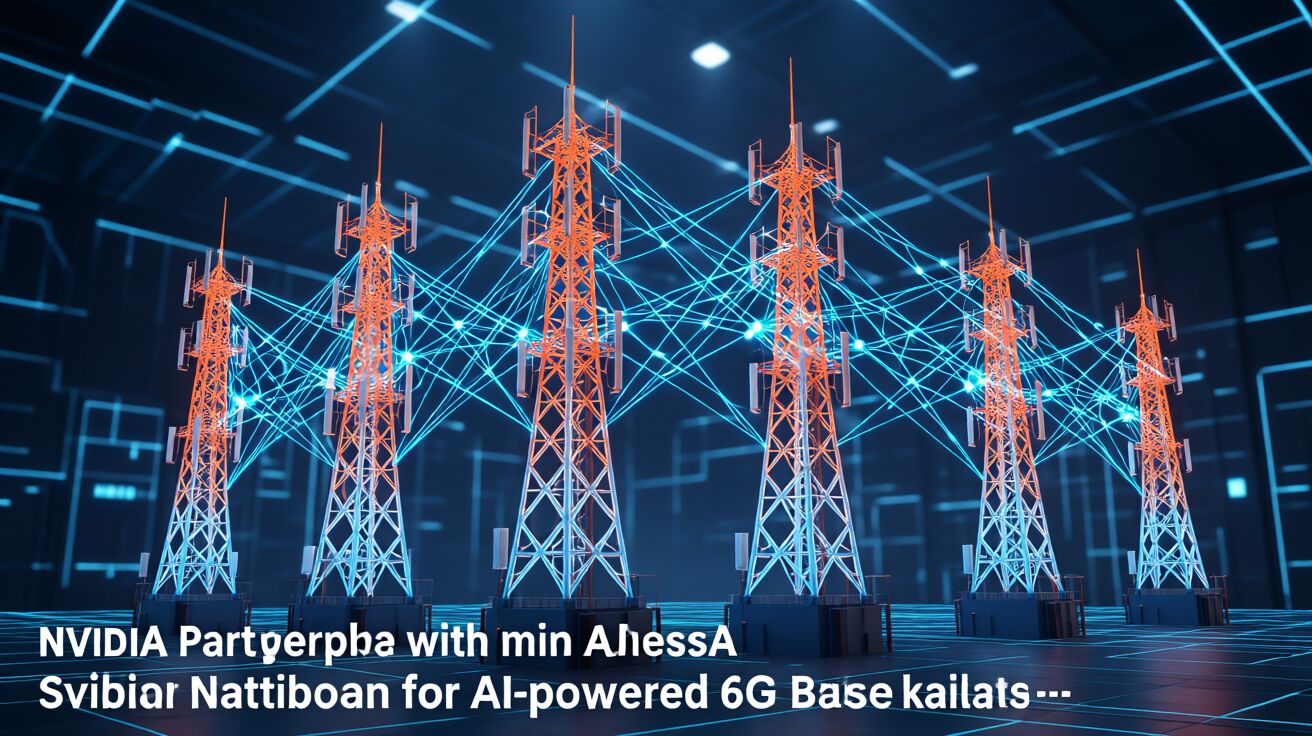
In a move that underscores the complicated relationship between American tech giants and Chinese manufacturing, Nvidia is reportedly seeking a Chinese base-station maker to develop AI-powered 6G infrastructure — despite ongoing US restrictions on semiconductor exports to China.
According to a report by TechNode, Nvidia has been in contact with Jiaxian Communications (佳贤通信), a Shenzhen-based company, since 2025. The two have been working on a project to combine Nvidia's AI computing platform with wireless network equipment for 6G systems aimed at overseas markets — not China itself.
The Partnership: AI Meets Telecom Infrastructure
The proposed collaboration represents a convergence of two of the most important technology trends of the decade: artificial intelligence and next-generation wireless communications. 6G networks are expected to deliver speeds up to 100 times faster than 5G, with latencies measured in microseconds rather than milliseconds. But the real promise of 6G isn't just raw speed — it's the ability to support AI-native networks that can diagnose, optimize, and repair themselves in real-time.
Nvidia's entry into this space makes strategic sense. The company has already established itself as the dominant provider of AI computing hardware, with its GPUs powering everything from large language models to autonomous vehicles. But Nvidia's data center business faces increasing scrutiny from US regulators, and the company is looking for new growth vectors. Telecom infrastructure — especially AI-powered 6G base stations — represents a massive addressable market.
Jiaxian Communications, meanwhile, brings expertise in wireless network equipment and base station manufacturing. The company has been working in the telecom infrastructure space for years, though it remains a relatively obscure player compared to giants like Huawei and ZTE. Partnering with Nvidia gives Jiaxian access to cutting-edge AI computing platforms that could differentiate its 6G offerings.
Why "Overseas Markets Only"?
The emphasis on overseas markets is critical. US export controls strictly limit the sale of advanced American semiconductors to China, and any partnership that involves transferring Nvidia technology to Chinese entities would face intense regulatory scrutiny. By targeting markets outside China, Nvidia can potentially bypass some of these restrictions — though the legal and geopolitical complexities remain significant.
The report indicates that trial networks could be targeted for 2027 or 2028, suggesting the partnership is still in early stages. Neither company has publicly confirmed the collaboration, and a final product has not been announced.
The Bigger Picture: AI and 6G Convergence
This partnership comes at a time when the convergence of AI and telecommunications is becoming a major industry trend. Companies like Ericsson and Nokia have already unveiled AI tools that let networks diagnose and fix themselves automatically. The concept of AI-RAN (AI-enabled Radio Access Network) is gaining traction as a way to make cellular infrastructure more intelligent and efficient.
6G is expected to take this convergence even further. The ITU-R's IMT-2030 framework, which is defining 6G standards, explicitly envisions networks that can support AI workloads natively — meaning the network itself becomes a platform for AI applications, not just a pipe for data transport.
Nvidia's involvement in this space could accelerate the trend. The company's AI computing platforms are already being used to optimize network performance in 5G deployments. Extending that capability to 6G — with the higher bandwidth and lower latency that the new standard promises — could create a compelling value proposition for telecom operators worldwide.
Geopolitical Implications
The reported partnership also highlights the geopolitical tensions that underlie the AI and telecom industries. The US has been increasingly restrictive about American technology reaching Chinese hands, particularly in semiconductors and AI. Nvidia itself has been subject to export controls that limit its ability to sell its most advanced chips to Chinese customers.
Yet the company's pursuit of a Chinese partnership — even one focused on overseas markets — suggests that the commercial realities are more complex than the political rhetoric. Chinese manufacturers remain essential to the global telecom infrastructure supply chain, and American companies that ignore that reality risk falling behind.
At the same time, China is aggressively pursuing 6G leadership. Companies like Huawei and ZTE are already developing 6G technologies, and the Chinese government has made telecommunications infrastructure a strategic priority. A partnership between Nvidia and a Chinese company could give China access to American AI expertise while allowing Nvidia to maintain a foothold in the global telecom market.
What This Means for the Industry
If the Nvidia-Jiaxian partnership materializes, it could have several implications:
1. Accelerated 6G development. Combining Nvidia's AI computing with Jiaxian's telecom expertise could speed up the development of AI-native 6G infrastructure, giving early movers a competitive advantage.
2. New business models for telecom operators. AI-powered 6G base stations could enable new services — from autonomous vehicle networks to immersive AR/VR experiences — that aren't possible with traditional infrastructure.
3. Increased competition for Huawei and ZTE. While Chinese companies currently dominate global telecom infrastructure, a partnership between Nvidia and a Chinese manufacturer could create a new competitive dynamic — one that combines American AI with Chinese manufacturing.
4. Regulatory challenges. Any partnership involving American AI technology and Chinese manufacturing will face scrutiny from US regulators, particularly given the ongoing tech war between Washington and Beijing.
🔥 Hot Takes
1. Nvidia is playing 4D chess while the US plays checkers. While Washington is busy restricting chip exports, Nvidia is finding creative ways to maintain its presence in the Chinese ecosystem — even if it's through a partnership focused on overseas markets. This is the reality of global tech: companies will find ways to make money, regardless of what regulators say.
2. The AI-6G convergence is the next big battleground. Just as AI chips became the most valuable hardware in tech, AI-powered telecom infrastructure could become the most valuable networking equipment. Whoever controls this convergence — Nvidia, Huawei, Ericsson, or a new partnership — will have a massive advantage in the 6G era.
3. "Overseas markets only" is a legal fiction that won't hold. The distinction between domestic and overseas markets is blurry in practice. Technology developed for overseas markets will eventually make its way back to China, either through reverse engineering or through Chinese companies that acquire the know-how. The US restriction regime is creating perverse incentives that may ultimately strengthen Chinese technological independence.
4. This is what "decoupling" actually looks like. Nobody in Washington talks about complete decoupling from China anymore — it's economically impossible. What we're seeing instead is a complex web of partnerships, workarounds, and compromises. Nvidia's reported pursuit of a Chinese partner is a perfect example: the US wants to restrict tech transfer, but American companies still want Chinese manufacturing capabilities.
The Bottom Line
Nvidia's reported pursuit of a Chinese partner for AI-powered 6G base stations is a small story with large implications. It shows that even as the US tightens restrictions on semiconductor exports, American companies are finding ways to maintain connections with Chinese manufacturers — particularly when the commercial opportunity is as compelling as 6G infrastructure.
The partnership is still in early stages, and nothing is confirmed. But if it materializes, it could accelerate the development of AI-native telecom infrastructure and reshape the competitive landscape for 6G — a technology that will define the next decade of global communications.
For now, the world waits to see whether Nvidia and Jiaxian Communications can navigate the geopolitical minefield that surrounds any American-Chinese tech partnership. The stakes — both commercial and strategic — could not be higher.