
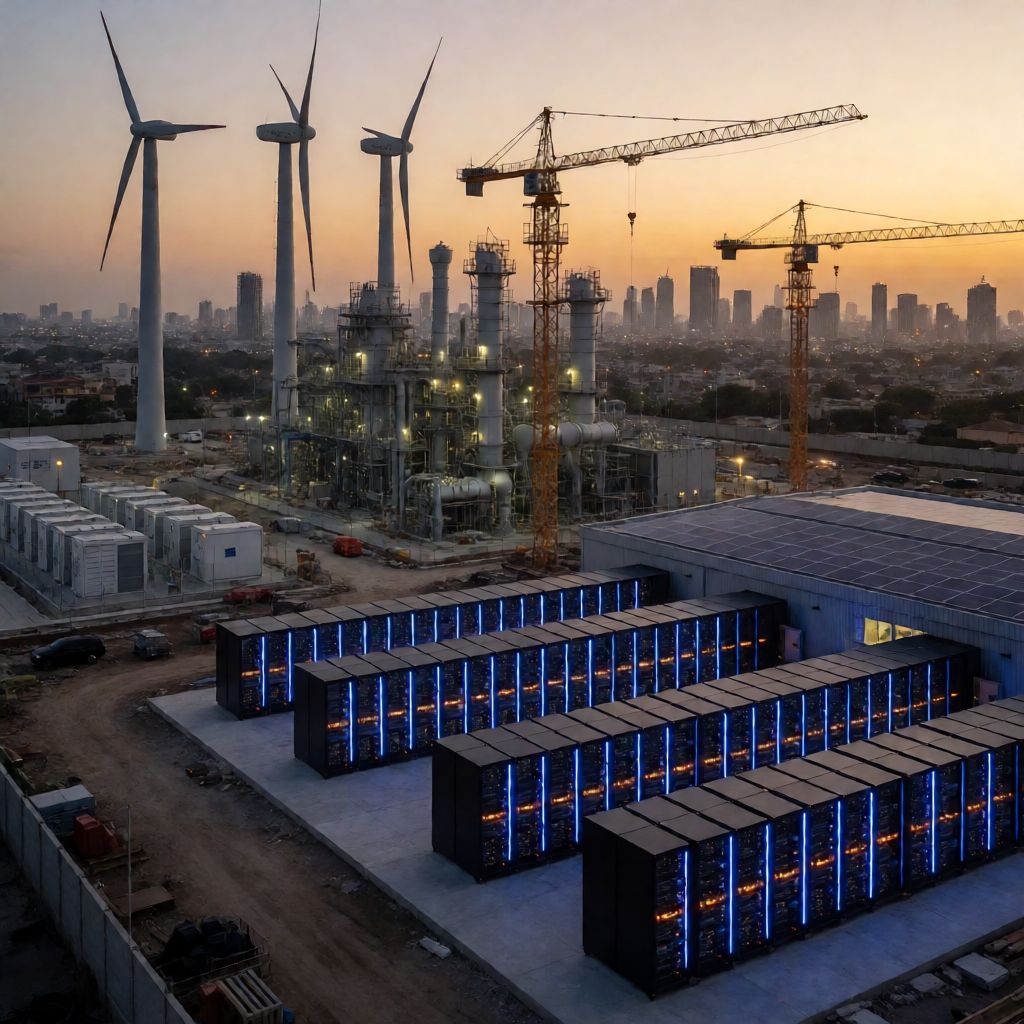
A South African infrastructure investment firm has landed on a number that shouldn't exist in most of Africa: a $650 million to $1 billion build for two AI-ready data centres in Nigeria, with construction slated for the second quarter of 2027. INFRAGORA Global Capital calls the facilities part of its AFRIDATA platform, and the detail that matters is the one most people miss. You cannot plug a modern data centre into Nigeria's grid. So the project ships with its own 160 to 200-megawatt power plant — gas and renewables, plus a battery storage backbone — sitting right next to the servers.
That is not a footnote. That is the business model. In the countries that matter most for this story, the binding constraint on artificial intelligence is not compute. It is electricity.
Why two data centres, why now
The numbers behind the timing are easy to find. According to the US Trade and Development Agency, Africa accounts for less than two percent of the world's data centre capacity. The majority of the continent's computing and storage is physically located outside the continent. For a bank in Lagos, a hospital in Nairobi, or a government agency anywhere in between, that means latency measured in milliseconds and data sovereignty measured in none.
INFRAGORA is not working in a vacuum. It is joining a small but growing field. Kasi Cloud has already broken ground on a 100-megawatt AI data centre in Lagos backed by an estimated $250 million in initial capitalisation. The broader AFRIDATA platform that the Nigeria project anchors is estimated at $3 billion to more than $5 billion, with plans to add between 300 and 550 megawatts of further capacity across Ghana, Côte d'Ivoire, Kenya, Tanzania, Angola, South Africa, and Egypt. The Nigeria facilities are the flagship. Everything else is the rollout.
INFRAGORA is describing the facilities as wholesale infrastructure — the data centres will supply computing, cloud, and disaster recovery to local operators, enterprises, government agencies, small businesses, and international cloud providers, at Tier III+/IV standards, which is the tier that means maintenance can happen without going dark and single equipment failures don't take the building down.
The power plant is the actual product
Here is where the story gets specific. INFRAGORA plans to develop the data centres alongside an independent power plant of 160 to 200 megawatts using gas and renewable energy, supported by battery storage. The electricity will flow through Ocha Energy, INFRAGORA's sister energy platform, under long-term power purchase agreements. The plant will cover the initial 80 to 100 megawatts of data centre capacity, with the excess sold to other infrastructure providers, energy merchants, and the national grid where feasible.
And here is the part that should make you pause, because the gaps in the disclosure are themselves a data point. The company has not disclosed the expected cost of the electricity. It has not disclosed what share of the energy mix is renewable. It has not disclosed the power plant's development timeline, or how much of the $650 million to $1 billion total actually goes to the machines versus the generators. Kiel Odiogo, INFRAGORA's senior managing director, says capital mobilisation is on track and the project has attracted commitments from regional and global institutional investors, but under a confidentiality obligation that keeps the specific funding sealed.
That is not unusual for a pre-financial-close project. But it means the entire commercial viability of the data centres rests on an engineering problem the world has been fighting for decades: can you deliver 200 megawatts of reliable power in a country where the national grid is itself a public problem? If yes, the data centre is just the most expensive customer of a very good power plant. If no, the data centre is a very expensive building with a generator that needs 24-hour maintenance attention.
The sovereignty gap
The most interesting angle is not African. It is American. The US Trade and Development Agency is funding the feasibility study for the project — technical and financial assessments of whether the facilities can support AI workloads — and its stated intention is to open up opportunities for American companies supplying AI software, cloud infrastructure, computing hardware, networking equipment, and cybersecurity solutions. The data centre will be African-owned. The stack that runs on it is being engineered to be American.
INFRAGORA is explicit about the ownership structure: African and institutional investors will retain ownership and control, and the facilities will operate under applicable data protection laws and government regulations. That is genuine — and genuinely important. But Odiogo's own framing highlights the distinction between owning the physical infrastructure and controlling the hardware, software, and platforms that run on it. The two are not the same thing, and this project is structured so that they are deliberately separated.
Odiogo offers one number that frames the demand: current estimates suggest 55 percent of African enterprises now run at least half of their workloads in the cloud. The trend, he says, is a sovereign-first hybrid — sensitive data kept in local facilities, elastic workloads pushed to public cloud. That is a coherent and defensible position for the continent's largest digital economy. It is also, by design, a position that leaves the software layer in foreign hands while localising the metal.
There is a useful contrast to draw with the last few weeks of coverage in the global north. Finland ordered a halt to work on two Google data centres over forest concerns. In the United States, a data centre in New Jersey was fined after drone pictures exposed 62 gas generators. The backlash in wealthy countries is about what the data centres do to the neighbourhood: noise, water, power, the environment. In Nigeria, the question is whether the neighbourhood has enough power at all. Same infrastructure, opposite side of the adoption curve.
The academy nobody is pricing in
Beyond the concrete and the turbines, INFRAGORA is planning an ICT business park and a regional academy — the AFRIDATA Academy — offering training in AI, machine learning, and information security, combined with an innovation hub for startups. The stated goal is to train government employees, businesses, SMEs, and young entrepreneurs to build local applications, with an innovation fund backing startups in agriculture, healthcare, energy, and financial services. The Nigeria rollout is being developed with Lagos Business School; the wider continental programme carries a partnership with MIT. The company expects tens of thousands of direct and indirect jobs, with emphasis on young people and women.
That is the part of the pitch that has no headline number attached, and arguably the most consequential. A data centre depreciates. A power plant runs for decades but generates no options. A trained workforce compounds. If the academy is delivering what it promises, the gap between owning the infrastructure and controlling the stack starts to close — not through the ownership structure, which is already African, but through the people who will be writing the code that runs on it.
What it means
Electrons are the real product. Every serious AI infrastructure project in Africa comes with a power plant attached, because the alternative is not slower service — it is no service. The business model is utility-plus-compute, and the investors who understand that are the ones getting access to the project; the ones pricing it as a data centre are mispricing the risk by an order of magnitude.
Sovereignty is a spectrum, and this deal sits mid-way. African ownership of the physical assets, American ownership of the software layer, and a US development agency engineering the gap between the two. That is not a contradiction — it is a phase. The question is which side of the spectrum the continent ends up on in ten years, and the AFRIDATA Academy is the lever that moves it.
The two-percent number is the whole pitch. If the majority of Africa's data is physically located off the continent, even a mediocre local data centre wins on latency and data residency before it wins on quality. The customer is not a cloud company evaluating a new region. It is a bank, a hospital, and a government that legally cannot put sensitive data on a server in Frankfurt or Virginia. That is a demand pool no hyperscaler is currently serving well, and it is why a $1 billion build in a country with a famously unreliable grid is a rational allocation of capital.
The build-versus-backlash dynamic is the defining contrast of 2026. In the countries that already have the infrastructure, the fight is over whether to add more of it. In the countries that don't, the fight is over whether to build it at all — and who gets to own it. The same capital is being deployed on both sides of that divide, with different risk profiles and different stories being told to different boards.
🔥 Hot Takes
1. The Nigeria project is a power company wearing a data centre suit. The GPUs are just the rent. The 160 to 200-megawatt plant with battery storage is the actual product — and the actual moat. INFRAGORA is not selling compute. It is selling the one thing the rest of the continent cannot reliably buy: electrons.
2. "Sovereignty-lite" has a business model, and it is being sold both directions. Sell the generators, own the metal, rent the stack — that is the US side of the deal. The African side owns the assets and the jobs. The academy is the only piece of the deal that changes who controls the software layer, and it is the only piece with no dollar figure attached yet. Watch it. Price it. That is where the real leverage is.
3. Europe is telling Google no. Africa is asking its own power plant to start up. That is the same planet, the same infrastructure, and two completely different phases of the adoption curve. The backlash in Finland and New Jersey is a problem of abundance. The build in Lagos is a problem of scarcity. Conflating the two — as most of the coverage does — is how you write the wrong story about the same object.
The bottom line is that the most interesting AI infrastructure story of 2026 is not a chip or a model. It is a 200-megawatt power plant in a country where the grid is a public problem, being built by a South African firm, funded with American development money, staffed by an academy that is training the next generation of African AI engineers, and housing the machines that will — if the electrons hold up — close the two-percent gap that has kept the continent computing in someone else's data centre for the better part of a decade.