
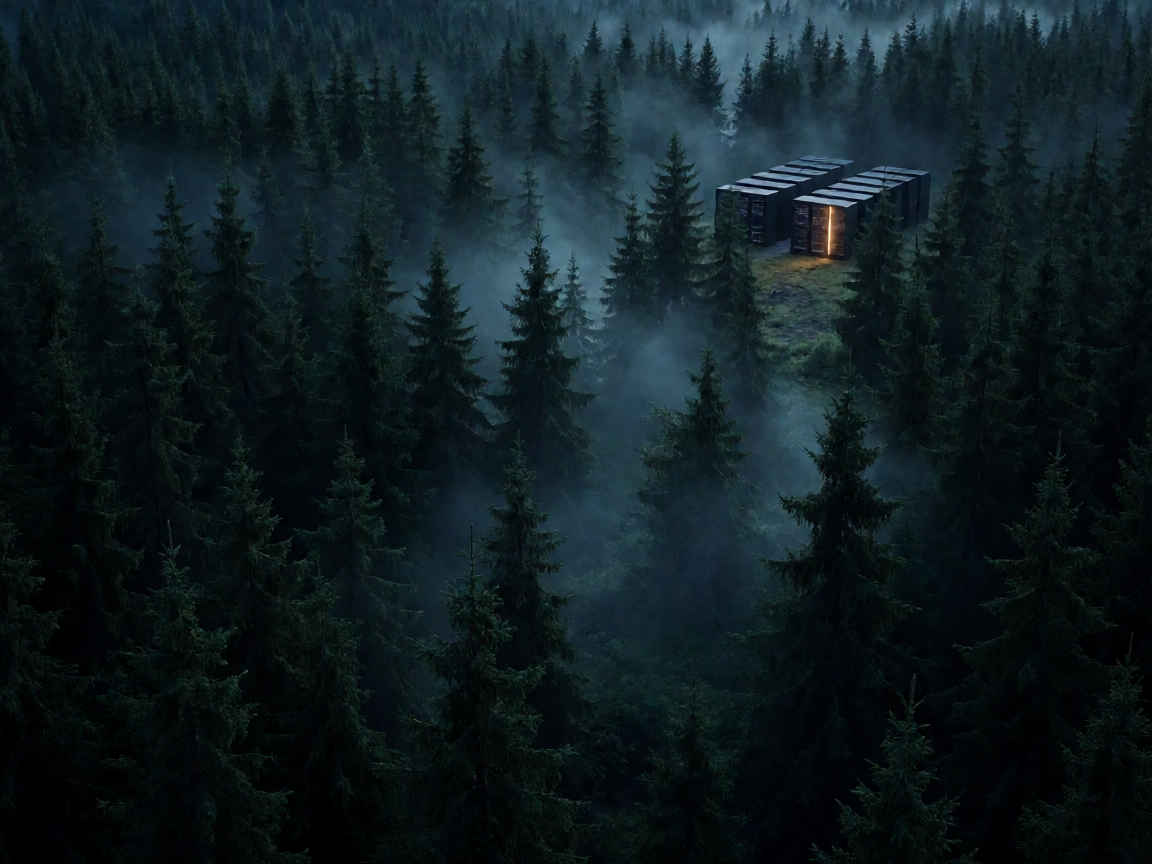
Somewhere in the AI infrastructure race, the first forest stood up and said no. Finnish authorities have ordered a halt to building work at two planned Google data centres in Muhos and Kajaani, over the clearance of more than 300 hectares of forest carried out without a mandatory environmental impact assessment. The catch — and the reason this matters more than it looks — is that this is Finland, the country the whole industry treats as the data center paradise: cool climate, low-carbon power, and now the anchor of Google's record €13 billion investment, its largest single investment in Europe. The AI boom's most privileged geography just developed a friction point. Let's look at what the brake actually does.
The Halt, in Detail
The sequence is important, because it's a compliance failure, not a protest:
- Who: the Finnish Supervisory Agency (LVV) — the environmental enforcement body — issued the order against Tuike Finland, the company running Google's data centre projects.
- What happened: preparatory work at both sites included removal of trees and topsoil, construction of site roads and storage areas, and changes to ditches — without the environmental impact assessment the law requires for measures that "significantly alter the environment."
- The deadline: suspending measures must be in place by 23 October. Tuike Finland must file an explanation and a plan by 14 October, or LVV can begin enforcement proceedings.
- The scale: more than 300 hectares of forest cleared across the two sites. A conservation group called the nature sites "which should be preserved," and the regulator has now put the work on hold while the environment is examined.
- Google's position: it admitted it "fallen short of our own high standards," said it acted in good faith under the Forestry Act, and pointed to a biodiversity plan including 130 hectares of tree planting at Muhos. Translation: they're contesting nothing, complying with the order, and buying goodwill.
The key word in all of it is preparatory. The data centres themselves aren't finished — this is the site-work phase, the part that moves the most ground and the part that's hardest to justify after the fact. The regulator caught the trees going down before the concrete went up. That timing is the difference between a fine and a schedule slip.
What's Actually Stakes
Now put the halt in the middle of the deal it sits inside, because that's where the money is:
- €13 billion ($15B) committed by Google to Finland across 2027–28 — new centres in Kajaani, Muhos, and Vaala, plus expansion of the existing Hamina facility.
- 37,000+ jobs in the construction phase, with Google estimating an average €3.6 billion per year flowing into the Finnish economy.
- A 22-year power purchase agreement with Fortum covering up to half the capacity of the Loviisa nuclear plant — a contract that helps keep the reactor running until 2050, tying the data centre boom directly into a national nuclear-continuation story.
- The strategic cover story: the infrastructure is there to serve Search, Maps, and — most pointedly — Gemini. Finland isn't a data center because it's cheap to build; it's a data center because a country that runs on nuclear, hydro, and cold air is the cheapest place on Earth to run a frontier model. The location is the product.
That last line is the whole tension. Google spent less than a month ago selling this as its biggest European bet. Now the regulator is saying: stop, you cleared the forest first and the paperwork second. The €13 billion doesn't pause, but two of the three greenfield sites do, and in a schedule where 2027–28 is the build window, a stop-work order in the prep phase is a real cost, not a public-relations footnote.
Why This Is the New Shape of the AI Race
Read this as infrastructure, not as environmentals news, because it's now part of the competitive cost structure:
The data center race has moved from "can we build it" to "will we let us build it." New York has a moratorium on the largest data centers. Finland is halting prep work over a forest. The binding constraint on AI capacity is increasingly not the chip or the money — both of which the industry has — but the local permission: the land, the trees, the grid, the public. That's a fundamentally different kind of bottleneck than the supply-chain one. You can't solve it with a bigger fab; you solve it with a permit queue.
Finland is the proof that the "easy geography" has limits. The whole pitch for northern European data centers is that cold air and clean power make them cheap and fast. What the LVV order shows is that the same geography that makes the cooling cheap also has the most forest to protect. The environment that's the asset is the environment that's the liability. Every "data center paradise" in the next wave of AI expansion — and there are a lot of them being courted — is going to learn this lesson somewhere between the announcement and the ribbon-cutting.
What It Means
1. "Sovereignty of the grid" just became a national policy, not a corporate one. The 22-year Fortum nuclear PPA is the quiet story inside the big story. Finland isn't just a host; it's using the data center boom to lock its own nuclear plant in service for a quarter century and tie national power policy to a single hyperscaler's expansion. That's a structural deal. The halt doesn't change the PPA, but it reminds everyone that the host can also be the brake. The next country that signs a data-center deal is going to negotiate, not just sign.
2. The compliance gap is a competitive opening, not just a penalty. Google's admission that it had fallen short of its own high standards is the opening. Every other hyperscaler building in a regulated, forest-dense, grid-constrained country is going to get the same question on day one: do you have the environmental impact assessment, or just the permits and the money? The ones that lead with the EIA are going to move faster through the next permit queue than the ones that race to the site and get stopped. Permit discipline is now a real, measurable advantage in AI infrastructure. It should be on the same slide as the TCO numbers.
3. The "data center paradise" pitch is about to get more expensive for the whole industry. Finland's case is the template every other high-latitude, low-carbon host will face: the same cold air and clean power that made it attractive is going to make the forest, the water, and the grid all subject to the same scrutiny. The industry is treating these sites as a commodity. The next three years are going to teach it that they're not. The sites that get built on time are the ones that treated the local environment as a co-tenant, not an obstacle. That's a new cost center in every AI data center business plan that doesn't exist yet, and it's going to be priced in the next two rounds of capex.
4. The geopolitical read: the AI infrastructure map is now partly a permission map. You can chart the AI race by where the chips are, where the money is, and where the data centers are. What the Finland halt adds is a fourth axis: where the local government can say no. That axis is going to matter more, not less, as the build-out moves from the greenfield frontier into the last mile of the grid and the last forest. The countries that own both the geography and the permit are going to be the ones that actually get the capacity. The rest are going to have the money and the chips and a stop-work order.
🔥 Hot Takes
1. Google just proved that even the most privileged data center geography in the world has a tree line. A company that can spend a quarter of a trillion on AI and move mountains in a few other places is telling a regulator, "okay, we'll stop, you were right, we need the paper first." That's not humility; that's the cost of being in a country where the forest has a seat at the table. It's also the first time the AI build-out has publicly lost a round to local permission. The next time it's not going to be a surprise — and the next time, it's going to cost more in schedule than it did here.
2. The 22-year nuclear deal is the part of this story that should scare the competition more than the forest does. Yes, the trees got cleared out of order. No, that's not what matters. What matters is that Finland has just used a data center expansion to lock its own nuclear plant in service until 2050 and tie national power policy to Google's capex. That's a quarter-century option on cheap, clean, predictable power. The rest of the industry is trying to buy that kind of power availability in the spot market. Finland just signed it. Every other data center host should be looking at that PPA and asking what it would cost to get the same kind of guarantee before the next build window.
3. "Data center paradise" was always going to be a temporary marketing term, and the forest just ended it. The pitch was: cold air, clean power, fast permits, cheap build. Three of the four are still true. The fourth — fast permits — just got a stop-work order over 300 hectares of forest, and that's the whole difference between a paradise and a queue. The industry is going to keep calling Finland a paradise in the next five press releases, and the regulator is going to keep being the one with the power to say when the trees come down. That's not a paradise. That's a relationship. And relationships have rules.
The Bottom Line
Finland didn't cancel Google's €13 billion bet. It paused two of the three greenfield sites over a forest that went down before the paperwork did, and it's making the company prove it can get the paper right before it pours the concrete. That's not the end of the story — it's the beginning of a new cost center in the AI infrastructure race: local permission, environmental co-tenancy, and the understanding that the same geography that makes a data center cheap to run can make it expensive to build. The next three years of AI capacity are going to be won by the ones who treat the regulator as a co-tenant and the forest as a line item. Google just got its first invoice. The rest of the industry is going to get theirs soon.