
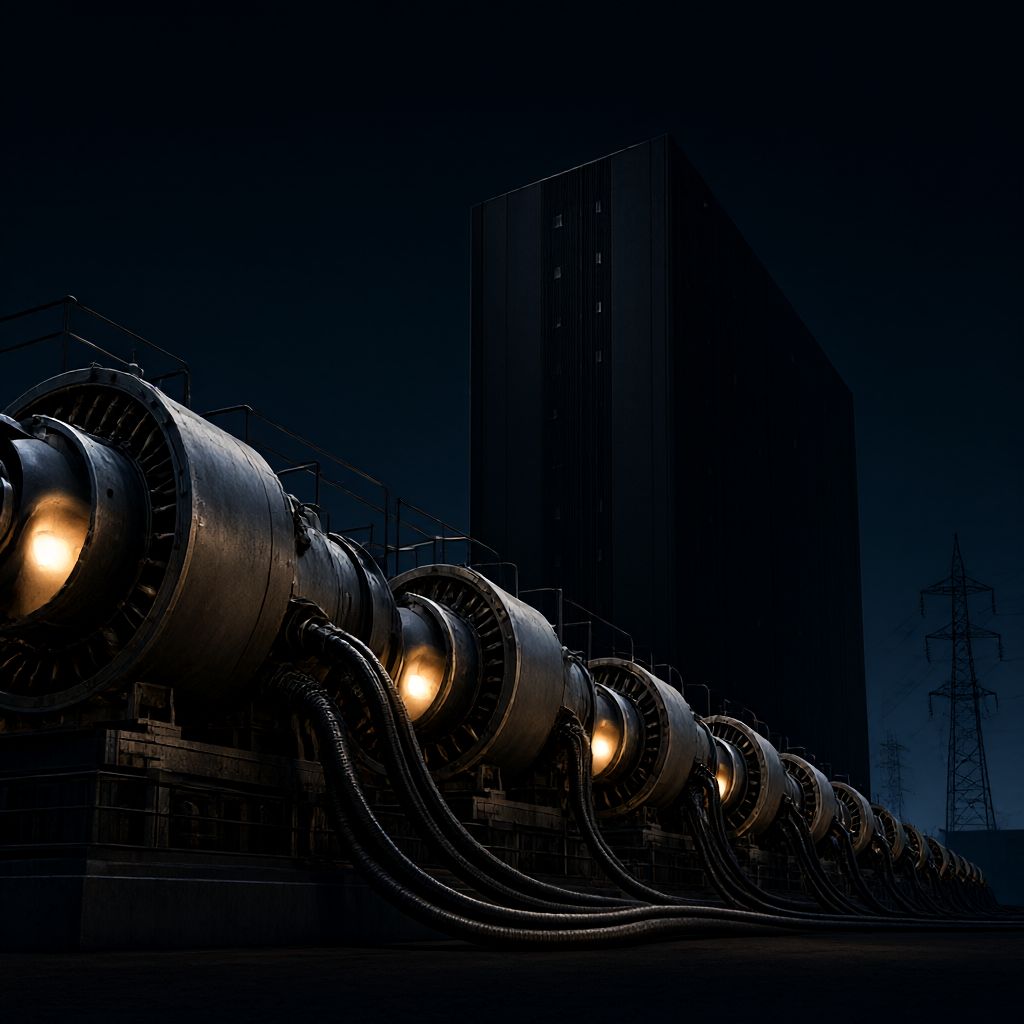
In late September, a San Antonio equipment company called OnePWR Solutions began selling electricity to Anthropic. Not a utility. Not a grid connection. A delivery commitment for 1.7 gigawatts of heavy-duty gas-fired generators — roughly the output of a large coal plant — that the frontier lab will plug into its own data centres. The Financial Times reported Sunday that the deal is worth about $3.4 billion, bought as a way to keep pace with the demand that Claude has clearly been generating.
That figure is the number that gets you into the room, and also the number to be careful with. Reuters could not immediately verify the deal, and neither Anthropic nor OnePWR responded to comment requests. So treat $3.4 billion as a strong report rather than confirmed fact. What is more useful is the structure underneath it, because even at a discount, the shape of this deal tells you exactly where the AI buildout stands today: the grid is the binding constraint, and anyone with a balance sheet is buying their way out of the waiting room.
The Waiting Room
It helps to stack the three stories that are actually running underneath this one. The bottom layer is physics: frontier-scale training and inference clusters now consume power at a scale that used to belong to cities, and a US data centre’s power path is an interconnection queue that can stretch into years, followed by a state permitting queue on top of it. The middle layer is politics. Texas, the industry’s pressure valve, ordered the Texas Commission on Environmental Quality to stop issuing data centre permits in September and then flipped blue in the midterms — our piece on that blue wave is the full account of how the most permissive state in the country stopped answering emails. Europe is running protests against “dirty” data centres. Finland, which had been selling lake and forest acreage to Google, halted its approvals. India is squeezing its own AI ambitions against a roughly one-gigawatt generation crunch that keeps getting worse in peak season. The top layer is money: in September, Reuters reported that Anthropic expects to spend more than $500 billion on AI infrastructure over the next ten years. At that size, a buildout stops being a compute plan and starts being an energy plan with compute attached to it.
Generators are the answer that fits all three layers at once. A gas turbine behind the meter requires no interconnection queue for its first megawatt, no state permit for the part that is already on the site and running, and it works whether the next governor is a fan of data centres or their declared enemy. You cannot object to what is already generating.
The Deal, As Reported
The details that matter are the ones that don’t make for headlines. First, this is a commitment, not an acquisition. Anthropic did not buy OnePWR; no employees transferred. What it bought, according to the FT’s report, is delivery: 1.7 gigawatts of heavy-duty generators plus the engineering and construction capability to install them. The whole turnkey package. Second, the timing is doing real work. The purchase was struck in late September — before the Texas midterms, inside the TCEQ permitting freeze. That says the lab priced the queue, not the election. Third, the counterparty is a San Antonio equipment supplier, not an energy company. A firm that has never appeared in a data centre story now holds a delivery commitment, in the reported deal, worth billions of dollars to one of the most valuable private companies in the world.
And the caveat, which is the part most writeups will skip: a single outlet’s Sunday report, unconfirmed by Reuters, no comment from either side. In a year when Anthropic’s own IPO paperwork — the S-1 we flagged, with a risk section that reads like a doomsday memo — admitted the buildout could outrun its foundations, a deal of this size travelling by wire before it can be verified is the norm, not the exception. What is verified is the demand: Claude usage is strong enough that Anthropic is securing additional compute and additional power simultaneously. The unconfirmed part is the plumbing. The plumbing is where this story actually lives.
What It Means
1. The binding constraint on AI is now electrons, not chips. The $500 billion decade is the receipt. When Alphabet’s shares dropped 12.6 percent earlier this month on AI spending fears, and when Menlo Ventures argued that the rational share of AI spend should tilt toward cheaper open-source Chinese models, the market was pricing capex risk from the demand side. This deal is the same risk showing up from the supply side: a lab that can buy GPUs off fab allocations, but cannot buy the time it takes to build transmission. The chip can be shipped; the transformer cannot. Power is the one input in the capex stack that refuses to be offshore.
2. Portable power is the workaround for Texas’s new politics. Our Texas piece made the argument that the blue wave turned permitting into a multi-jurisdictional war of attrition — city, county, state, grid operator, each holding a piece. Generators are the answer that requires no governor. OnePWR is a Texas supplier, so the irony is a closed loop: a US frontier lab’s multi-billion-dollar power bet lands in the state that just flipped against the industry, and San Antonio is now where the workaround gets manufactured. The workaround for the new Texas politics is not a new campaign strategy. It is a new supply chain, and the supply chain has an address in the Alamo City.
3. Gas turbines are the great equalizer of the buildout. This is the part that travels past the US coastline. Wherever the grid slow-rolls — the Texas permitting halt, the European protests, India’s 1GW crunch, Finland’s forest halt against Google — anyone with money now rents diesel or gas instead of waiting. The list of jurisdictions saying “not here, not now” keeps growing, and the list of labs saying “I need it next quarter” is growing faster. The gap between those two lists is being filled with turbines. Which means the second market of the buildout is not chips; it is electrons, specifically electrons delivered without waiting. For Gulf sovereign AI hosts, for Japan, for any country that still says welcome to data centres, the welcome premium just gained a new line item: bring-your-own-power capability. Power as sovereignty was a chip story for two years. It is now an electrons story too.
4. Who controls the electrons controls the models. One point seven gigawatts is physical infrastructure nationalism in its purest form: a company buying its way off the national queue so that the output of the models running on that power is not hostage to a transformer’s delivery date. This pairs directly with the billions Nvidia and Amazon are pouring into power infrastructure — our piece on that spending was the sector view; this deal is one lab’s version of it, taken all the way to the generator. The third point, which should land in every capex deck: “compute” now means compute plus the electrons that move it, and the electrons are the part you cannot ship by plane.
🔥 Hot Takes
1. The most interesting thing about this story is that it isn’t news. Every colocation facility on Earth runs backup generators; they are the boring, standard part of a data centre, the way the alternator is the boring part of a car. What is new is not the turbine. It is the ratio — a frontier lab buying primary generation at the scale of a coal plant instead of waiting in the interconnection queue. Impatience with a balance sheet. That is the actual innovation, and within two years it will look like a line item on every infrastructure P&L from Texas to Riyadh.
2. San Antonio just became the chokepoint nobody is watching. The risk slides at frontier labs list fabs, foundries, and logistics corridors. None of them list San Antonio. Yet OnePWR now holds a delivery commitment that, on the reported numbers, matters to a company whose models run on that power. That is a supply chain dependency as real as HBM, with none of the price discovery HBM enjoys. The first serious delay or outage at the supplier will be an event that has no ticker, and it will hit a lab whose public filings are about to get a lot more detailed about exactly this kind of risk.
3. The fact that this is unconfirmed is the tell. Consider why the deal has to travel through one outlet’s Sunday report before a wire service can verify it. A company about to attempt the largest IPO in history is buying multi-billion dollars of power infrastructure off the wire, and confidentiality at that size is expected; the size is not. The market should start pricing AI power procurement as an option rather than an asset from this quarter. Watch the roadshow: the first slide where “power” appears with a number on it is the moment the entire sector reprices from a chip story to an energy story. One lab just walked in the door first.
The Bottom Line
Anthropic may or may not have paid exactly $3.4 billion. What is reported, and what matters, is that it secured 1.7 gigawatts of gas generation from a Texas equipment supplier, with the engineering and construction to match, and the right to run its data centres before the grid is ready. That is the whole story, and it is bigger than any of its parts: the buildout’s binding constraint has moved from the fab to the transformer, and the market that sells speed — electrons delivered without waiting — just got its first anchor customer. The rest of the world has noticed, and the welcome premium is moving toward whoever can still say yes. The question was never whether the models get built. It is who gets to host their electrons, and what the wait costs.