
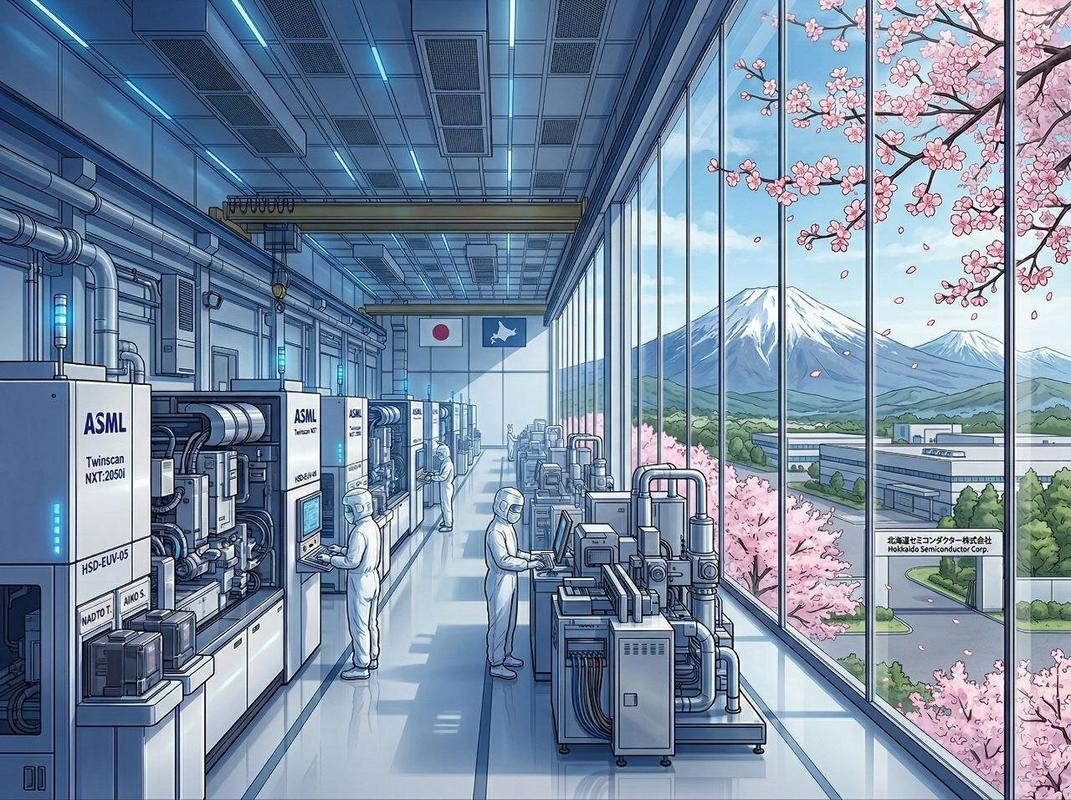
Japan is going all-in. On Saturday, the country's industry ministry approved an additional 631.5 billion yen ($3.96 billion) in funding for Rapidus — a state-backed chip startup that represents Japan's last, best hope of rejoining the cutting-edge semiconductor race. The total government commitment now exceeds $16 billion. The goal: produce 2-nanometer AI chips by 2027. The competition: TSMC, Samsung, and Intel. The odds: not great. But Japan has run out of alternatives.
For a country that once dominated the global chip industry, the fall has been steep and humiliating. In the 1980s and early 1990s, Japanese companies like NEC, Toshiba, and Hitachi were the world's semiconductor leaders. They controlled memory markets, set technology standards, and seemed untouchable. Then came the lost decades — economic stagnation, corporate conservatism, and a strategic retreat from the most capital-intensive parts of the chip business.
By the 2010s, Japan had ceded cutting-edge logic chip manufacturing entirely to Taiwan's TSMC and South Korea's Samsung. Japanese firms still supplied critical materials and equipment — Tokyo Electron and Shin-Etsu Chemical remained indispensable — but the actual manufacturing of the world's most advanced processors happened elsewhere. Japan became a supplier to the industry it once ruled.
Now, with AI reshaping the global economy and chips becoming a matter of national security, Japan wants back in. And it's betting everything on Rapidus.
What Is Rapidus?
Rapidus is not a typical startup. Founded in 2022 by a consortium of Japanese companies including Sony, Toyota, NEC, and NTT, it has the explicit backing of the Japanese government and a mission straight from the top: restore Japan's ability to manufacture the world's most advanced semiconductors.
The company's target is ambitious to the point of audacity. Rapidus aims to leapfrog multiple generations of chip technology and begin producing 2-nanometer logic chips by 2027. For context, TSMC — the undisputed leader in advanced chip manufacturing — only began mass production of 2nm chips in late 2025. Samsung and Intel are still struggling to catch up.
The 2nm generation matters because it's where Moore's Law gets genuinely difficult. Transistors are measured in mere atoms. Manufacturing requires extreme ultraviolet (EUV) lithography machines that cost $200 million each and facilities that cost $20 billion to build. The technical challenges are immense. The capital requirements are staggering. And the timeline Rapidus has set — just three years from now — would be aggressive even for an established player.
Industry analysts are skeptical. "This is widely regarded as a long shot," Bloomberg noted in its coverage of the latest funding approval. The technological gap between where Rapidus is today and where it needs to be by 2027 is enormous. The company has never mass-produced any chip, let alone the most advanced logic processors on the planet.
Why Japan Can't Afford to Lose
The Rapidus gamble isn't just about industrial policy or national pride. It's about economic survival in an AI-driven world.
Japan has watched with alarm as Taiwan's TSMC has become the world's most critical company — the sole source of the advanced chips that power everything from smartphones to data centers to military systems. Japan has watched as the United States and China have poured hundreds of billions of dollars into domestic chip manufacturing, recognizing that control of semiconductor supply chains is control of the 21st-century economy.
And Japan has watched as its own economy has stagnated, its tech industry has fallen behind, and its geopolitical influence has waned. The country that gave the world the Walkman, the PlayStation, and the lithium-ion battery has become a bit player in the technologies that matter most.
The COVID-19 pandemic and subsequent chip shortage drove home the vulnerability of Japan's position. Japanese automakers — the crown jewels of the country's industrial economy — were forced to halt production because they couldn't get enough semiconductors. The chips were designed in Japan, manufactured in Taiwan, and shipped back to Japanese factories. When supply chains broke, so did Japan's industrial output.
"Economic security" has become the watchword of Japanese industrial policy. The government has committed billions to reshoring chip production, attracting foreign investment — including a TSMC fab in Kumamoto — and, most ambitiously, making Rapidus a success. The latest $4 billion approval brings total government support for Rapidus to more than $16 billion, making it one of the most expensive industrial policy bets in Japanese history.
The Technology Challenge
Here's the hard truth about what Rapidus is trying to do: manufacturing 2nm chips is arguably the most complex industrial process humans have ever attempted.
The "2-nanometer" label refers to the size of the transistors on the chip — roughly 2 billionths of a meter. At this scale, quantum effects become significant. Electrons start behaving unpredictably. The manufacturing process requires EUV lithography, which uses light with a wavelength of just 13.5 nanometers to etch circuit patterns onto silicon wafers.
Each EUV machine costs over $200 million and requires a supply chain of thousands of specialized components from around the world. Only one company — ASML of the Netherlands — can make them. The machines are so complex and so scarce that even Apple and NVIDIA struggle to secure enough capacity at TSMC.
Rapidus has secured access to EUV technology through partnerships, including with IBM in the United States. But having the machines is only the beginning. Operating them at scale, with the yield rates necessary for commercial viability, requires expertise that takes years to develop. TSMC has been refining its processes for decades. Samsung has spent billions trying to catch up and is still behind.
And Rapidus is trying to do this while building a new fab from scratch on the island of Hokkaido, in a region with limited semiconductor infrastructure, in a country that hasn't manufactured leading-edge logic chips in over a decade.
The technical obstacles are immense. The timeline is aggressive. And the competition — TSMC, Samsung, Intel — is not standing still.
🔥 Our Hot Take
Let's be real about what Japan is attempting here. Rapidus is a moonshot — and moonshots usually fail.
The odds are stacked against this project in ways that $16 billion can't fully address. TSMC's manufacturing expertise represents decades of accumulated knowledge, trial and error, and continuous improvement. You can't buy that with government subsidies. You can't fast-track it with political will. Chip manufacturing at the cutting edge is as much art as science, and Japan has been out of the studio for a long time.
But here's the thing: Japan might not have a choice. The alternative to trying is accepting permanent dependence on Taiwan and TSMC for the technologies that will define the 21st century. For a country with Japan's resources, industrial base, and strategic concerns, that's not a tenable position.
And there's a scenario where this works — not by beating TSMC at its own game, but by finding a niche. The AI chip market is exploding. Demand for advanced semiconductors is outstripping supply. If Rapidus can achieve even modest yields of 2nm chips by 2027, there will be customers. Japanese automakers, desperate for secure chip supply chains, would likely be first in line. Government and defense applications would follow.
The goal doesn't have to be displacing TSMC. It can be establishing a viable alternative — a second source for the world's most critical components. In a world increasingly worried about Taiwan's geopolitical vulnerability, that has value.
Still, the skepticism is warranted. Industrial policy on this scale has a mixed track record. Japan's own history includes expensive failures — the Fifth Generation Computer Project of the 1980s spent billions pursuing artificial intelligence and produced little of commercial value. The United States' CHIPS Act is pouring $52 billion into domestic manufacturing with uncertain returns. China's hundreds of billions in semiconductor subsidies have yet to produce a truly competitive domestic chipmaker.
Semiconductor manufacturing is hard. Really hard. The number of companies that can do it at the cutting edge has shrunk from dozens to basically three. Adding a fourth — especially one starting from scratch — would be unprecedented.
But Japan has to try. The alternative is accepting decline, accepting dependence, accepting that the technologies that matter most will be made elsewhere by others. For a country that remembers when it led the world in semiconductors, that's not an acceptable outcome.
So Japan bets $16 billion on a long shot. The world watches. TSMC keeps manufacturing. And in Hokkaido, construction crews work through the winter, building a fab that might — just might — restore Japan to the top tier of the global chip industry.
The chips will tell the story. They always do.