
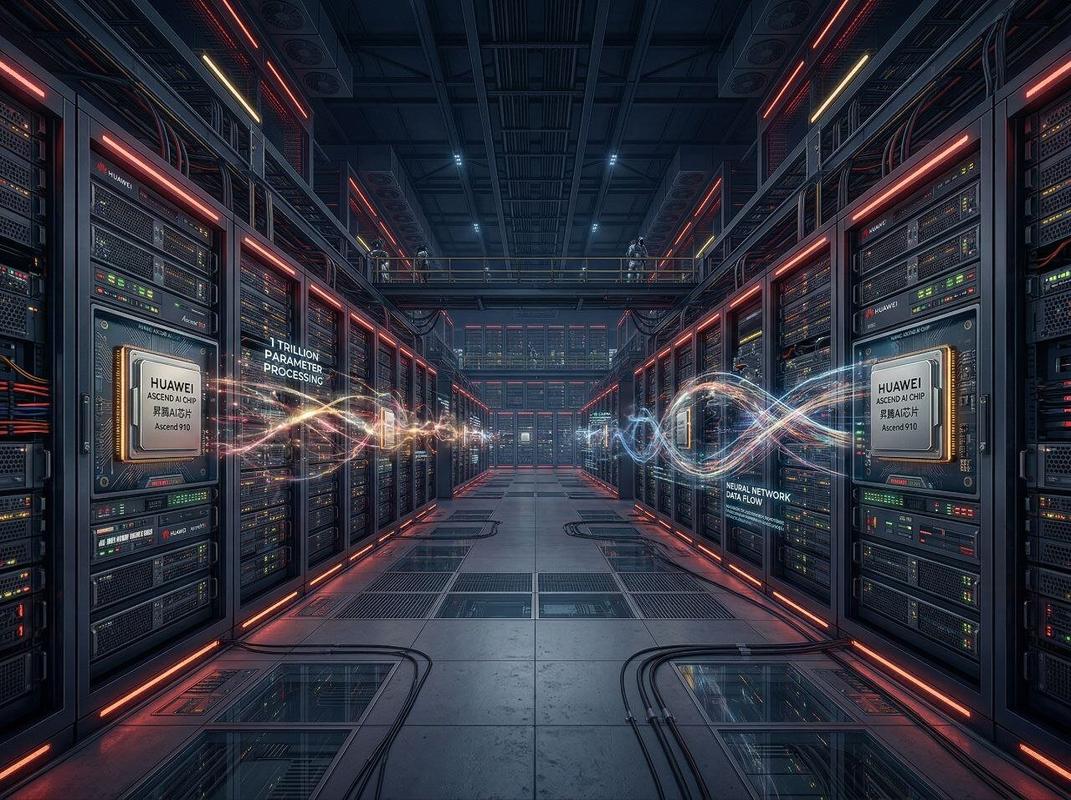
The waiting is almost over. After two delays and months of speculation, DeepSeek V4 is targeting a late April launch — and this isn't just another AI model release. It's a high-stakes test of whether China can build frontier-class artificial intelligence using only domestic chips, while cut off from the world's most advanced semiconductors.
The numbers being floated are staggering: 1 trillion parameters, a 1 million token context window, and a Mixture-of-Experts architecture that could deliver frontier-level performance at a fraction of the inference cost. But the real story isn't the specs — it's the silicon underneath.
According to Reuters, DeepSeek V4 will run on Huawei's Ascend processors. Not NVIDIA. Not AMD. Huawei. And in a deliberate strategic move, DeepSeek reportedly gave Chinese chipmakers early optimization access while denying that window to Western suppliers.
If the benchmarks hold up, this changes everything.
The Trillion Parameter Question
Let's talk about what 1 trillion parameters actually means — and why it might not mean what you think.
DeepSeek V4 is reportedly built on a Mixture-of-Experts (MoE) architecture. In plain English: the model has roughly 1 trillion total parameters, but only about 32–37 billion are active for any given task. It's the same approach DeepSeek used with V3, which had 671 billion total parameters.
The genius of MoE is that inference costs stay relatively flat even as the total model size grows dramatically. You get the capability gains from a much larger model without the proportional compute bill. That's how DeepSeek has been able to undercut competitors on pricing while still delivering competitive performance.
But there's a catch: MoE architectures are complex to implement and even harder to optimize. They require sophisticated routing mechanisms to determine which "experts" (parameter subsets) to activate for each task. Get it wrong, and you've built an expensive, inefficient mess.
DeepSeek's track record suggests they know what they're doing. V3 was widely praised for its efficiency. R1, released in January 2025, shocked the industry with its reasoning capabilities and sent US tech stocks tumbling. President Trump called it a "wake-up call" for American firms.
Now they're aiming higher. Much higher.
The Huawei Gamble
Here's where it gets geopolitical.
US export controls have cut off Chinese AI developers from NVIDIA's most advanced GPUs — the H100s, B200s, and Blackwell chips that power virtually every major AI model outside China. The strategy was simple: deny China access to frontier AI hardware, and their AI progress slows to a crawl.
It hasn't worked out that way.
Huawei's Ascend chips have emerged as the domestic alternative. They're not as powerful as NVIDIA's best, and they don't have the mature software ecosystem (CUDA) that makes NVIDIA hardware so sticky. But they're improving fast — and DeepSeek V4 could be the proof point that they're good enough.
Reuters confirmed that DeepSeek gave Huawei and other Chinese chipmakers early optimization access while deliberately excluding Western suppliers. That's not just a technical decision — it's a political statement about where China's AI infrastructure is heading.
The implications are enormous. If V4 performs at frontier level on Huawei silicon, it directly undermines the US strategy of using export controls to maintain AI leadership. It proves that China can innovate around sanctions, building competitive AI systems with domestic hardware.
And it wouldn't just be DeepSeek. Reuters reported that Alibaba, ByteDance, and Tencent have all placed large orders for Huawei chips in preparation for the V4 launch. If the model succeeds, expect a flood of Chinese AI development to shift onto domestic silicon.
The 1 Million Token Context Window — Real or Rumor?
Of all the V4 specs being discussed, the 1 million token context window is the most exciting — and the least confirmed.
To put that in perspective: GPT-4's context window is 128,000 tokens. Claude 3 Opus handles 200,000. A 1 million token window would be 5–8x larger than the current state of the art, enabling entirely new use cases.
Imagine feeding an entire book into a model and asking nuanced questions about plot development. Or analyzing a company's complete financial history in a single prompt. Or debugging a million-line codebase with full context.
DeepSeek hasn't officially confirmed this spec. The claim comes from leaks, research paper trails, and community analysis — not an official spec sheet. But there's reason to believe it's plausible.
In January 2026, DeepSeek published research on "Engram" — a conditional memory system designed specifically for long-context retrieval. V4-Lite, a smaller variant already live on some API nodes, is showing dramatically improved context recall in early testing. The infrastructure for long-context processing is clearly being built.
Whether it reaches 1 million tokens in the initial V4 release remains to be seen. But even getting close would be a significant advance.
The Delay Pattern
V4 was originally expected in February, around Lunar New Year. Then it slipped to March. Now the target is late April.
The delays could mean many things: technical challenges with the MoE architecture, optimization struggles on Huawei hardware, infrastructure scaling issues, or simply the difficulty of training a 1 trillion parameter model.
But there's another possibility: DeepSeek is taking the time to get this right because the stakes are so high.
V3 and R1 established DeepSeek as a serious player. V4, if successful, would cement their position as a global AI leader and validate China's domestic chip strategy. If it fails — if the Huawei optimization doesn't work, if the benchmarks disappoint — it would be a significant setback for Chinese AI ambitions.
The company is clearly feeling the pressure. DeepSeek has ramped up hiring for data center engineers in Inner Mongolia, signaling infrastructure expansion. They've added "Fast Mode" and "Expert Mode" toggles to their web interface, suggesting new capabilities are being tested.
And the API has been running V4-Lite on some nodes since early April — usually a sign that the full model launch is imminent.
🔥 Our Hot Take
Let's be honest about what's really at stake here.
The US bet everything on export controls. The strategy assumed that cutting off China's access to NVIDIA chips would create a permanent AI gap that American companies could exploit. It was a reasonable bet — NVIDIA hardware is genuinely superior, and building competitive AI chips is incredibly hard.
But here's what the sanctions advocates missed: necessity is the mother of invention.
China was always going to invest heavily in domestic chip development. The question was whether they could close the gap fast enough to matter. DeepSeek V4, if it delivers on its promises, suggests the answer might be yes — and sooner than anyone expected.
This isn't just about one model. It's about whether the US can maintain technological supremacy through restrictions, or whether those restrictions accelerate the development of alternatives that eventually make the sanctions irrelevant.
We've seen this movie before. The US tried to restrict China's access to space technology. China built its own space station. The US restricted supercomputer exports. China built the world's fastest supercomputers using domestic chips. In both cases, sanctions delayed but didn't prevent Chinese advancement.
AI could be next.
If DeepSeek V4 performs at frontier level on Huawei chips, it proves that China's AI ecosystem has reached escape velocity — the point where domestic capabilities are sufficient to sustain continued progress without Western technology. That's a geopolitical inflection point with implications far beyond the tech industry.
But let's not get ahead of ourselves. V4 hasn't launched yet. The benchmarks haven't been independently verified. And even if the model is impressive, there's a difference between a single breakthrough and sustained ecosystem dominance.
NVIDIA's CUDA ecosystem, built over 15 years, is still the gold standard for AI development. Huawei's software stack is improving but isn't there yet. One great model doesn't change that overnight.
Still, the trend is clear. Every year, the gap between Chinese and Western AI capabilities shrinks. Every year, China's domestic chip ecosystem gets stronger. DeepSeek V4 could be the moment those trends converge into genuine competitiveness.
The AI industry is watching closely. So are policymakers in Washington. And somewhere in Beijing, they're counting down the days to late April.
The trillion parameter question isn't just about model size. It's about whether the future of AI will be dominated by a handful of American companies — or whether China has finally built a viable alternative path.
We're about to find out.