
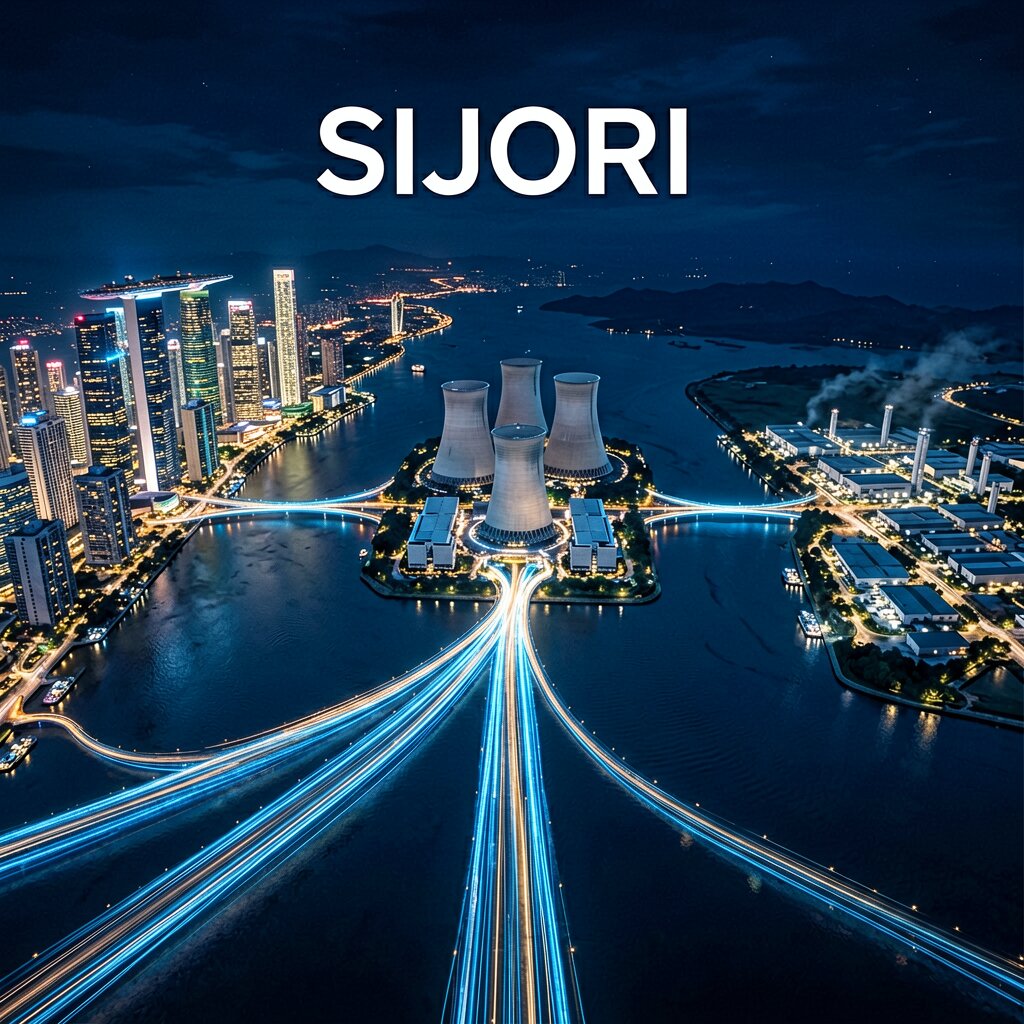
Singapore is full. Not of tourists, not of expats, not of overpriced cocktails — full in the way that actually matters to the future of AI. The island has run out of land. It has run out of power. And it has absolutely run out of patience for anyone who wants to build another 100MW data center campus without solving the laws of physics first.
Yet here we are, in the middle of the SIJORI Cloud & Datacenter Convention 2026, watching the three-pointed star of Singapore, Johor (Malaysia), and Batam (Indonesia) assemble into something that looks less like a region and more like a single, distributed AI compute organism. The hyperscalers are not just attending this conference. They are signing leases, announcing billion-dollar commitments, and quietly treating the SIJORI corridor as one unified geography.
And they are right to do so. Because what is emerging here is not three separate markets. It is one cross-border digital ecosystem with three distinct roles, three regulatory regimes, and one very clear purpose: to become the primary AI infrastructure hub for Southeast Asia, and arguably the most important data center corridor in the world outside of Northern Virginia.
The Geography of Necessity
Let's start with the obvious. Singapore has been the undisputed connectivity capital of Southeast Asia for decades. It hosts more submarine cables than most continents. Its network latency to the rest of Asia is measured in single-digit milliseconds. Its financial and legal infrastructure is the envy of the region. If you are building anything that needs to talk to the internet at scale, Singapore is where you start.
But Singapore is also a city-state of 283 square miles. Its power grid is already strained. Its government, wisely, has capped data center power consumption and imposed strict sustainability requirements that effectively freeze out new large-scale builds unless they are genuinely exceptional. The Singapore Economic Development Authority has been transparent about this: the country wants to remain a hub, but it cannot be the factory. The math simply does not work.
Enter Johor. Just across the Johor Strait, the Malaysian state has become the fastest-growing data center market in the world. Not Asia. The world. Johor has land. Johor has power — and more importantly, it has the political will to build power generation faster than almost anywhere else in the region. The state government has designated data centers as a strategic priority, and the result is a pipeline of AI-ready facilities scheduled to come online in Q4 2026 that would make Ashburn, Virginia blush.
And then there is Batam. The Indonesian island sits 20 kilometers from Singapore, connected by multiple submarine cables and ferry services. Its latency to Singapore is under 3 milliseconds — effectively the same metro area from a networking perspective. Batam is business-friendly in the way that only a rapidly developing Indonesian special economic zone can be: streamlined permits, tax incentives, and a government that understands that data centers do not compete with local industry, they enable it. Batam is expansion-ready in a way that Singapore stopped being a decade ago.
The Hyperscaler Gold Rush
The numbers coming out of SIJORI 2026 are not projections. They are receipts.
Amazon Web Services has committed $33 billion to Southeast Asia, with the bulk of that capital directed toward Singapore and its immediate neighbors. This is not a press release number. It is a capital allocation that implies physical construction, power purchase agreements, and fiber routes that will reshape the region's infrastructure for the next two decades.
Microsoft has announced $1.7 billion in Indonesia and $2.2 billion in Malaysia. These are not exploratory investments. They are campus-scale commitments that include AI training facilities, cloud regions, and the kind of long-term power contracts that only make sense if you believe the demand will be structural, not cyclical.
Google, Alibaba Cloud, and Tencent are all in various stages of expansion across the triangle. The common pattern is unmistakable: Singapore for the control plane, Johor for the training clusters, Batam for the overflow and edge workloads. This is not accidental. It is the architectural blueprint for how AI infrastructure gets built when land and power are finite and demand is not.
DayOne DC and the Hub-and-Spoke Model
One of the more revealing developments at SIJORI 2026 is the formalization of what DayOne DC calls its "hub-and-spoke" model. The Singapore-based data center operator has been quietly building capacity across all three points of the triangle for the past three years, and this week they presented the architecture as a finished product rather than a concept.
The model is elegant in its simplicity. Singapore serves as the hub: interconnection, financial services, low-latency inference for trading and real-time applications. Johor serves as the primary spoke: massive AI training campuses, liquid-cooled facilities, and the kind of power density that only makes sense when you have acres of land and a substation next door. Batam serves as the secondary spoke: disaster recovery, batch workloads, and the long-tail expansion that does not need to be in the absolute core but benefits enormously from being in the same metro latency envelope.
DayOne DC is not the only operator thinking this way. But they are the most explicit about it, and their presentation at SIJORI 2026 made clear that they view the three jurisdictions as a single market from a network topology perspective. The cross-border fiber is already being laid. The regulatory harmonization is already being negotiated. The only question is how fast the rest of the industry catches up to the model.
The Cross-Border Digital Ecosystem
What makes SIJORI genuinely interesting — and genuinely different from other multi-jurisdiction data center regions like Northern Virginia or Frankfurt — is the degree of cross-border integration that is both possible and actively being built.
Singapore, Malaysia, and Indonesia do not share a currency. They do not share a legal system. They do not even share a common language in the administrative sense. But they are building a shared digital infrastructure layer that treats the strait between them as a network cable, not a border.
The submarine cable capacity between Singapore and Batam is being expanded by multiple consortiums. The cross-border power interconnection between Singapore and Malaysia is being upgraded to allow for greater energy trading, which directly benefits data center load balancing. The regulatory frameworks for data sovereignty are being harmonized in practical ways — not through treaty, but through mutual recognition agreements that allow certified data centers in one jurisdiction to serve clients in another without requiring full local replication.
This is not the European Union. It is something more pragmatic and, in some ways, more effective. The SIJORI triangle is building a digital single market through infrastructure rather than legislation. The fiber goes where it needs to go. The power flows where it is cheapest. The data centers locate where the physics and economics make sense. The regulatory layer is adapting to the physical reality, not the other way around.
What It Means for the Global AI Infrastructure Map
The emergence of SIJORI as a unified AI compute corridor has implications that extend well beyond Southeast Asia.
First, it demonstrates that the AI infrastructure boom is not just a Northern Hemisphere phenomenon. The capital flows, the engineering talent, and the demand are all genuinely global. When Amazon commits $33 billion to a region, it is not charity. It is a bet that the next billion AI users will come from Asia, and that their compute needs will be served from Asia.
Second, it shows that data center geography is being rewritten by power and land constraints in real time. Singapore was the obvious choice for Southeast Asian AI infrastructure five years ago. Today, it is the coordination layer. The actual compute is moving to where the resources are. This is a pattern we will see repeated across the world as other constrained hubs — Amsterdam, Dublin, parts of Northern Virginia — hit their own ceilings and force demand into adjacent markets.
Third, and most importantly, SIJORI represents a new model for how digital infrastructure can be built across borders without waiting for political integration. The three governments are competing for investment, yes, but they are also cooperating on the physical layer in ways that make the entire region more attractive than any single jurisdiction could be on its own. This is competitive cooperation, and it is producing results faster than any top-down integration project could.
🔥 Hot Takes
1. Singapore is becoming the Switzerland of AI infrastructure — neutral, wealthy, and increasingly irrelevant to the actual fighting. The island will remain the financial and legal hub for Asian tech, but within five years it will host a shrinking percentage of the region's actual AI compute. Singapore's data center strategy is not a growth strategy. It is a managed decline strategy dressed in ESG clothing. The smart money is already treating it as a place to route traffic, not a place to train models.
2. Johor is about to experience the most extreme boom-and-bust cycle in data center history. The Malaysian state is building capacity like the demand will grow 40% annually forever. It will not. When the AI training bubble cools — and it will, because all bubbles do — Johor will have millions of square feet of white elephant facilities that were designed for workloads that no longer exist. The state is making the classic mistake of confusing a cyclical demand spike with a structural shift. The winners will be the operators who signed flexible leases. The losers will be the ones who built on speculation.
3. Batam is the real story here, and almost nobody is paying attention. Under 3ms latency to Singapore. Business-friendly regulation. Expansion-ready land. And an Indonesian government that has finally realized that data centers are not a threat to local industry but a prerequisite for it. In five years, Batam will be the surprise winner of the SIJORI triangle — not because it is the biggest, but because it is the most adaptable. The island will absorb the overflow from Singapore, the cost-sensitive workloads from Johor, and the edge computing demand from Indonesia's domestic market. It is the Goldilocks zone of Asian AI infrastructure, and the hyperscalers know it even if the press does not.
The Bottom Line
The SIJORI corridor is not a conference theme. It is a physical reality that is being built in real time, with real capital, and real consequences for the global distribution of AI compute power.
Singapore provides the brain. Johor provides the muscle. Batam provides the flexibility. Together, they form something that no single city or country could build alone: a distributed, cross-border AI infrastructure hub that is large enough to serve a continent, diverse enough to absorb regulatory shocks, and connected enough to function as a single network.
The SIJORI Cloud & Datacenter Convention 2026 will end. The leases signed here will not. The fiber being laid this year will still be carrying traffic in 2046. And the triangle that looked like three separate markets on a map will increasingly function as one continuous digital geography — the most important AI infrastructure corridor in Asia, and the template for how the rest of the world will build when the old hubs run out of room.