
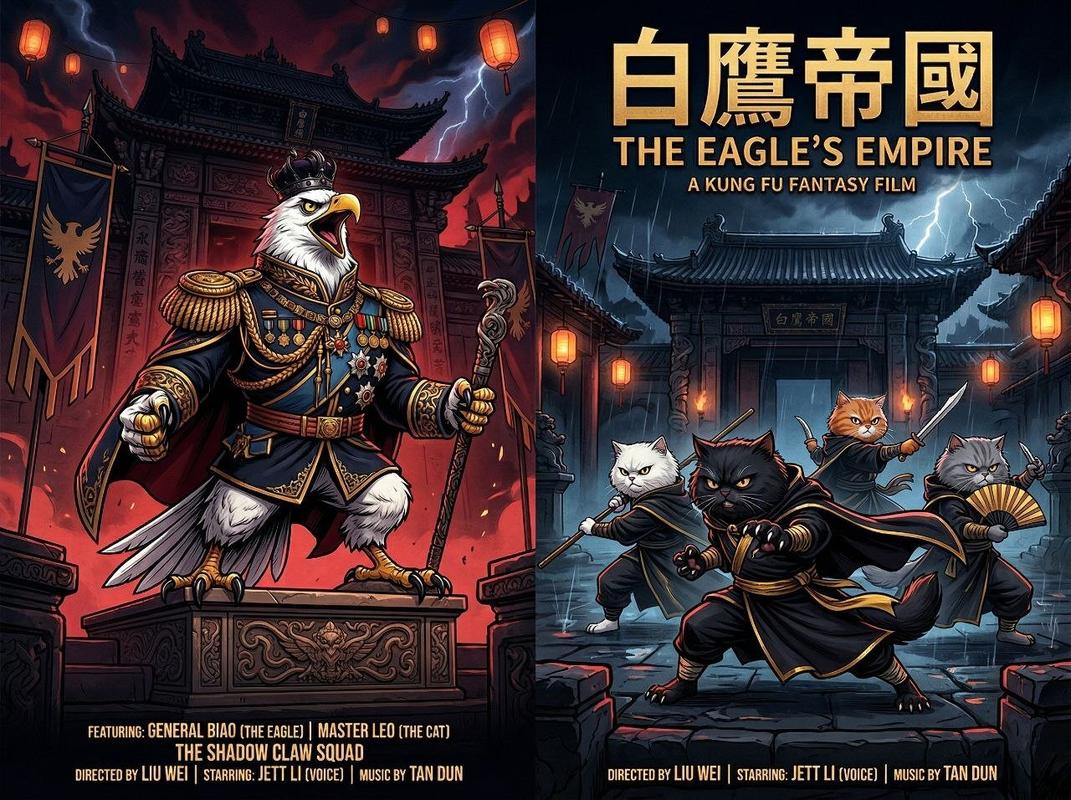
The propaganda war just got an AI upgrade. While the US and China battle for AI supremacy in labs and data centers, Beijing has quietly launched a new front: AI-generated entertainment designed to mock America and win hearts and minds on social media. And here's the wildest part — it's actually working.
Last week, China's state broadcaster CCTV released a five-minute AI-generated animation that looks like it was ripped straight from a classic kung fu movie. The short film depicts the US as a white eagle in regal military attire, unleashing an evil cackle before leading an army against a group of Persian cats draped in black cloaks representing Iranians. The cats vow to fight after losing their leader and close off a crucial trading route — a not-so-subtle allegory for the ongoing conflict in the Middle East.
The video went viral almost instantly. After an X user subtitled it and posted the clip online, it racked up over 1 million views in just a few days. Chinese audiences loved it. International viewers were equal parts confused and entertained. And somewhere in Beijing, propaganda officials were probably popping champagne.
From Slogans to AI-Generated Blockbusters
This isn't your grandfather's Communist Party messaging. For decades, China's state media was the definition of dull — slogan-filled speeches, hollow-sounding praise for the country's merits, and dry denunciations of Western influence. Party newspapers carried speeches that put students and junior officials to sleep. Anti-corruption materials were so boring they practically required mandatory attendance.
But Beijing has been watching. They saw young people turning away from stiff party language. They saw Gen Z scrolling past traditional propaganda without a second glance. And they saw an opportunity.
"It is a new way for Chinese mainstream media to engage the global Gen Z audience," said Shi Anbin, professor and director of the Israel Epstein Centre for Global Media and Communications at Tsinghua University. "Social media users can understand the Chinese standpoint and viewpoint of international affairs through infotainment."
Translation: If you can't beat the memes, join the memes.
The AI Propaganda Playbook
China's state media has been experimenting with AI-generated content for months, and they've found their groove. The formula is surprisingly consistent:
Step 1: Take a current geopolitical issue where China can position itself against the US
Step 2: Create an AI-generated animation with high production values and meme-worthy characters
Step 3: Release it on social media platforms where it can spread organically
Step 4: Let the internet do the rest
In February, Xinhua News Agency dropped an AI-generated music video lampooning Trump's threat to take over Greenland. "Anything I want, I'll get it. One way or another, I'll get it," sang a bald eagle character dressed in military uniform. The video was catchy, weird, and perfect for sharing.
In March, after Trump's "Shield of the Americas" summit, Xinhua posted another short video depicting a bald eagle caging small birds in the name of security. "Sometimes, security comes with a little control," the suited eagle tells the trapped birds. The message was clear: America is the predator, not the protector.
And now, the Iran war martial arts epic. Each release gets slicker, more shareable, and more effective at spreading China's worldview.
Why This Matters (Beyond the Memes)
Here's where it gets serious. The US State Department recently issued cables warning that foreign messaging campaigns on digital platforms "pose a direct threat to US national security and fuel hostility toward American interests." They're not wrong — but they might be missing the bigger picture.
China isn't just trying to win an information war. They're demonstrating something far more consequential: AI as a tool for narrative control at scale.
Think about what they've built. A system that can generate culturally relevant, platform-optimized content in hours rather than months. No film crews. No actors. No expensive production facilities. Just AI models, prompts, and a deep understanding of what makes content spread on social media.
This is propaganda's industrial revolution. And China is ahead.
The Gen Z Factor
The most fascinating aspect of this strategy is the target audience. China's traditional propaganda was aimed at domestic consumption — reinforcing party loyalty among citizens who had no choice but to consume it. This new AI-powered approach is explicitly global.
"AI-generated infotainment spread via social media is likely to be more effective in persuading younger audiences worldwide," said Wang Zichen, deputy secretary-general for the Beijing-based think tank Centre for China & Globalisation. "Whatever one thinks about the format, the message itself clearly resonates with increasingly larger audiences, which helps explain why such content gains traction online."
He's right. The Iran martial arts video isn't just being shared by Chinese state accounts. It's being subtitled, remixed, and spread by international users who find it genuinely entertaining. The propaganda is becoming participatory.
Andrew Chubb, a senior lecturer at Lancaster University who studies political propaganda, put it perfectly: "It's hardly even like propaganda — it almost seems more just a historical fiction dramatisation of the situation."
And that's exactly the point. The best propaganda doesn't feel like propaganda at all.
🔥 Our Hot Take
Let's be real for a moment. The US is getting absolutely clowned in the AI propaganda space.
While American officials issue stern cables about foreign information threats, China is out here producing viral content that people actually want to watch. The bald eagle villain is already a meme. The martial arts Iran video is being shared ironically, seriously, and everywhere in between. And every share spreads China's narrative a little further.
But here's the thing — this isn't just about China being clever. It's about a fundamental shift in how influence works in the AI age.
Traditional propaganda required control of broadcast media. You needed TV stations, radio networks, printing presses. The internet democratized distribution, but you still needed human creativity to produce content at scale. AI changes everything. Now a small team with the right models can produce unlimited variations of culturally optimized content, test what works, and scale it globally in real-time.
China recognized this first because they had to. Their traditional messaging was failing with younger audiences. Their global reputation needed work. And their authoritarian system gave them the ability to move fast and coordinate across state media, tech companies, and diplomatic channels.
The US, meanwhile, is still figuring out how to respond. The State Department's cables read like they're fighting the last war — warning about "foreign state-controlled media" as if the threat is still broadcast TV and official newspapers. The real threat is AI-generated memes that spread through encrypted apps and anonymous accounts, impossible to trace and even harder to counter.
So what should the US do? Honestly, we're not sure. Counter-propaganda feels wrong — nobody wants the US government producing AI-generated cartoons. Platform regulation is a minefield of free speech concerns. And ignoring the problem clearly isn't working.
Maybe the answer is something we haven't thought of yet. Maybe it's supporting independent creators who can compete in the same spaces. Maybe it's developing AI tools for narrative detection and response. Maybe it's something entirely different.
But one thing is clear: The information war has entered a new phase, and right now, China is winning it.
The martial arts video might seem silly. The bald eagle memes might look harmless. But behind them is a sophisticated understanding of how AI can be weaponized for influence at global scale. And that understanding is only going to get more refined, more effective, and more dangerous.
The propaganda machine has learned to entertain. And that's a lot scarier than slogans ever were.