
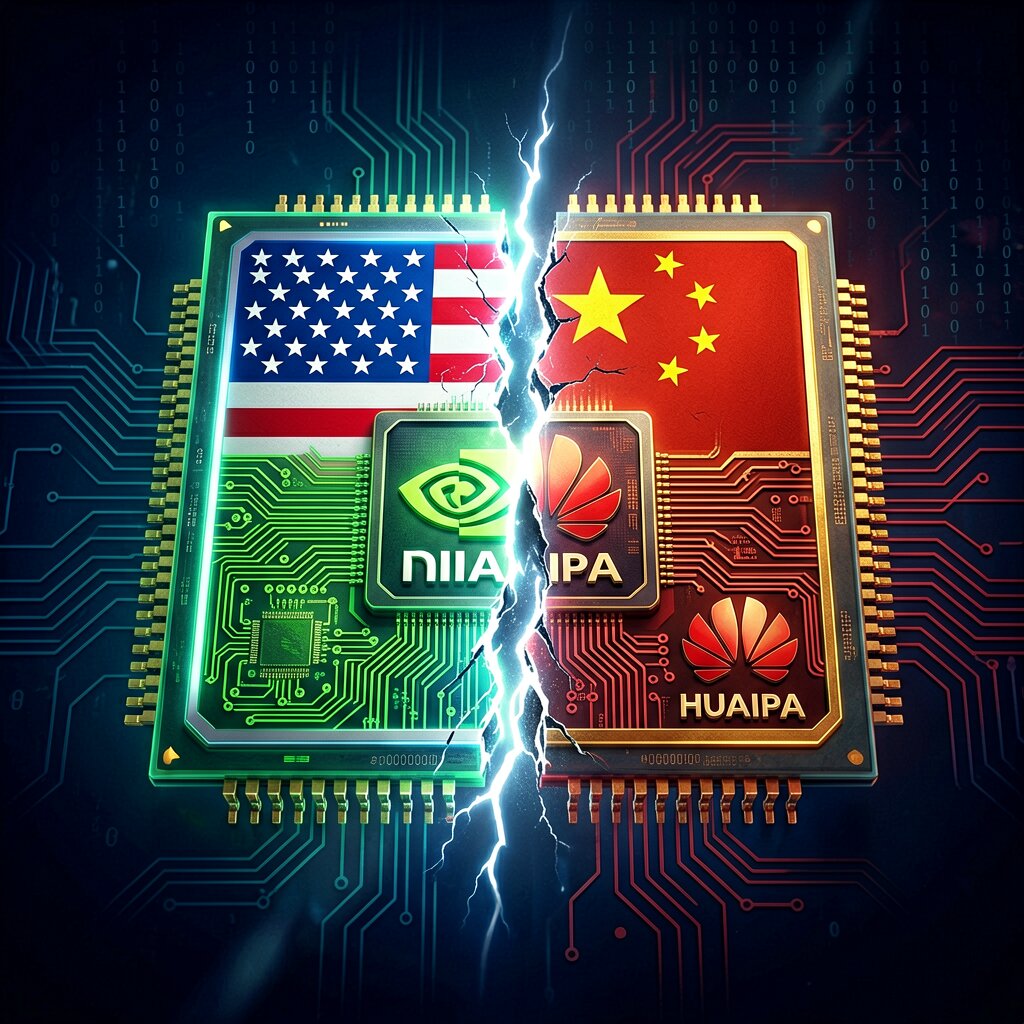
On May 31, the US Commerce Department quietly moved to close a loophole that had allowed Chinese companies to access America's most advanced AI chips for nearly a year — despite strict export bans designed to keep them out of Beijing's hands. The move signals a dramatic escalation in the US-China tech war, one that could reshape the global AI supply chain for decades to come.
The loophole was elegant in its simplicity. While the US had banned direct exports of advanced chips like Nvidia's Rubin and Blackwell architectures, as well as AMD's MI350x, to Chinese entities, it had left a backdoor wide open: Chinese subsidiaries operating in third-party countries like Malaysia, Thailand, and other Southeast Asian nations could still receive these chips legally. For months, if not longer, Chinese firms may have been accessing top-tier US silicon through these overseas subsidiaries, building AI capabilities that Washington had explicitly tried to choke off.
Now that door is closing. And the consequences will ripple across the entire global technology ecosystem.
The Loophole That Wasn't
The US has been tightening its grip on advanced chip exports to China since 2022, starting with the initial restrictions on Nvidia's A100 and H100 GPUs. Each subsequent round of controls — October 2022, October 2023, and beyond — was designed to close gaps and prevent Chinese companies from accessing the cutting-edge silicon needed to train large AI models.
But regulators missed one critical vector: the multinational subsidiary. Chinese tech giants like Huawei, Alibaba, Baidu, and a host of smaller AI firms have been aggressively expanding their presence across Southeast Asia. Malaysia, in particular, has become a hub for Chinese tech investment, with data centers and AI facilities sprouting up across the country. Thailand, Singapore, Vietnam, and Indonesia have all seen similar inflows.
Under the old rules, a Chinese-owned subsidiary in Malaysia could legally purchase Nvidia Blackwell chips for a "local" AI data center. Whether those chips stayed in Malaysia, or whether their computational output was piped back to China, was largely unmonitored. The same applied to AMD's MI350x accelerators and other advanced silicon.
Industry insiders have suspected for months that this loophole was being exploited at scale. Nvidia's Blackwell and Rubin chips, which represent the absolute cutting edge of AI training hardware, have been in ferocious demand globally. The fact that Chinese-affiliated entities in Southeast Asia were among the most aggressive buyers was not lost on analysts — but until now, it was technically legal.
Commerce Department Moves to Seal the Gap
The May 31 action by the Commerce Department appears designed to end this workaround. While full regulatory text has not yet been published, sources familiar with the matter indicate that the new rules will expand the definition of "Chinese entity" to include subsidiaries and affiliates operating in third countries, particularly when there is evidence that advanced chips are being diverted or that computational resources are being made available to Chinese-parent organizations.
Crucially, the move also signals potential new restrictions on chip shipments to Thailand and Malaysia themselves. If the US begins treating these countries as potential diversion points for Chinese AI acquisition, American chipmakers may face additional licensing requirements, end-user verification, or even outright bans on certain exports to these markets.
This is a nuclear option for Southeast Asia's burgeoning AI economies. Malaysia has been positioning itself as a regional AI hub, with government-backed initiatives to attract data center investment and build domestic cloud capacity. If US chip exports to Malaysia are restricted, those ambitions could be severely curtailed. The same applies to Thailand, which has been courting Chinese tech investment while simultaneously trying to maintain strong trade relations with the US.
For Nvidia and AMD, the implications are equally significant. Southeast Asia has been a growth market for both companies, and any restrictions on sales to the region would directly hit revenue. More importantly, it adds yet another layer of compliance complexity to an already Byzantine export control regime. These companies now face the prospect of having to verify not just the end user, but the end user's parent company, its beneficial owners, and the ultimate destination of the computational output.
China's Response: The AI Chip Fortress
Beijing saw this coming. For years, China has been preparing for the day when American silicon becomes completely unavailable — and that day is now essentially here.
The response is what industry analysts are calling China's "AI chip fortress" — a comprehensive, state-backed effort to build domestic alternatives to Nvidia and AMD, no matter how long it takes or how much it costs. The strategy has three pillars: Huawei's Ascend line, specialized ASICs from startups like Cambricon and Moore Threads, and a pivot away from general-purpose GPUs toward task-specific accelerators.
Huawei is the undisputed anchor of this strategy. The company's Ascend 910B and 910C chips have already been deployed in Chinese data centers, and while they lag behind Nvidia's best in raw performance, they are improving rapidly. The Ascend 950PR, Huawei's next-generation flagship, is reportedly targeting shipments of 750,000 units in 2026 — a staggering number that, if achieved, would give China a genuine domestic alternative for large-scale AI training.
But the Ascend line is not without problems. The chips are manufactured on older process nodes, which means higher power consumption and lower performance per watt compared to Nvidia's latest. They also suffer from software ecosystem gaps — CUDA, Nvidia's proprietary programming platform, has a decade of developer lock-in that Huawei's CANN platform is struggling to replicate. Chinese AI researchers consistently report that porting models from CUDA to CANN is painful, time-consuming, and often results in suboptimal performance.
Which brings us to DeepSeek — and the bottleneck that's now threatening China's most promising AI startup.
DeepSeek V4 Delayed: The Huawei Bottleneck Bites
DeepSeek, the Chinese AI lab that stunned the world in early 2025 with models that rivaled Western counterparts at a fraction of the training cost, is now facing a crisis of its own making. The company's next-generation model, DeepSeek V4, has been delayed — and the reason is directly tied to the chip bottleneck.
DeepSeek's earlier models were trained on a mix of Nvidia chips acquired before the strictest bans took effect, plus a growing fleet of Huawei Ascend hardware. But as the company has tried to scale V4 training, it has hit the limits of what Ascend can deliver. The chips are simply not powerful enough, and the software stack is not mature enough, to support the kind of massive training run that DeepSeek needs to stay competitive with OpenAI, Google, and Anthropic.
The delay is a stark illustration of the bifurcation now underway. Chinese AI labs can still build impressive models — DeepSeek V3 and the R1 reasoning model proved that — but pushing the absolute frontier of capability may now require hardware that China cannot access and cannot yet replicate. The gap between "competitive" and "state-of-the-art" is widening, and it is widening on silicon.
DeepSeek is not alone. Alibaba's Qwen series, Baidu's Ernie models, and ByteDance's various AI initiatives all face the same constraint. They can iterate on existing architectures, optimize for efficiency, and squeeze more out of available hardware. But the kind of leapfrog improvement that comes from training on a 100,000-GPU cluster of Nvidia's latest? That path is now closed.
The ASIC Pivot: Specialization as Survival
Faced with the limitations of general-purpose GPUs, Chinese chipmakers are pivoting hard toward specialized ASICs — application-specific integrated circuits designed for particular AI workloads.
Cambricon, once hailed as China's answer to Nvidia, has shifted focus from general AI chips to specialized accelerators for specific domains like computer vision and natural language processing. Moore Threads, another well-funded startup, is pursuing a similar strategy, building chips optimized for inference rather than training.
The logic is sound. If you cannot beat Nvidia at the general-purpose GPU game — and after a decade and hundreds of billions of dollars in R&D, no one has — then change the game. Specialized chips can outperform general ones on specific tasks, and if China's AI ecosystem can standardize around a few key workloads, ASICs could deliver competitive performance without needing to match Nvidia's raw hardware superiority.
The risk is fragmentation. Nvidia's dominance is built not just on hardware but on CUDA — a unified software platform that lets developers write code once and run it anywhere. A fragmented landscape of Chinese ASICs, each with its own toolchain and programming model, could slow development and make it harder for Chinese AI labs to share innovations.
But Beijing has a tool for this: central planning. If the Chinese government mandates standards, funds unified software stacks, and directs research institutions to align around specific architectures, it could overcome the fragmentation problem through sheer organizational will. Whether that will is enough to compensate for the technical gap remains the open question of the decade.
China Restricts AI Talent Travel: The Human Dimension
While the hardware war grabs headlines, a quieter but equally significant battle is unfolding over human capital. China has extended its restrictions on AI researcher travel — and this time, the net is cast far wider than state-run labs.
Previously, travel restrictions applied primarily to researchers at government-affiliated institutions and state-owned enterprises. Now, sources indicate that the rules have been expanded to cover private firms, including high-profile AI labs like DeepSeek, Alibaba's DAMO Academy, and others. Top AI researchers are reportedly being required to obtain approval for international travel, with some applications being denied or delayed indefinitely.
The goal is clear: prevent brain drain and knowledge transfer. China has invested enormous resources in building its domestic AI talent pipeline, and the government is determined not to let that investment walk out the door — literally. Every researcher who attends a conference in the US, takes a sabbatical at a Western university, or consults for a foreign firm is seen as a potential leak of strategic knowledge.
The irony is that this policy could backfire. The global AI research community is deeply interconnected. Chinese researchers have been among the most prolific contributors to top conferences and journals, and their participation in the international discourse has been a major source of soft power for Beijing. Restricting that participation risks isolating Chinese AI from the global conversation — and isolation, in fast-moving fields like AI, is a recipe for stagnation.
Western labs, meanwhile, are watching closely. If Chinese researchers can no longer travel freely, the flow of talent may reverse — or at least bifurcate. Chinese researchers already in the West may face pressure to stay, while those in China may find it harder to build the international collaborations that have historically accelerated breakthroughs.
The Full Bifurcation: Two AI Worlds
What we are witnessing is nothing less than the full bifurcation of the global AI supply chain. Not just chips, but talent, software, standards, and capital are now splitting into two parallel systems — one American-led, one Chinese-led, with decreasing overlap between them.
This is not a temporary disruption. It is a structural shift. The US and China are each building complete, self-contained AI ecosystems from the ground up. Silicon, systems, software, and scientists — each is being duplicated, with the goal of ensuring that neither side can be choked off by the other.
The cost is staggering. Duplicating Nvidia's ecosystem will cost China hundreds of billions of dollars and a decade of effort. Building a domestic alternative to Taiwan's TSMC — the foundry that actually manufactures the chips — will cost even more. And the opportunity cost of cutting off Chinese researchers from the global community is impossible to quantify but certainly significant.
For the rest of the world, the choices are narrowing. Countries and companies that want access to the best American AI technology will need to align with US export controls and limit their engagement with Chinese entities. Those that want access to Chinese markets and technology will face the opposite pressure. Neutrality is becoming harder to maintain, and the middle ground is shrinking.
Southeast Asia, in particular, is caught in the crossfire. The region has been the beneficiary of investment from both sides, with American chipmakers building packaging and testing facilities while Chinese firms pour money into data centers and AI infrastructure. Now, with the US signaling potential restrictions on chip shipments to Malaysia and Thailand, those countries may be forced to choose — or find themselves shut out of both ecosystems.
🔥 Hot Takes
1. The loophole was never a bug — it was a feature for American chipmakers who wanted to keep selling to China without technically breaking the law. Let's be real: Nvidia and AMD knew exactly what was happening. Their sales teams in Southeast Asia were not stupid. They saw Chinese-affiliated entities buying their best chips in bulk and conveniently looked the other way. The Commerce Department didn't "discover" this loophole — they were pressured into closing it after it became politically embarrassing. For nearly a year, American companies profited from a backdoor that undermined their own government's national security policy. If you think this was an accident, I have a bridge in Johor to sell you.
2. DeepSeek's delay proves that China's AI miracle was always built on borrowed silicon — and the bill just came due. The narrative of Chinese AI self-sufficiency was always more hype than reality. DeepSeek's "efficient" training runs were efficient because they were running on Nvidia chips acquired before the bans tightened. Now that the real constraints are biting, the gap between Chinese and American frontier models is going to widen fast. DeepSeek V4 being delayed because of a Huawei bottleneck is the most honest signal we've had in years about where Chinese AI actually stands. The fortress is under construction, but it is not yet defensible.
3. The talent travel restrictions are the real killer — and they will hurt China more than any chip ban. Hardware can be replicated, given enough money and time. But the global AI research community is a network effect, and China is voluntarily unplugging itself from it. The best Chinese researchers will either leave permanently or stagnate in isolation. Meanwhile, the open research culture in the US and Europe will keep accelerating, fed by a global talent pipeline that Beijing is now choking off. In ten years, we may look back at the travel restrictions as the single most self-destructive policy in China's AI strategy — worse than any export control Washington could impose.
The Bottom Line
The US Commerce Department's May 31 move to close the Nvidia chip loophole is more than a regulatory tweak. It is a declaration that the era of half-measures in the US-China tech war is over. Washington is no longer willing to tolerate backdoors that let Chinese firms access American technology through third countries.
For China, the message is equally clear: the safety net is gone. The "AI chip fortress" is no longer a contingency plan — it is the only plan. Whether Huawei can deliver 750,000 Ascend 950PR chips in 2026, whether DeepSeek can find a way to train V4 on domestic silicon, and whether China's ASIC pivot can overcome the fragmentation risk will determine whether Beijing remains competitive in the global AI race or falls permanently behind.
The global AI supply chain has split. Two parallel systems are emerging, each racing to achieve self-sufficiency before the other achieves dominance. The next decade of AI will be defined not by open collaboration but by fortified borders — silicon borders, talent borders, and knowledge borders. The loophole is closed. The walls are going up. And the world is entering an era of AI nationalism that will reshape technology, economics, and geopolitics for a generation.