
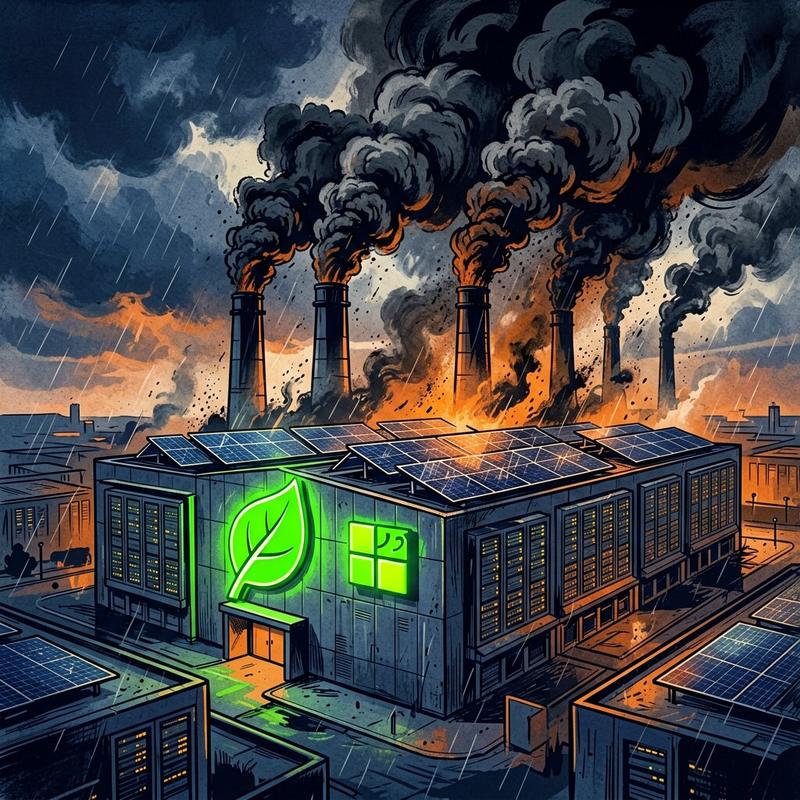
Microsoft's greenhouse gas emissions jumped 27% in its latest fiscal year, reaching 21.1 million metric tons of CO2 equivalent. The company that promised to be carbon negative by 2030 just emitted more than ever before. And here's the kicker: they knew this was coming.
In February 2025, Microsoft quietly stopped purchasing spot energy attribute certificates and carbon removal credits. The company called it a "commitment to high-integrity climate action." What they didn't advertise was the footnote: this move would "temporarily move us out of a carbon-neutral position."
"Temporarily." That's the word they used. Nine months later, emissions are up 27%. Water consumption up 22%. Scope 2 market-based emissions — the ones from purchased electricity — climbed nearly tenfold, from 259,090 tons to 2.7 million tons.
This isn't a climate strategy. It's a magic trick. And the audience is just now noticing the rabbit was never in the hat.
The Carbon Credit Shell Game
For years, Microsoft's climate marketing has been impeccable. Carbon negative by 2030. $1 billion climate innovation fund. AI for Earth. The company positioned itself as the responsible tech giant, the one that cared about the planet while others pillaged it.
The reality was always more complicated. Microsoft's "carbon neutral" status relied heavily on offset purchases — buying carbon credits and renewable energy certificates to cancel out emissions. It was an accounting maneuver, not an operational transformation. The data centers still burned fossil fuels. The AI training runs still consumed megawatts. But on paper, Microsoft was "green."
Then in February 2025, the company changed the rules. They stopped buying spot energy attribute certificates — the financial instruments that let companies claim renewable energy credits without actually building renewable infrastructure. They stopped purchasing carbon removal credits — the offsets that supposedly cancel out emissions by funding tree planting or direct air capture.
The official explanation: Microsoft wanted "high-integrity climate action" instead of "low-quality offsets." The unofficial reality: carbon credit markets were collapsing under scrutiny. Investigations found that up to 90% of rainforest offset credits were worthless. Tree-planting projects were being counted twice. Direct air capture was consuming more energy than it saved.
Microsoft saw the writing on the wall. If they kept buying credits, they'd face accusations of greenwashing. If they stopped buying credits, their emissions would spike. They chose the spike — and called it integrity.
The AI Emissions Bomb
The timing is not coincidental. Microsoft's emissions surge coincides with the most aggressive data center expansion in corporate history. The company is spending $80 billion annually on AI infrastructure. It's building data centers faster than any company on Earth. And every one of those facilities is an emissions factory.
Here's what Microsoft won't put in their press releases: training a single large AI model can emit as much carbon as five cars over their entire lifetimes. Running that model for inference — answering your ChatGPT queries, generating your Copilot code — consumes electricity continuously. Microsoft's AI services are used by hundreds of millions of people. The cumulative emissions are staggering.
The company's emissions intensity — carbon per dollar of revenue — increased for the first time in at least six years. Microsoft emitted 75.0 metric tons of CO2 per million dollars of revenue, up from 68.1 the previous year. Revenue grew 15% to $281.7 billion. Emissions grew faster than revenue. The AI business is literally less efficient, per dollar, than what came before.
And it's not just carbon. Microsoft's water consumption increased 22% to 8,170 megaliters. Half of that water came from regions facing high or extremely high water stress. Data centers are thirsty. AI training is thirsty. And Microsoft is draining aquifers in drought-prone areas to power your chatbot.
The Industry-Wide Cover-Up
Microsoft isn't alone. Google and Amazon also reported significant emissions increases in the same period. The pattern is clear: every major tech company building AI infrastructure is breaking its climate promises. And they're all using the same playbook.
Step 1: Make ambitious climate pledges with 2030 deadlines — far enough away that nobody holds you accountable today.
Step 2: Buy carbon credits and renewable energy certificates to maintain "carbon neutral" status while emissions grow.
Step 3: When carbon markets collapse under scrutiny, abandon the credits and claim you're pursuing "high-integrity" alternatives.
Step 4: Watch emissions spike. Blame AI demand. Promise new technologies (small modular reactors, fusion, direct air capture) that don't exist at scale.
Step 5: Repeat.
The United Nations has noticed. In June 2026, UN Secretary-General António Guterres launched the AI Environmental Transparency Initiative, calling on major AI companies to transition all data centers to renewable energy by 2030. "If AI is to help build a better future, it must be honest about what it costs us now," he said.
The tech industry's response? More press releases about "sustainable AI" and "green data centers" while emissions climb.
The Nuclear Fantasy
Microsoft's new climate strategy rests on a bet: small modular nuclear reactors (SMRs) will save them. In September 2024, Microsoft signed a deal to reopen Three Mile Island — yes, that Three Mile Island — to power its data centers. It's investing in fusion startups. It's talking about "24/7 carbon-free energy."
Here's the problem: SMRs don't exist at commercial scale. The first ones might come online in the early 2030s, if everything goes perfectly. Fusion is still decades away from grid-scale deployment. Three Mile Island won't be producing power until 2028 at the earliest — and it'll only supply a fraction of Microsoft's needs.
In the meantime, Microsoft is building data centers now. Training AI models now. Consuming fossil fuel electricity now. The nuclear promise is a distraction — a way to claim future virtue while continuing present pollution.
It's the same trick as the carbon credits, just with a longer timeline. Instead of buying fake offsets today, Microsoft is promising real solutions tomorrow. The emissions keep rising either way.
🔥 Hot Takes
1. Microsoft's "carbon negative by 2030" pledge was never achievable — and they knew it. The company built its climate brand on offset accounting that was always going to collapse. When carbon credit markets faced scrutiny, Microsoft had two choices: keep buying discredited offsets and face greenwashing accusations, or stop buying offsets and watch emissions spike. They chose the spike because it looks more honest. But the emissions are the same. The only thing that changed was the accounting.
2. The AI industry is running the biggest environmental bait-and-switch in corporate history. Every AI company markets itself as "efficient" and "sustainable" while building infrastructure that consumes more power than most countries. The UN reports that global data centers now use more electricity than all but ten nations. And this is just the beginning. AI demand is projected to grow 10x by 2030. There is no renewable energy buildout fast enough to match that growth. The math doesn't work. The industry knows it. They're building anyway.
3. The "high-integrity climate action" framing is the new greenwashing. Microsoft stopped buying carbon credits and immediately saw emissions spike 27%. Their response? Frame it as integrity. "We're not cheating anymore — we're just polluting more openly." This is genius PR. It turns a failure into a virtue signal. But the atmosphere doesn't care about accounting integrity. It cares about molecules. And Microsoft is pumping more CO2 into it than ever before.
The Bottom Line
Microsoft's emissions surge isn't a surprise. It's the inevitable result of building AI infrastructure at a pace that outstrips renewable energy capacity. The company made climate promises it couldn't keep, used carbon credits to hide the gap, and when credits became untenable, switched to nuclear fantasies with timelines that don't match reality.
The real question isn't whether Microsoft can become carbon negative by 2030. It can't. The question is whether anyone will hold them accountable for the lie.
So far, the answer is no. Investors keep buying. Customers keep subscribing. Regulators keep deferring. And the emissions keep climbing — 27% this year, probably more next year, while the press releases get greener and the atmosphere gets hotter.
Microsoft didn't break its climate promise. It exposed it.