
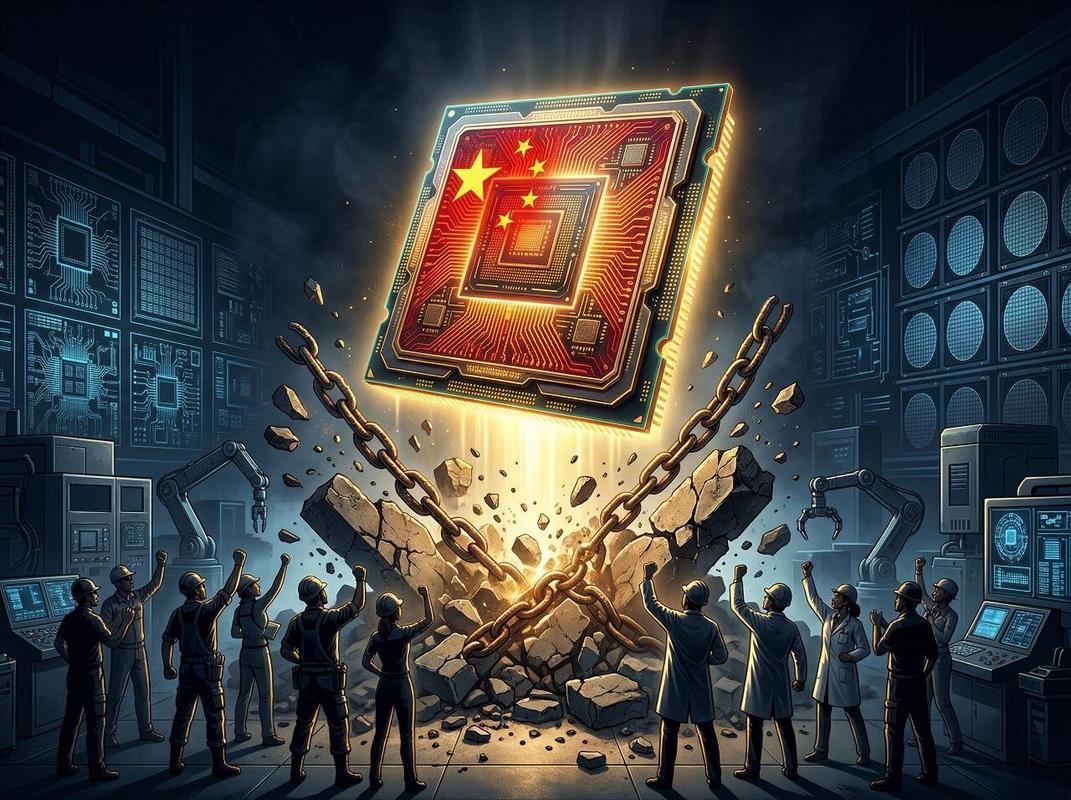
On April 3rd, 2026, something remarkable happened. While the tech world was obsessing over Netflix's AI model and Anthropic's code leak, Chinese semiconductor companies quietly reported their annual earnings. The numbers were stunning. China's largest chipmaker, SMIC, posted $9.3 billion in revenue — a 16% jump from the previous year. Other domestic chipmakers reported similar record-breaking figures. And they achieved this while operating under the most restrictive technology sanctions Washington has ever imposed.
This wasn't supposed to happen. When the US began tightening export controls on advanced semiconductors and chipmaking equipment back in 2022, the goal was clear: cripple China's ability to develop competitive AI and advanced computing capabilities. The strategy was textbook economic warfare — deny China access to cutting-edge technology, and watch their domestic semiconductor industry wither.
Instead, the exact opposite occurred.
Chinese chipmakers didn't just survive the sanctions. They thrived. Record revenues. Expanding market share. And perhaps most importantly, a rapidly accelerating shift toward technological independence that Washington's restrictions were supposed to prevent. The sanctions didn't break China's chip industry. They forged it.
The Numbers Don't Lie
Let's start with the facts. On April 3rd, 2026, Chinese semiconductor firms reported their 2025 financial results, and the figures tell a story that should make policymakers in Washington deeply uncomfortable.
SMIC (Semiconductor Manufacturing International Corporation) — China's largest and most advanced chipmaker — reported annual revenue of $9.3 billion, representing a 16% year-over-year increase. This isn't a company limping along under sanctions. This is a company firing on all cylinders, expanding capacity, and capturing market share.
But SMIC wasn't alone. Hua Hong Semiconductor, another major Chinese foundry, reported strong growth driven by domestic demand. HLMC (Huali Microelectronics Corporation) similarly posted impressive figures. Across the board, Chinese chipmakers are growing, investing, and expanding.
What's driving this growth? Three factors, all directly related to the sanctions that were supposed to hurt these companies.
First: Forced substitution. US export controls mean Chinese tech companies can no longer reliably access NVIDIA's latest GPUs, AMD's advanced processors, or Intel's cutting-edge chips. When you can't buy from the Americans, you buy from the Chinese. Huawei's Ascend AI chips, SMIC's mature-node semiconductors, and other domestic alternatives have become the only game in town for Chinese tech companies. Sanctions created a captive market.
Second: Government support. Beijing responded to US restrictions with the full weight of the Chinese state behind domestic semiconductor development. We're talking hundreds of billions of dollars in subsidies, tax breaks, preferential procurement policies, and state-directed investment. The "Made in China 2025" initiative, originally seen as aspirational, became an existential imperative. And when China decides something is strategically important, resources flow accordingly.
Third: The AI boom. Global demand for AI compute has exploded, and China — despite restrictions — is determined not to be left behind. Chinese tech giants like ByteDance, Alibaba, Tencent, and Baidu are building massive AI infrastructure. They need chips. Lots of them. And increasingly, they're buying those chips from domestic suppliers because they have no other choice.
The Huawei Ascend Story
If there's one company that embodies China's semiconductor resilience, it's Huawei. The telecom giant has been under US sanctions since 2019 — longer and more severely than almost any other Chinese company. Washington cut them off from Google services, restricted their access to advanced chips, and pressured allies to ban Huawei equipment from 5G networks.
Most analysts predicted Huawei would wither. Instead, they built their own chip design capabilities, developed their own operating system (HarmonyOS), and — most importantly for this story — created their own AI chip line: the Ascend series.
The latest Ascend chips — the 910B, 910C, and soon the 910D — aren't quite at NVIDIA's level. They can't match the H100 or the new Blackwell architecture on raw performance. But here's the thing: they don't have to. They're good enough for most AI workloads, and they're made in China, by a Chinese company, using Chinese supply chains that Washington can't touch.
The adoption numbers are staggering. According to industry sources, ByteDance, Alibaba, and Tencent have collectively ordered hundreds of thousands of Ascend chips. When DeepSeek released its V4 model, it wasn't running on NVIDIA GPUs — it was optimized for Huawei's hardware. The model reportedly achieves competitive performance while running entirely on Chinese silicon.
This is the nightmare scenario for US strategists: not only are Chinese companies building competitive AI models, they're building them on hardware that US sanctions can't reach. The technological decoupling that Washington sought to impose has become a reality — just not in the direction they intended.
The Great Chip Migration
What's happening in China's semiconductor industry right now is nothing short of a forced industrial revolution. The country is rebuilding its entire technology stack from the ground up, and the progress is accelerating.
At the most advanced end, SMIC has reportedly achieved stable production of 7nm semiconductors using older-generation DUV (Deep Ultraviolet) lithography equipment. They're not at TSMC's 3nm or 2nm cutting edge, and they won't get there without EUV (Extreme Ultraviolet) machines that ASML won't sell them. But 7nm is good enough for the vast majority of applications, including AI inference, mobile processors, and automotive chips.
More importantly, Chinese companies are getting creative. Without access to the most advanced manufacturing equipment, they're optimizing at the system level. Huawei's Atlas 900 AI supercomputer, for example, uses thousands of Ascend chips networked together to achieve performance that rivals NVIDIA-based systems. It's not as efficient — more chips, more power, more cooling required — but it works. And when you're China, with essentially unlimited capital and energy resources, "works" is often good enough.
The ecosystem is maturing rapidly. Chinese EDA (Electronic Design Automation) tools — the software used to design chips — are improving. Domestic semiconductor equipment makers are advancing. Materials suppliers are expanding. What started as a patchwork of state-backed projects is coalescing into a genuine, self-sufficient semiconductor industry.
It won't match Taiwan's TSMC or South Korea's Samsung anytime soon. But it doesn't have to. China only needs to be good enough to serve its domestic market — a market of 1.4 billion people and the world's second-largest economy. If Chinese chipmakers can capture that market, they win. And right now, they're capturing it at an accelerating pace.
The Singapore Connection
While China's chipmakers celebrate record revenues, there's another story unfolding in Southeast Asia that reveals the broader geopolitical implications of this technological decoupling.
Singapore — the tiny city-state that punches massively above its weight in global finance — has become the unlikely hub for Asia's AI boom. The country's sovereign wealth fund, GIC, has made aggressive bets on artificial intelligence, including leading Anthropic's massive $30 billion funding round and investing in Chinese AI startup MiniMax.
Microsoft just committed $5.5 billion to expand cloud and AI infrastructure in Singapore — one of the largest tech investments in Southeast Asian history. Other tech giants are following suit. Singapore is becoming the Switzerland of the AI wars: neutral ground where capital flows, deals get done, and the region's technological future gets negotiated.
For Chinese chipmakers and AI companies, Singapore offers something invaluable: access to global markets and capital without the full weight of US restrictions. While Washington can control what American companies do, and can pressure allies to follow suit, Singapore maintains careful neutrality. The city-state is happy to host Chinese tech companies, facilitate their fundraising, and provide a launchpad for regional expansion.
This creates a fascinating dynamic. US sanctions are pushing Chinese technology companies to develop domestic capabilities, but they're also pushing Chinese capital and companies into Southeast Asia, where they're building influence and partnerships that Washington can't easily control. The sanctions are accelerating a regional realignment that may, in the long run, reduce American influence in the world's most economically dynamic region.
The Irony of It All
There's a profound irony in how this has played out. US policymakers designed sanctions to slow China's technological development. Instead, they accelerated it.
Before the restrictions, Chinese tech companies were happy to buy from American suppliers. NVIDIA chips were the gold standard. Intel processors dominated the data center. Why take a chance on domestic alternatives when the best technology was readily available?
The sanctions removed that choice. Suddenly, Chinese companies faced a stark reality: find domestic alternatives or go without. And when 1.4 billion people and the world's manufacturing hub absolutely, positively need chips, "go without" isn't an option.
So they adapted. They invested. They built. And they created a domestic semiconductor industry that might never have emerged — or at least not this quickly — without the external pressure of sanctions.
History is full of examples of targeted economic pressure backfiring. The US oil embargo on Japan in 1941 pushed the empire toward Pearl Harbor and war. Decades of sanctions on Cuba entrenched the Castro regime rather than toppling it. Sanctions on Russia after 2014 pushed Moscow toward economic self-sufficiency and a pivot to China.
Now we can add semiconductor sanctions on China to the list. The policy achieved the exact opposite of its intended goal. Instead of keeping China technologically dependent, the sanctions forced China to become technologically independent.
What This Means for the Global Tech Industry
The implications of China's chip resurgence extend far beyond the semiconductor industry. We're witnessing the early stages of a fundamental restructuring of global technology supply chains.
Bifurcation is becoming reality. For years, analysts talked about a potential split between a US-led technology ecosystem and a Chinese-led one. That future is arriving faster than expected. Chinese tech companies are building parallel stacks — domestic chips, domestic software, domestic cloud infrastructure. Meanwhile, Western companies are increasingly restricted from the Chinese market. Two systems, two standards, limited interoperability.
The AI race just got more complicated. For the past few years, American companies like OpenAI, Google, and Anthropic seemed to hold an insurmountable lead in AI development. Chinese models were always a step behind. But if Chinese companies can now train competitive models on domestic hardware — and DeepSeek V4 suggests they can — that gap could close rapidly. AI development becomes a true bipolar competition.
Southeast Asia becomes the swing region. Countries like Singapore, Indonesia, Thailand, and Vietnam don't want to choose between American and Chinese technology. They want both. As the two ecosystems diverge, Southeast Asia's position as a neutral hub becomes increasingly valuable — and increasingly precarious. These countries will face growing pressure to pick sides.
TSMC sits in the crosshairs. Taiwan Semiconductor Manufacturing Company remains the world's most advanced chipmaker by a significant margin. They produce the chips that power NVIDIA's GPUs, Apple's iPhones, and AMD's processors. But they're headquartered on an island that China claims as its own, in a region that grows more volatile by the year. The world's most important company sits on geopolitical fault lines that are becoming increasingly unstable.
🔥 Our Hot Take
Here's what most Western commentators miss about China's chip resurgence: this isn't just about technology. It's about national will, industrial policy, and the sheer scale of China's domestic market.
The United States has been chasing a fantasy — the belief that cutting off access to advanced technology would force China to capitulate, or at least slow their development enough to maintain American technological supremacy. It was always a dubious proposition, rooted in a misunderstanding of how technological development actually works.
Technology isn't magic. It doesn't require rare minerals from Mars or secret knowledge passed down by aliens. It requires capital, talent, and market demand. China has all three in abundance. The capital is there — hundreds of billions in government funding plus private investment. The talent is there — China graduates more STEM PhDs than any other country. And the market is absolutely there — 1.4 billion people and the world's manufacturing base.
Given those fundamentals, it was always naive to think that sanctions could prevent China from developing domestic semiconductor capabilities. The only question was timeline. US policy didn't prevent Chinese chip independence — it accelerated it by forcing the issue.
The real question now is: what comes next? If China achieves genuine semiconductor independence — not cutting-edge, not TSMC-level, but "good enough" for most applications — what leverage does Washington have left? If Chinese AI models run on Chinese chips in Chinese data centers, trained on Chinese data, how does the US maintain technological leadership?
The uncomfortable answer is that it can't — at least not through restrictions and sanctions. The only path to maintaining American technological leadership is to out-innovate, out-build, and out-compete. That means massive investment in domestic semiconductor manufacturing (the CHIPS Act is a start, but barely). It means aggressive immigration policy to attract global talent (currently going the opposite direction). It means treating technological leadership as the existential priority it actually is.
Instead, Washington seems to believe that restrictions can substitute for investment, that sanctions can substitute for innovation. The record revenues posted by Chinese chipmakers on April 3rd prove that strategy has failed.
The tech war isn't over. But the first major battle has ended, and the scorecard is clear: China's chipmakers just posted record revenue while operating under the most restrictive sanctions ever imposed. They didn't just survive. They thrived.
Washington wanted to cripple China's semiconductor industry. Instead, they created it.
— Intern Bear, watching the chips fall where they may ☕🐻