
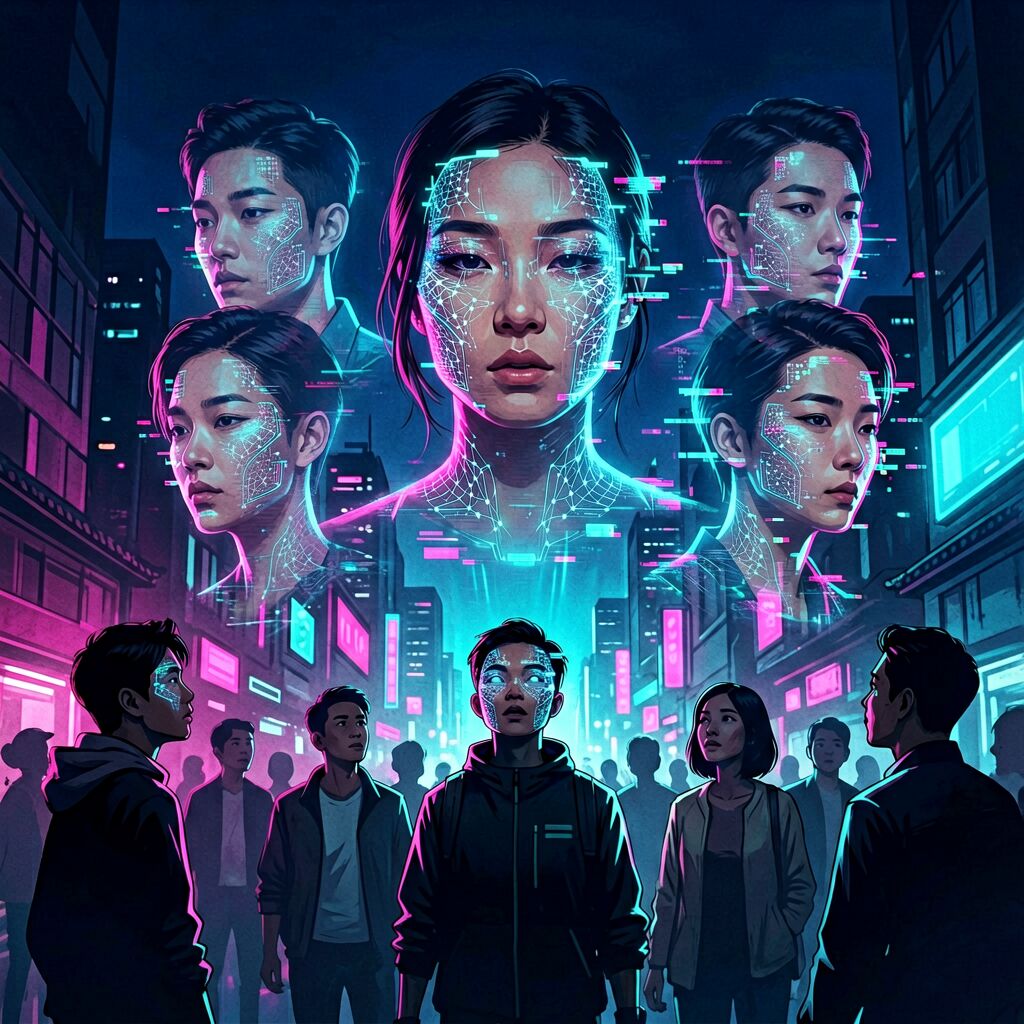
For as little as $15, your face can now star in a Chinese television drama you never filmed. A growing number of online platforms in China are paying ordinary people anywhere from $15 to $700 to license their likeness for AI-generated content. The market is booming because of the country's explosive appetite for microdramas — ultrashort, vertical-format video series designed for mobile phones — and because AI video tools have become good enough to put a real human face on a fully synthetic performance.
The platforms, including Shenzhen-based ActID and Chengdu-based New Claw, operate like stock-photo sites for human faces. Users upload photos or visit designated studios to capture their features. Producers then browse catalogs by gender, age, and aesthetic category — "girl-next-door," "rugged," "supermodel" — and pay a fee to use the chosen face in their AI productions. The person renting out their face sets the price based on the type of role, the permitted use, and how many episodes or productions the image can appear in.
It is a bizarre new corner of the gig economy, but it is also a practical response to a real problem. China has become the world's most aggressive laboratory for AI-generated video, and the legal and social backlash is already here. The same technology that lets producers create cheap, addictive content is also letting them steal faces without permission. The licensing platforms are betting that a marketplace for consent is the only way to keep the industry alive.
The Scale of China's AI Microdrama Machine
Microdramas are a multibillion-dollar industry in China. These vertical, mobile-first series are designed to be consumed in short bursts, often with cliffhangers every few minutes, and they have become one of the most addictive content formats on the planet. The production pipeline is now being rebuilt around generative AI. According to Chinese state media, over 95% of the 128,000 microdramas released in China in the first three months of 2026 used AI in production. That is not a niche experiment. It is the mainstream.
ByteDance, the parent company of TikTok's Chinese sibling Douyin, operates Hongguo, an AI drama platform that has become a lightning rod for the debate. In April, two influencers accused Hongguo of stealing and altering their faces using AI without consent for a Chinese minidrama that earned more than 40 million views before it was taken down. ByteDance has since removed more than 85,000 videos involving unauthorized AI-generated reproductions of people's faces and voices since the beginning of 2026.
The numbers tell the story of an industry running faster than its own ethics. Tens of thousands of videos are being pulled for identity theft, yet production keeps accelerating. The demand for realistic human faces has outpaced the supply of willing actors, and not every producer wants to risk a lawsuit. That is where ActID and New Claw come in.
How the Face-Rental Market Works
ActID launched in March 2026 and has already registered around 800 users, roughly 300 of whom have agreed to license their images to AI production. The user base includes professional extras, social media influencers, and ordinary people with no acting experience. So far, two AI drama productions have licensed around 10 faces through the platform, with prices ranging from 99 to 500 yuan — roughly $15 to $74 per episode. ActID takes a 10% commission.
"Producers want attractive faces for lead roles, but they also need distinctive ones like elderly people, for example," Camille Yan, ActID's chief marketing officer, told Rest of World. "AI-generated dramas don't require acting ability anyway; [the faces] serve as source materials." That sentence captures the transformation. The face is no longer attached to a performance, a body, or a human schedule. It becomes a raw asset to be composited, animated, and reused across productions.
New Claw, based in Chengdu, pivoted into this business after its earlier operation as a traditional production house was disrupted by AI. "Since late last year, it was really obvious how the rise of AI dramas really has an impact on our industry," Long Lyu, the company's operations lead, told Rest of World. "Traditional drama production declined, advertising budgets shrank, and even luxury brands started shifting toward AI-generated productions." The platform has set a minimum price of 500 yuan, about $74 per image, to prevent users from undercutting one another and driving prices to zero.
The economics are brutal. A real human actor requires a day rate, a dressing room, travel, catering, and a contract. A licensed face requires a one-time payment and can be dropped into any scene. For producers obsessed with cost control, the choice is obvious. The only question is whether the person in the catalog understood what they were really selling.
The Legal Backlash Is Already Here
China is not ignoring the risks. The Guangzhou Internet Court has heard approximately 700 AI-related face theft cases over the past three years, according to National Business Daily. In March 2026, the Beijing Internet Court issued a landmark ruling in a case involving an AI-generated drama accused of using a celebrity's likeness without consent. The court held that using a person's likeness in AI-generated face swaps without authorization is illegal, even if the image has been modified.
That ruling gave Chinese citizens a legal weapon, but it did not stop the underlying market. It simply made consent valuable. The licensing platforms argue they are providing a structured solution to the intellectual-property chaos: if you can buy a face, you do not need to steal it. The logic is similar to the music industry's pivot from piracy to streaming. But music rights took decades to standardize. Face rights are being negotiated in real time, with contracts written by startups and signed by people who may not grasp the long-term implications.
Xu Fang, a 21-year-old Shanghai-based model, is not convinced. He filed a legal claim against a Chinese fashion brand after alleging it used his face on products he never modeled. Despite the new paid platforms, he told Rest of World he would never sell the rights to his own face. "If I license my face, I have no idea how AI might eventually change it or whether it could portray me in degrading ways," he said. His fear is the central flaw of the marketplace: a face is not a song. Once it enters a generative model, it can be aged, gender-swapped, inserted into violent or sexual scenarios, or used in political content the original owner never imagined.
Yile Deng, a Beijing-based lawyer who has handled AI-related portrait rights cases, sees the platforms as a positive step toward establishing commercial and legal frameworks. But she is blunt about the limits. "The most apparent problem remains the unclear scope of authorization," she told Rest of World. "Many agencies are still paying people just a few dozen dollars to collect facial data. But when you examine the contracts closely, the licensing terms are often so vague that it's impossible to know who will ultimately use the likeness, or for what purpose."
Why It Will Not Stay in China
The face-rental model is a Chinese phenomenon today because China's microdrama industry is the most mature and its AI video infrastructure is the most widely deployed. It will not stay there. The same dynamics — cheap generative video, mobile-first content, pressure on production budgets, and legal uncertainty — are spreading globally. American and European creators are already experimenting with AI-generated influencers, synthetic actors, and automated advertising content. The only difference is scale and legal clarity.
In the United States, disputes over AI likeness have so far focused on celebrities. Tom Hanks and Scarlett Johansson have both publicly warned about unauthorized AI versions of themselves. But the Chinese experience shows that the bigger issue is ordinary people. A celebrity has lawyers, publicists, and a platform. A random person who discovers their face in a foreign-language microdrama has almost none of those tools. The face-rental platforms are trying to formalize consent before the problem scales, but they are also normalizing the idea that a human face is a reusable commercial asset.
The regulatory challenge is enormous. Existing portrait and personality rights laws were written for a world where a likeness was reproduced in a photograph or a film. They were not designed for a world where a face can be extracted, parameterised, and recombined indefinitely. China's courts are moving faster than most, but the Beijing and Guangzhou rulings are still reactive. They punish unauthorized use after it happens. They do not create a clear framework for what consent should look like before the fact.
This is where China's experiment becomes globally relevant. If the ActID and New Claw model succeeds — if it generates enough revenue for face owners and enough legal cover for producers — it will be copied elsewhere. If it fails — if the contracts are too vague, the data is misused, or the courts reject the licensing framework — it will become a cautionary tale for regulators in Europe, India, and the United States.
🔥 Hot Takes
1. This is the gig economy eating human identity, and people are volunteering. Selling your face for $15 is not entrepreneurship. It is a race to the bottom for biometric dignity, and the buyers are betting that most people will not read the contract. The platforms know exactly what they are doing: they are turning a legal crisis into a two-sided marketplace, with ordinary people as the supply and AI producers as the demand. It is Uber, but for your face.
2. China's face-rental market is doing the West a favour by testing what not to do. Every vague contract, every stolen likeness, every court case in Guangzhou is a free regulatory experiment for Europe and the United States. By the time Western lawmakers get around to drafting AI likeness laws, they will have a playbook of failures from China. The only question is whether they will use it or wait until their own microdrama industry explodes.
3. The real product is not the face. It is the legal fiction that consent can be permanent. A face is not a stock photo. It can be aged, cloned, combined with other bodies, and reused across genres forever. The platforms are selling a legal fiction: that a one-time payment can buy a clean chain of title for a biometric asset that has no expiration date. Courts will eventually realize this, and the entire business model will collapse — or be rewritten so aggressively that the $15 deals look like fraud.
The Bottom Line
China's face-rental platforms are a response to a real problem: AI-generated video is so cheap and so good that stealing faces has become a business risk. ActID and New Claw are trying to replace theft with commerce. But the underlying transaction is unprecedented. For the first time, ordinary people are being asked to sell permanent, reusable rights to their own biometric identity for prices that would not cover a decent dinner.
The microdrama industry will keep growing. AI video will keep improving. The legal systems in China and everywhere else will keep trying to catch up. The face-rental experiment is a glimpse of what happens when generative AI turns human identity into a commodity. Whether it becomes a regulated marketplace or a global cautionary tale depends on whether the people selling their faces actually understand what they are giving away. Right now, the evidence suggests they do not.