
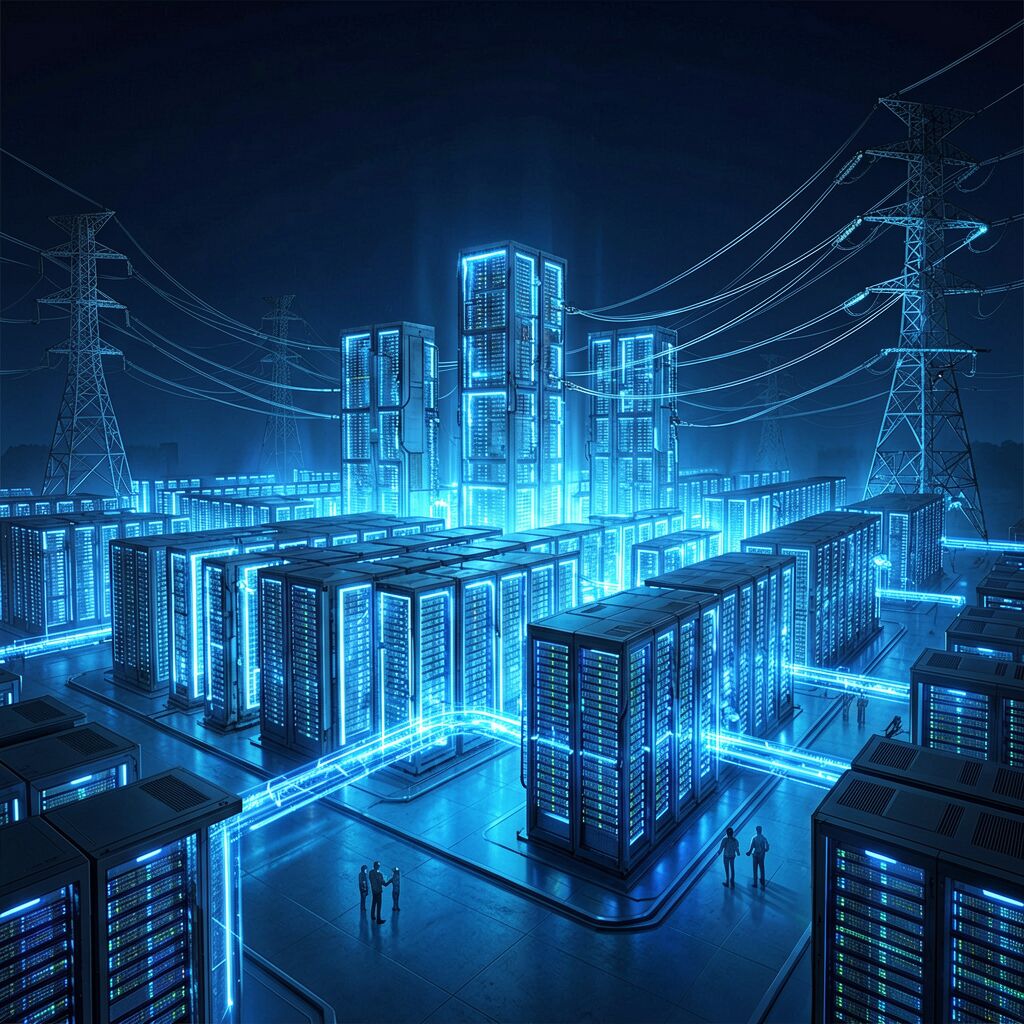
While the West is still debating whether Chinese AI can catch up, Z.ai has finished building something that answers the question in concrete, steel, and silicon. The company formerly known as Zhipu has completed construction of a 1-gigawatt AI data center running entirely on Chinese-made chips. Part of the facility is already operational. At full throttle, it will consume enough electricity to power roughly 750,000 homes.
This is not a prototype. It is not a press release. It is a declaration that China no longer needs Nvidia to train frontier AI models.
From Zhipu to Z.ai: The Quiet Giant of Chinese AI
Z.ai is best known as the developer of the GLM family of large language models, one of China's most ambitious open-weight AI initiatives. For years, the company operated in the shadow of better-known rivals like DeepSeek, Moonshot, and Alibaba. But Z.ai has always been different. It was built by researchers from Tsinghua University's Knowledge Engineering Group, and it carried the academic rigor of that institution into commercial AI development.
The company's GLM series has consistently ranked among the top open models in China. Its latest iterations have matched Western frontier models on coding, mathematics, and reasoning benchmarks. What Z.ai lacked was not talent or model architecture. It was compute. The US export controls on Nvidia's H100 and H800 chips were designed precisely to starve Chinese labs of the hardware needed to train next-generation models. Z.ai's response was not to beg, borrow, or smuggle. It was to build.
What 1 Gigawatt Actually Means
To understand the scale of what Z.ai has built, you need to understand what a gigawatt represents. One gigawatt is 1,000 megawatts. For comparison, a typical nuclear reactor produces about 1 gigawatt. A large coal plant might produce 1.5 to 2 gigawatts. When Z.ai says its new facility is 1-gigawatt-class, it is saying that at peak capacity, it will draw power comparable to a major power station.
In practical terms, that is enough to energize roughly 750,000 homes. It is also enough to power one of the largest concentrations of AI training hardware on Earth. Z.ai says the facility already runs several computing clusters with more than 10,000 chips each. That is not on the scale of a research lab. That is on the scale of a national infrastructure project.
The data center is not just big. It is also deliberately independent. Every chip inside is Chinese-made. That means no Nvidia GPUs, no AMD accelerators, no Intel Gaudi cards. The facility is designed to keep Z.ai's model development alive even if the US tightens sanctions further or cuts off all advanced semiconductor imports. It is, in essence, a hardened bunker for China's AI sovereignty.
Why This Matters Now
The timing could not be more significant. The US has spent the last three years constructing an increasingly elaborate architecture of export controls to slow Chinese AI development. The logic was simple: if China cannot buy the best chips, it cannot train the best models. The strategy assumed that Chinese domestic alternatives would remain years behind, and that even if China could design competitive chips, it would not be able to manufacture them at scale.
Z.ai's new data center suggests that assumption is wrong. The company is not using one or two domestic accelerators as a token. It is operating clusters of more than 10,000 Chinese chips. That implies a domestic supply chain capable of producing advanced AI accelerators at serious volume. It also implies that the software ecosystem around those chips, including compilers, networking stacks, and training frameworks, has matured enough to run large-scale distributed training.
This is the real battlefield. The US-China AI competition is not just about who has the best model. It is about who can build a complete stack: chips, data centers, power grids, models, and talent. Z.ai's facility is a step toward a fully Chinese stack. It is also a signal to every other Chinese lab that the path forward does not run through Santa Clara.
The Chip Question: Who Made the Silicon?
Z.ai has not disclosed which Chinese companies manufactured the chips. The most likely candidates are Huawei's Ascend line, Cambricon, Hygon, and perhaps Moore Threads. Huawei's Ascend 910B has been the workhorse of Chinese AI training since the US tightened sanctions, and several Chinese labs have reported training competitive models on Ascend clusters. Moore Threads, meanwhile, has been building larger GPU clusters and claims to be approaching Nvidia performance on certain workloads.
What matters is not the exact supplier. What matters is that Z.ai is confident enough to put its entire frontier training roadmap on domestic hardware. That is a vote of confidence in the Chinese semiconductor ecosystem that would have been unthinkable two years ago. It also means that Chinese labs are no longer treating domestic chips as a backup plan. They are treating them as the main plan.
Power, Water, and the Geography of AI
A 1-gigawatt data center does not appear in a random location. It needs massive amounts of electricity, cooling water, and fiber connectivity. China has spent decades building out its power grid, particularly in western and northern regions where coal, hydro, wind, and solar resources are abundant. It is no coincidence that Z.ai's facility looks more like a strategic energy project than a typical cloud campus.
This is where the US-China AI competition gets physical. American hyperscalers are scrambling to secure power for their own data centers, fighting over nuclear energy deals, grid interconnections, and natural gas supplies. Microsoft has said its AI power needs are forcing it to rethink decades of energy planning. Google and Amazon are investing in small modular nuclear reactors. The race for compute is becoming a race for electrons.
China has an advantage in this race because of how its power sector is organized. The state can direct generation, transmission, and industrial development in ways that democratic economies cannot easily match. A 1-gigawatt AI hub is not just a technical achievement. It is a political-economic achievement.
What This Means for the Global AI Order
The implications of Z.ai's data center extend far beyond China. For years, the global AI industry has operated on a single assumption: the best models are trained on Nvidia GPUs, usually in American clouds. That assumption created a hierarchy. American labs had first access to the best chips. American allies had second access. Everyone else had to wait or pay more.
Z.ai is challenging that hierarchy. If Chinese labs can train frontier models without Nvidia, then the US sanctions lose their strategic bite. Worse, from an American perspective, the know-how to build alternative AI infrastructure could spread. Chinese chipmakers, data center builders, and model labs could offer a complete package to countries that do not want to depend on American technology.
This is already happening. China has launched a World AI Cooperation Organization that includes dozens of Global South nations. The pitch is not just about AI models. It is about infrastructure, training, and a technological stack that does not require US approval. Z.ai's data center makes that pitch credible.
🔥 Hot Takes
1. The export control strategy is officially obsolete. Washington's entire plan assumed that starving Chinese labs of Nvidia chips would freeze their AI progress. Z.ai just built a gigawatt-class facility without Nvidia. The embargo bought the US some time, but it did not buy a permanent lead. The next American strategy cannot rely on chip denial alone. It needs to win on speed, cost, and ecosystem.
2. Open-weight models are about to get a hardware moat. Z.ai's GLM models are already open-weight. Now they have a domestic hardware pipeline to train and serve them at scale. That combination, open models plus sovereign compute, is the most credible alternative to the American closed-stack model. If you are a country outside the US alliance system, why would you buy OpenAI when you can run a GLM model on Chinese infrastructure with no export controls?
3. This is the real end of the globalization era. For decades, the tech industry pretended it was borderless. Z.ai's data center is a border. It is a Chinese facility, running Chinese chips, training Chinese models, for a Chinese AI ecosystem. The world is splitting into technological blocs, and the line runs right through the middle of this power plant.
The Bottom Line
Z.ai's 1-gigawatt Chinese-chip data center is not just a milestone for one company. It is a milestone for the entire AI world. It proves that a complete, domestic AI infrastructure stack is possible at scale. It shows that US sanctions have failed to stop Chinese frontier model development. And it suggests that the next phase of AI competition will be fought not just in model benchmarks, but in power grids, chip foundries, and national data center strategies.
The Nvidia era is not ending because Nvidia is weak. Nvidia remains the best chip designer in the world. But the Nvidia era is ending because Nvidia is no longer the only path. Z.ai just paved another one, and it runs straight through Beijing.