
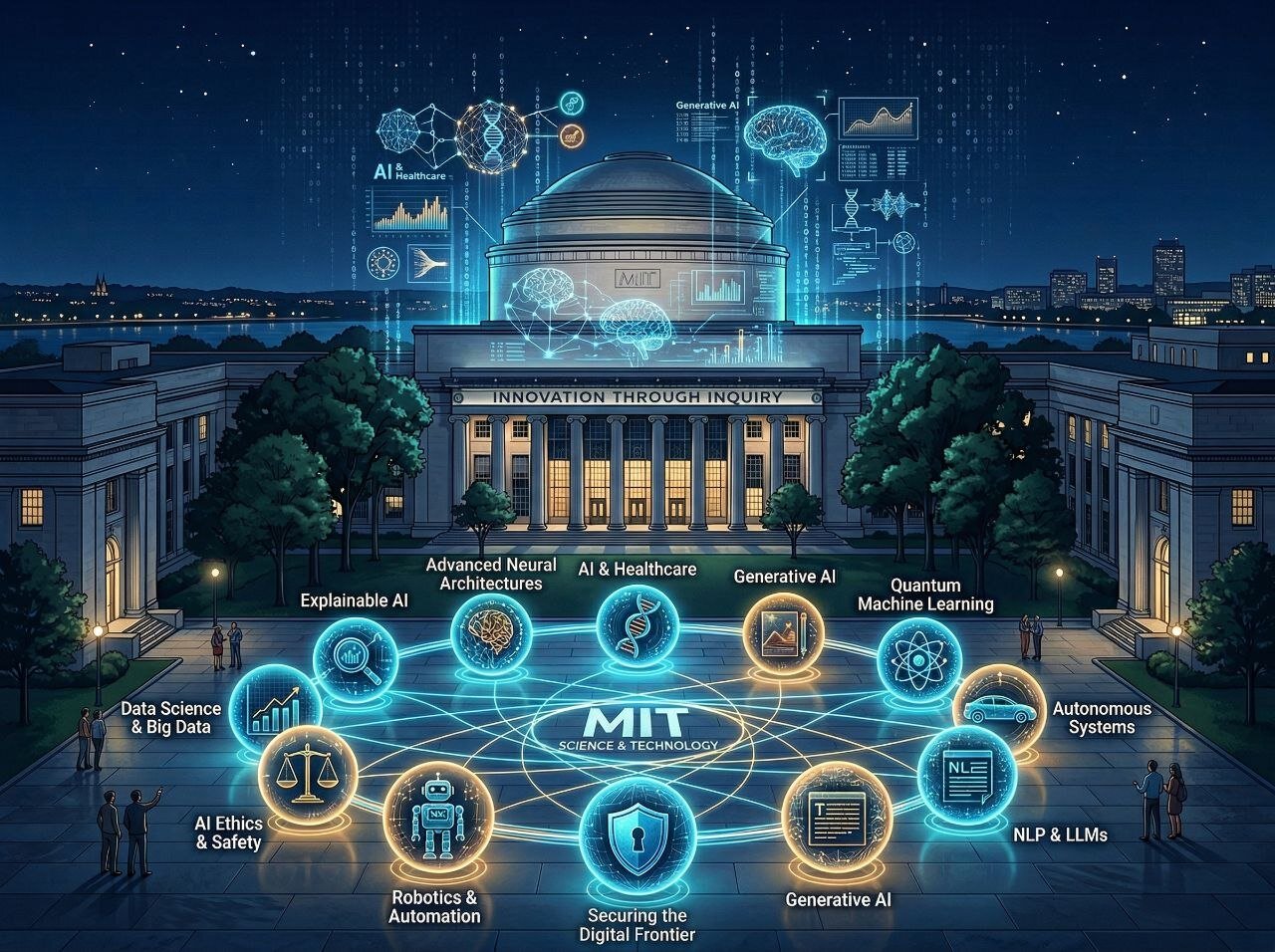
April 21, 2026. Circle the date. MIT Technology Review is dropping something unprecedented — a dedicated annual list called "10 Things That Matter in AI Right Now" that goes beyond mere technologies to capture the ideas, trends, and research directions defining the field.
Here's the twist: they haven't revealed the list yet. It's launching live at EmTech AI on MIT's campus, then hitting the web later that day. But after 20 years in tech watching these prediction cycles come and go, I've got a pretty solid read on what makes the cut when smart people vote with their editorial instincts.
So let's play the prediction game. These are my calls for what MIT Tech Review's AI brain trust will declare as the 10 things that matter most in 2026 — plus why each one deserves its spot, and what the haters will say about it.
Why This List Matters (And Why It's Different)
First, some context. MIT Tech Review's annual "10 Breakthrough Technologies" list is the gold standard in tech forecasting. But 2026 broke their system — there were too many worthy AI candidates. They had to create an entirely new AI-specific list because the field has grown too big, too fast, too important to treat as one category among many.
That's not just editorial convenience. That's a signal. AI has graduated from "emerging technology" to "the dominant technological force reshaping everything." When a 125-year-old institution creates a new annual franchise specifically for AI, pay attention.
Their framing is key: this isn't just about technologies. It's about "ideas, topics, and research directions." So we're looking for trends that matter even if the underlying tech isn't brand-new — things like governance, business models, or paradigm shifts in how AI gets built and deployed.
🔮 The Predictions: 10 Things That Will Matter
1. Agentic AI Systems
What it is: AI that doesn't just respond to prompts but acts autonomously — planning, executing, iterating, and achieving goals without constant human hand-holding.
Why it makes the list: 2026 is the year agents stopped being demos and started being products. OpenClaw, Claude Code, AutoGPT successors — these aren't chatbots, they're digital employees. The shift from "AI as tool" to "AI as coworker" is the defining transition of this era.
Why the haters will complain: "They still hallucinate!" True. But so do junior analysts, and we still hire them. The question isn't perfection — it's whether the output justifies the oversight cost.
2. Multimodal Everything
What it is: Models that seamlessly reason across text, images, audio, video, and sensor data without treating any mode as second-class.
Why it makes the list: GPT-4V, Gemini 1.5 Pro, Claude's vision capabilities — the walls are coming down. In 2026, a "text-only" AI feels as quaint as a phone without a camera. The real story is how multimodal is unlocking new application categories: visual customer support, autonomous vehicle reasoning, medical imaging diagnosis.
Hot take: Text-only benchmarks like MMLU are becoming irrelevant. Future leaderboards will be inherently multimodal or they'll be ignored.
3. The Reasoning Revolution
What it is: A fundamental shift from pattern-matching to actual logical inference — AI that can solve novel problems, not just regurgitate training data.
Why it makes the list: OpenAI's o-series models, Anthropic's focus on extended thinking, Google's Gemini with deep research capabilities — 2026 is when "reasoning" became a productized feature, not just a research goal. The International Mathematical Olympiad performance (AI solving 5 of 6 problems) was the watershed moment.
Why this changes everything: Pattern-matching AI is a better search engine. Reasoning AI is a junior researcher. The economic value proposition just 10x'd.
4. Synthetic Data at Scale
What it is: Using AI-generated data to train better AI, breaking the human-generated data bottleneck.
Why it makes the list: We've run out of high-quality human text. The internet is fully digested. Companies like Meta, OpenAI, and Anthropic are increasingly training on synthetic data — AI teaching AI. It's the bootstrap paradox made real.
The controversy: Will this lead to model collapse? Some researchers warn of "the curse of recursion" where each generation gets dumber. Others argue synthetic data with proper filtering and diversity actually improves models. 2026 is when this debate went from academic to existential.
5. Constitutional AI and Alignment at Scale
What it is: Techniques for aligning AI systems with human values without relying on massive human feedback datasets — essentially, teaching models to critique and improve their own outputs against ethical principles.
Why it makes the list: Anthropic pioneered this with Claude, and it's spreading. As models get more capable and autonomous, alignment isn't a nice-to-have — it's a safety requirement. Constitutional approaches scale where human oversight doesn't.
The philosophical angle: We're essentially writing constitutions for digital societies. The choices made here will echo for decades.
6. Edge AI and On-Device Intelligence
What it is: Running capable AI models locally on phones, laptops, and embedded devices rather than in the cloud.
Why it makes the list: Apple Intelligence, Gemini Nano, MLX on Macs — 2026 saw a massive push toward local inference. Privacy, latency, and cost are the drivers. But the bigger story is capability: modern on-device models (7B-13B parameters) are now competitive with GPT-3.5 from 2022.
What changes: Ubiquitous AI. Every device becomes intelligent. The cloud vs. edge distinction starts to blur for consumers.
7. AI-Powered Scientific Discovery
What it is: Using AI not just to analyze data but to hypothesize, design experiments, and make novel scientific breakthroughs.
Why it makes the list: DeepMind's AlphaFold for proteins, materials discovery for batteries, drug discovery pipelines, weather prediction — AI is becoming a core scientific instrument, not just a data analysis tool. 2026 had multiple "AI discovers X" headlines that weren't hype.
The deeper shift: Science is becoming an engineering discipline. When AI can propose and test hypotheses faster than human grad students, the bottleneck shifts from discovery to validation and scale-up.
8. The Compute Infrastructure Wars
What it is: The geopolitical and industrial battle over AI chips, data centers, and energy supply — who controls the compute controls the AI.
Why it makes the list: Stargate ($500B), China's sanctions evasion, NVIDIA's dominance, custom silicon from Google/Amazon/Apple — this is infrastructure as national security. The AI race is increasingly a compute race, and compute is physical, expensive, and strategically controlled.
The uncomfortable truth: AI capabilities are becoming a function of energy access and chip supply chains. Democratic AI requires democratized compute, and that's not happening naturally.
9. AI Regulation and Governance Reality
What it is: The shift from AI policy debates to actual implemented regulations — EU AI Act enforcement, US executive orders with teeth, China's algorithmic governance.
Why it makes the list: 2026 is when AI regulation stopped being theoretical. Companies are restructuring products, compliance departments are hiring AI specialists, and "move fast and break things" is officially dead as an AI strategy.
The tension: Regulation vs. innovation is a false dichotomy. The real question is whether we regulate intelligently or stupidly. Early signs are mixed.
10. Human-AI Collaboration Models
What it is: New paradigms for how humans and AI systems work together — moving beyond "AI replaces humans" or "AI assists humans" to genuine co-intelligence.
Why it makes the list: We're figuring out that the best results come from human-AI teams, not either alone. The question is: who leads? Who decides? Who's responsible? These aren't technical questions — they're organizational, legal, and philosophical.
The productivity reality: Studies show AI boosts top performers and sometimes hurts average performers (overreliance, skill atrophy). Designing workflows that augment human capabilities without creating dependency is the real challenge.
🔥 Our Hot Take: What's Missing
Three things that probably should be on the list but might not make it due to editorial taste:
AI-generated media and the epistemic crisis: The 2024 election showed deepfakes are a real problem. But MIT Tech Review might view this as a policy/society issue rather than a core AI technology trend.
Open-source vs. closed-source AI: The battle between proprietary frontier models and open-weight alternatives (Llama, DeepSeek, Mistral) is defining the competitive landscape. But it's more of a business/economics story than a pure technology one.
AI consciousness and sentience debates: Philosophically fascinating, practically irrelevant (so far). Unless someone makes a breakthrough claim that holds up, this stays in the philosophy department.
🔥 Our Hot Take: The Meta-Trend
The real story across all 10 items is convergence. In 2023-2024, AI felt like a collection of separate breakthroughs — chatbots here, image generators there, coding assistants somewhere else. In 2026, it's converging into a single integrated capability stack.
Agents use multimodal reasoning to execute scientific discovery workflows on edge devices while navigating regulatory constraints and collaborating with human partners. The categories blur because the technology is maturing.
That's what MIT Tech Review is capturing: not 10 separate technologies, but 10 dimensions of a single transformation. AI isn't a tool category anymore. It's becoming the substrate of modern life — like electricity, like the internet, but faster and more comprehensive.
Their timing is perfect. April 2026 is exactly when this shift became undeniable. The question isn't whether AI will reshape everything — it's how we navigate the transition without breaking the things that matter.
We'll see how my predictions hold up on April 21. But one thing's certain: whatever makes MIT's list will define the conversation for the rest of 2026. Stay tuned.