
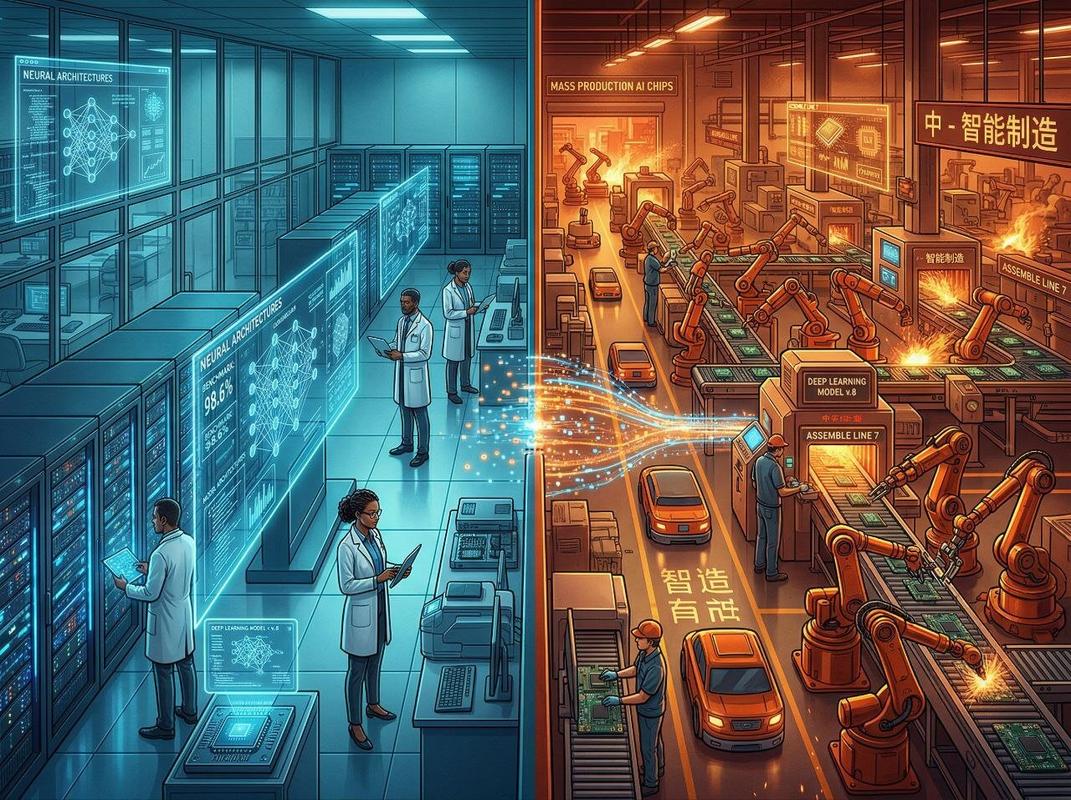
The AI race isn't just about who builds the smartest chatbot. It's about who deploys AI at scale across the real world—and China is winning that battle. While US labs obsess over benchmark scores and trillion-parameter models, China has quietly built a different kind of advantage: one rooted in open-source adaptation, manufacturing dominance, and the kind of real-world data that money can't buy.
This isn't the narrative you'll hear from Silicon Valley. The prevailing wisdom says America leads in AI because OpenAI, Anthropic, and Google DeepMind build the most capable frontier models. GPT-4, Claude, Gemini—these are the crown jewels of American AI supremacy. China, denied access to advanced chips by US export controls, is supposedly stuck in second place, forever trailing the cutting edge.
But a growing chorus of experts, including the US-China Economic and Security Review Commission, is sounding a different alarm. China's AI strategy operates in what researchers call "two reinforcing loops"—and those loops might prove more decisive than who has the biggest model.
The Two Loops: How China Is Building AI Dominance
Loop one is digital: China's "all in" embrace of open-source AI models. While American companies guard their weights and training methods like state secrets, Chinese developers are taking publicly available models—particularly from the open-weight ecosystem—and optimizing them for mass deployment at breathtaking speed.
The DeepSeek phenomenon exemplifies this approach. When DeepSeek released R1 as an open-weight model, it didn't just make AI accessible to developers with limited resources. It proved that China could build competitive AI despite chip restrictions. The model's trained parameters are publicly available, allowing rapid fine-tuning, deployment, and community-driven iteration across China's massive tech ecosystem.
This open-source strategy creates a virtuous cycle. More developers using and improving models leads to faster innovation. Faster innovation leads to more deployment. More deployment generates more feedback and use cases, which drives further improvement. While American companies spend months on safety testing and gradual rollouts, Chinese teams are deploying, learning, and iterating in weeks.
Loop two is physical: China's manufacturing dominance provides something no amount of GPU clusters can replicate—real-world deployment at scale. The country that produces the majority of the world's electronics, runs the most extensive logistics networks, and operates the largest manufacturing base has an unmatched laboratory for testing and improving AI systems.
Every factory floor, every warehouse, every autonomous vehicle on Chinese roads generates data. Not synthetic training data, not carefully curated datasets, but messy, real-world information about how AI systems actually perform when the stakes are real. A computer vision model trained on factory defects sees more variety in a week than a Western lab sees in a year. A logistics optimization algorithm handling China's e-commerce volume processes more edge cases in a day than most American systems handle in months.
This is the data advantage that doesn't show up in benchmark scores. It's the kind of real-world performance data that makes AI systems robust, reliable, and genuinely useful. And China is generating it at industrial scale—literally.
Deployment vs. Capability: Different Races, Different Winners
The US-China AI competition isn't really one race. It's two different competitions with different rules and different metrics for success.
America is winning the capability race. OpenAI's GPT-5, Anthropic's Claude, Google's Gemini—these are genuinely impressive technical achievements. They demonstrate creativity, reasoning, and knowledge synthesis that seemed impossible just years ago. American labs have access to more compute, more capital, and (for now) the best AI researchers money can buy.
But China is winning the deployment race. While American AI remains largely confined to chat interfaces and coding assistants, Chinese AI is being integrated into manufacturing, logistics, agriculture, and infrastructure. The gap between laboratory capability and real-world utility is where China is building its advantage.
Consider the implications. An AI system that scores perfectly on academic benchmarks but can't reliably operate in a noisy factory environment is, for many purposes, less useful than a simpler system that works consistently in the real world. China's approach prioritizes the latter—and they're getting very good at it.
The US-China Economic and Security Review Commission highlighted this dynamic in a recent report, noting that China has "embraced low-cost open-source models, optimising them for mass deployment and scaling." The emphasis isn't on building the most capable model. It's on building models that can be deployed widely, cheaply, and effectively.
The Chip War Paradox
America's strategy for maintaining AI leadership has centered on restricting China's access to advanced semiconductors. The logic is straightforward: without cutting-edge GPUs, Chinese companies can't train frontier models. Deny the chips, maintain the lead.
But this strategy may have backfired. Faced with chip scarcity, Chinese developers got creative. They optimized smaller models for efficiency. They embraced open-source architectures that don't require massive compute. They focused on deployment and iteration rather than training from scratch.
The result? China is building AI capabilities that are less dependent on American hardware. DeepSeek proved that competitive AI models can be built with limited resources. The open-source ecosystem means improvements are shared and compounded. And the manufacturing deployment loop generates value that doesn't require frontier-model scale.
Meanwhile, American AI remains heavily concentrated. A handful of companies control the most capable models. Access is gated by API keys and usage limits. Deployment is cautious, heavily monitored, and often delayed by safety concerns and regulatory scrutiny.
The chip restrictions didn't stop Chinese AI development. They redirected it toward approaches that may prove more scalable and more resilient.
The Data Advantage That Doesn't Show Up in Benchmarks
AI researchers love benchmarks. MMLU, HumanEval, GPQA—these standardized tests provide objective measures of model capability. American models consistently top these leaderboards, which seems to confirm US leadership.
But benchmarks measure a narrow slice of what matters. They test knowledge and reasoning in controlled conditions. They don't measure robustness, reliability, or real-world performance under messy, unpredictable conditions.
This is where China's manufacturing dominance creates an insurmountable data advantage. When you operate the world's largest manufacturing base, you see edge cases that don't appear in training datasets. When you run the most extensive logistics networks, you encounter scenarios that synthetic data can't replicate. When you deploy AI at scale across diverse industries, you learn what actually works.
The US-China Economic and Security Review Commission report emphasizes this point: China's physical loop of "large-scale deployment across manufacturing, logistics, and robotics... continuously generates real-world data to improve AI capabilities." This isn't theoretical. It's happening every day across China's industrial landscape.
American AI researchers might have better tools for measuring capability. Chinese practitioners have better data for building utility. In the long run, utility may matter more.
🔥 Hot Take: America Is Building the Wrong Kind of AI Lead
Here's the uncomfortable truth that Silicon Valley doesn't want to hear: America is optimizing for the wrong metrics. We're building AI systems that excel at benchmarks and struggle with deployment. We're celebrating trillion-parameter models that few can afford to run. We're guarding our innovations so closely that we're slowing the feedback loops that drive improvement.
Meanwhile, China is building AI that works—cheaply, reliably, and at scale. They're not trying to match GPT-5 parameter for parameter. They're trying to make AI useful across their entire industrial base. And they're succeeding.
The open-source vs. closed-source debate isn't just philosophical. It has strategic implications. Open models spread faster, improve faster, and get deployed faster. They create ecosystems rather than products. China's embrace of open-source AI isn't ideological—it's practical. They recognize that deployment velocity matters more than model size.
America's chip war strategy assumed that compute is the bottleneck. But China's response suggests that creativity, optimization, and real-world data matter just as much. By forcing China to develop efficient, deployment-focused AI, we may have accelerated the exact competition we were trying to prevent.
The manufacturing angle is particularly galling. We spent decades offshoring production to China, creating the industrial base that now generates their AI data advantage. We optimized for quarterly earnings and cheap consumer goods. They optimized for industrial capacity and supply chain control. Now that capacity is feeding their AI development in ways we can't easily replicate.
Some American analysts still dismiss China's AI capabilities as derivative, claiming they merely copy US innovations. This is dangerously complacent. Yes, China started with open-source models. But what they're building on that foundation—deployment at scale, real-world optimization, industrial integration—is genuinely innovative and potentially more transformative than incremental improvements to chatbot capabilities.
The race for artificial general intelligence (AGI) gets all the headlines. But the race for AI utility—the ability to deploy intelligent systems across the economy—is happening now, and China is winning. By the time AGI arrives, the countries that have mastered deployment will be best positioned to capitalize on it.
America needs to wake up. Our current strategy—frontier models, closed weights, chip restrictions—isn't delivering the dominance we expected. We need to get serious about deployment, about open-source ecosystems, about rebuilding the industrial base that generates real-world AI data. We need to compete on China's terms as well as our own.
Because right now, we're building the most impressive AI demos in the world. China is building the most deployed AI systems. And in the long run, deployment beats demos every time.
The AI race isn't over. But the path to victory may not look like we expected. Open-source, manufacturing dominance, and real-world data—these are China's weapons. And they're proving more potent than anyone in Silicon Valley wants to admit.