
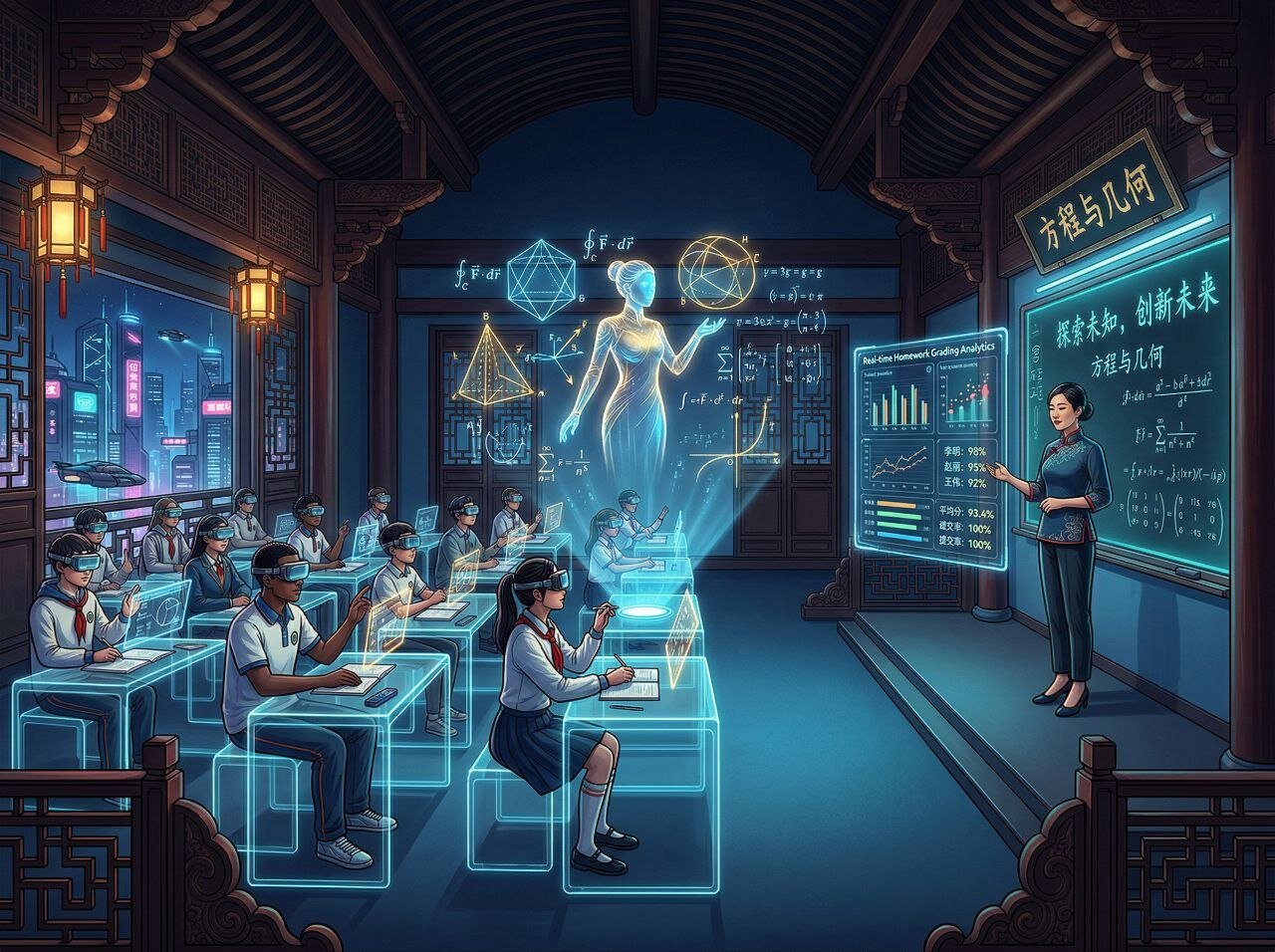
China just made a bold bet on the future of education. While Western schools debate whether to ban ChatGPT in classrooms, Beijing is going all-in — mandating AI literacy for every student, training teachers to use intelligent tutoring systems, and deploying machines to grade homework and prepare lessons.
On April 10, 2026, China's National Data Administration published a comprehensive action plan that doesn't merely suggest AI in education — it requires it. The policy calls for AI classes at every level of the education system, from primary schools to vocational training. Teachers must learn to work with AI assistants. Homework will be machine-graded. Lessons will be AI-prepared. And every classroom will become a data collection point for "evidence-based teaching research."
This isn't a pilot program in Shanghai or Shenzhen. This is national policy affecting 280 million students and 17 million teachers. And it raises a question that education systems worldwide will soon face: If China can scale AI education nationwide, what happens to countries that don't?
What China Actually Announced
The National Data Administration's action plan is remarkably detailed about how AI will transform Chinese education. Unlike the vague policy documents common in other countries, this reads like a technical implementation roadmap.
Curriculum integration is mandatory, not optional. The plan calls for AI classes to become part of the standard curriculum at all education levels — primary, secondary, vocational, and higher education. Chinese students will learn about AI not as an extracurricular activity, but as a core subject alongside math and science.
Teacher training is compulsory. Beijing isn't assuming educators will figure this out themselves. The policy explicitly requires training teachers to use AI tools in classrooms. The goal isn't to replace teachers but to make them "AI-augmented" — using intelligent systems to enhance their capabilities.
AI will handle the grunt work. The plan envisions AI systems that "assist teachers in managing homework, and promote intelligent grading, Q&A, and tutoring." Teachers currently spend hours grading assignments and answering repetitive questions. China's solution: Let machines handle the routine so humans can focus on the complex.
Classrooms become data collection environments. Perhaps most ambitiously, the policy calls for using "intelligent technology to analyze classroom teaching behavior" and "conduct evidence-based teaching research practices using artificial intelligence." Every interaction, every question, every moment of confusion becomes data to optimize the learning experience.
The Technical Vision: What This Actually Looks Like
Reading between the lines of policy-speak, China's education ministry is describing a comprehensive AI transformation that touches every aspect of schooling:
Digital textbooks will replace or supplement physical books. These won't be static PDFs — they'll be adaptive learning systems that adjust difficulty based on student performance, embed interactive simulations, and update content in real-time.
Smart MOOCs (Massive Open Online Courses) will get an AI upgrade. China's existing online education infrastructure — already among the world's largest — will incorporate intelligent tutoring systems that provide personalized feedback at scale.
Virtual simulation experiments will allow students to conduct dangerous or expensive science experiments in digital environments. Chemistry labs without chemical burns. Physics experiments without equipment costs. Biology dissections without the formaldehyde.
Immersive teaching spaces suggest VR/AR integration. Imagine history lessons where students walk through ancient Rome, or biology classes where they explore the inside of a cell. China's policy explicitly calls for building these environments nationwide.
Human-machine collaborative teaching is the endgame. The policy describes a future where AI systems and human teachers work together — each doing what they do best. Machines handle routine instruction, grading, and administrative tasks. Humans provide mentorship, emotional support, and complex problem-solving guidance.
The Security and Control Dimension
China's policy documents always include security considerations, and this one is no exception. But the security framework reveals as much about Beijing's concerns as its ambitions.
The plan calls for developing "security evaluation standards for AI applications in education" and ensuring "that the application of technology conforms to educational principles." This sounds benign, but in China's context, "educational principles" includes political education and ideological conformity.
More revealing is the emphasis on "genuine software" to ensure "safety, reliability, and controllability of AI applications." China doesn't want foreign AI systems — particularly American ones — shaping the minds of Chinese students. This is partly about data security, partly about technological sovereignty, and partly about controlling the information environment.
The policy also addresses risks that any education system would worry about: fraud, academic misconduct, exam-oriented learning, and privacy leaks. But China's approach to these problems will likely be more heavy-handed than Western alternatives. When AI systems detect cheating, the consequences in China won't be a warning letter — they'll be serious penalties that affect a student's entire academic trajectory.
Why This Matters Globally
China's AI education push isn't happening in isolation. It's part of a broader competition for technological supremacy that will shape the 21st century. And education is the battleground where that competition will be won or lost.
Human capital is the ultimate resource. China's population is aging. Its working-age population peaked in 2015 and has been declining since. The country can't rely on demographic dividends anymore — it needs productivity gains from better-educated workers. If AI can accelerate learning and improve educational outcomes, that's worth any investment.
The scale is unprecedented. When China implements a national education policy, it affects more students than the entire population of most countries. A 1% improvement in educational outcomes at China's scale translates to millions of better-prepared workers entering the global economy.
The data advantage is massive. China's AI education systems will generate training data that Western systems can't match. Every homework assignment, every test, every classroom interaction becomes data to improve AI tutors. More data means better models. Better models mean more effective education. It's a virtuous cycle that compounds over time.
The ideological dimension is real. China's education system has always been about more than skills — it's about shaping citizens. AI systems that grade homework can also assess political correctness. Intelligent tutoring systems can embed ideological content seamlessly. The same infrastructure that personalizes math instruction can personalize political indoctrination.
🔥 Our Hot Take: The West Is Sleepwalking Into an Education Gap
While China is building a comprehensive national AI education infrastructure, Western countries are still arguing about whether students should be allowed to use ChatGPT for homework. The gap in ambition is staggering — and potentially catastrophic.
American schools are banning AI tools because of cheating concerns. Chinese schools are mandating AI literacy because they recognize that students who can't work with AI will be unemployable in a decade. One approach prepares students for the future. The other protects an educational model designed for the industrial revolution.
The privacy concerns that dominate Western debates about AI in education aren't wrong — they're just irrelevant to the bigger picture. Yes, China's AI education systems will surveil students. Yes, that data could be misused. But Chinese students will still learn more, faster, with personalized instruction that adapts to their needs. Meanwhile, American students sit in classrooms designed in 1890, listening to lectures that don't adapt to their learning styles, waiting for overworked teachers to grade their papers by hand.
The uncomfortable truth is that China's approach — despite its surveillance implications, despite its ideological control, despite everything liberals find objectionable — might actually produce better educational outcomes. And if it does, the competitive implications are profound.
Imagine a world where Chinese graduates enter the workforce with years of experience working alongside AI systems, while their Western counterparts are just starting to learn what AI is. Where Chinese professionals are fluent in human-machine collaboration, while Western workers struggle to adapt. Where China's productivity gains from AI-augmented education compound decade after decade.
That's the world China's betting on. And right now, the West doesn't even seem to realize the bet has been placed.
The question isn't whether AI should be in classrooms. That ship has sailed. The question is which countries will use AI to transform education for the better — and which will cling to obsolete models while their competitors pull ahead. China's made its choice. The West needs to make theirs.