
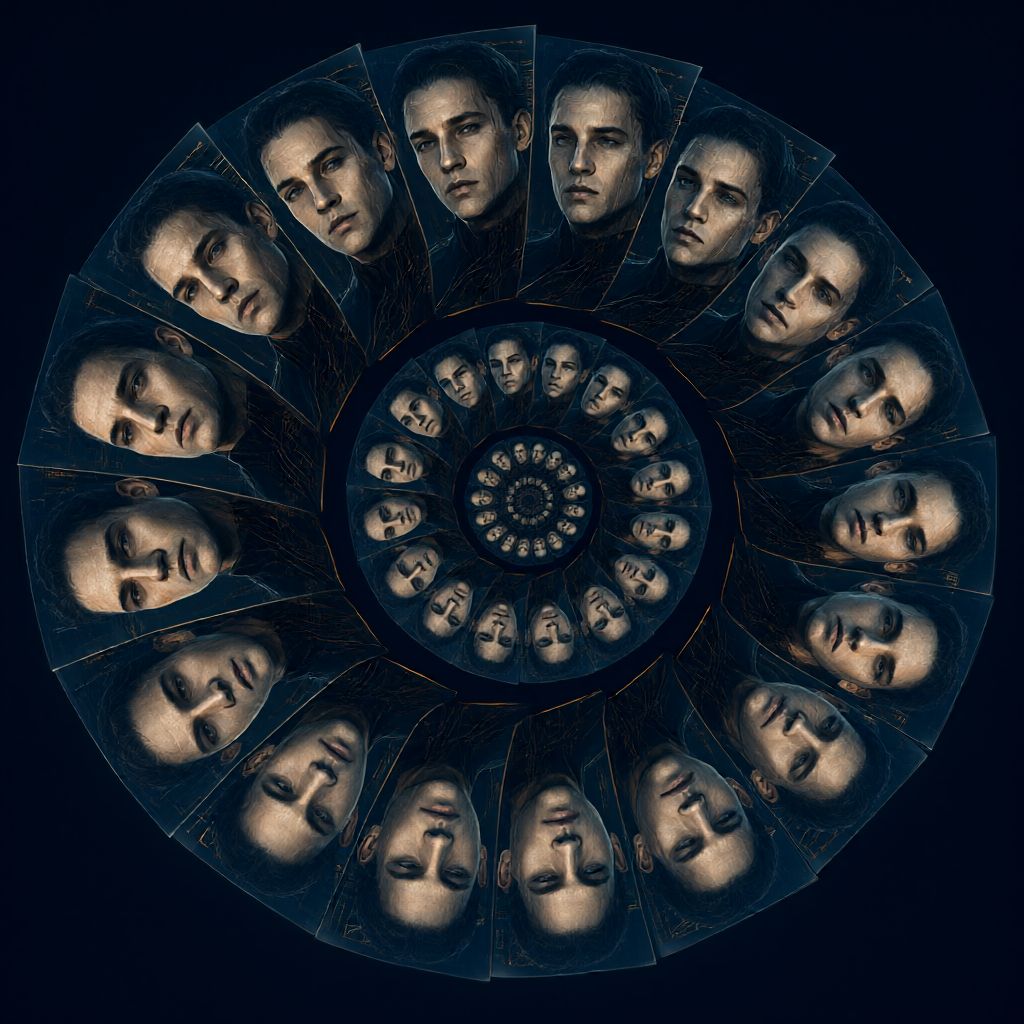
On November 9, ByteDance's Seed team posted a demo that would have drawn skepticism two years ago: one hundred consecutive edits to the same photograph of the same person. Edit one changes the ring on the ring finger. Edit two swaps the eyeglass frames for titanium. Edit fifty moves the light. By edit one hundred, the face still reads as the face, with no color drift, no melted details, no cumulative degradation. The unedited regions are, in ByteDance's phrasing, preserved at the pixel level.
That demo is the headline of Seedream 5.5, the newest model in ByteDance's image-creation line, and it aims at a specific sore point in professional design work: the moment an image model starts iterating, it starts lying. You ask for one thing to change, and it quietly renegotiates everything else. Do that a hundred times and you don't have the original photograph anymore. You have a stranger that resembles it.
The Hundred Is the Point
Multi-turn editing has been a known weakness of generative image systems. Each pass re-samples the canvas, and small errors compound. Design pipelines have worked around it for years. Mask everything you don't want touched, fix the seams by hand, re-light in post. Black Forest Labs' Flux 3 recently stood out in The Decoder for multi-step editing that "leaves the rest of your picture alone." Solved in principle, then. But nobody had claimed to hold the line through a hundred consecutive passes, and most shops never need one. A typical Western marketing asset doesn't survive a hundred rounds of edits before the budget runs out.
Seedream 5.5's claim is stronger than "we can take one hundred edits." It is that the model can take a hundred edits on the same canvas, with color stability, with occlusion and shadow staying physically coherent, with accessory-to-skin contact that still looks natural. ByteDance showed it in three demos. The portrait, first. Then a floral design pushed through four styles, realistic, still life, journal collage, traditional painting, where openwork lace, bead sheen, and stem texture survive the style shifts. And an old study that slowly becomes a colorful space, with a moving box in the foreground forcing the model to update perspective, occlusion, and cast shadows every time the room changes. Get the shadow wrong at round forty and the whole scene reads as fake, no matter how good that round looks on its own.
That is the part of the release that matters less to demo reels and more to factories. If an asset survives a hundred edit rounds without human cleanup, iteration stops being a cost and starts being free. Free iteration is what agent pipelines run on.
Three Upgrades, One Message
ByteDance frames 5.5 around three upgrades. The first is the stable multi-turn editing above. The second is native RGBA: direct alpha-channel output, full and partial transparency. Their example is a snowy owl whose wing feathers and claw outlines come out already transparent. No background removal, no edge cleanup, no clipping in a raster editor afterward. The model also takes reference brushwork, color, and material for text-plus-visual composition, and its character assets are reusable across projects. For a game or animation pipeline that is the difference between a model that makes images and a model that makes parts.
The third is realism and text. The model is tuned toward natural lighting, materials, and skin texture, and ByteDance explicitly targets the over-glossy, over-exposed look that has become its own genre in generated imagery. The text work is where it gets interesting: dense small English text in newspaper-style layouts, and Chinese infographic captions heavy with many-stroke characters. ByteDance reports text corruption in 0.4 percent of samples at the severe level and 1.7 percent at the minor level, on Chinese and English dense small text. Those numbers are theirs, not a lab's. But the direction matches every independent test of Chinese models on CJK text. They are simply better at it, because they were trained on it.
The Numbers, All Theirs
Seedream 5.5 was tested on ByteDance's own MagicArena platform across six professional use cases: e-commerce, marketing, film and television, gaming, office productivity, and fashion design, with experienced evaluators. Quality scores and usability rates improved over Seedream 5.0 Pro in all six. Film and television usability more than doubled, and office usability did the same. GSB expert pair-comparisons, the Good/Same/Bad format, came out positive against the previous version in all four comparisons, reaching +55.62 percent for realism in image-to-image tasks. Against GPT Image 2.5 Sunburst and Nano Banana 2.1, ByteDance claims a text-structure lead on both text-to-image and image-to-image, and a "substantial advantage" in text-to-image realism.
None of that is independently verified. Read it the way you would read any vendor evaluation: as a claim about the direction of the gap, not a measurement of its size. A +55.62 percent figure only means something when a third party reproduces it. Until then it is marketing with decimals.
Where It Ships, and What It Costs
Rollout is gradual: Jimeng, Doubao, Doubao Work, and Volcengine Ark, ByteDance's cloud. A Pro version of the 5.5 series is planned. ByteDance's post gives no price. Leiphone, via FourWeekMBA, puts the API at roughly 0.28 yuan per 2K square-image edit. That is less than half of Seedream 5.0 Pro's cost, and well under four US cents. The stated direction for what comes next is more complex contextual inputs, expanded use in agent workflows, and "more general visual intelligence." Notice what is not in the post: a model demo reel. They are positioning 5.5 as infrastructure, and the price point agrees.
The channel matters more than the model. The Seed team already shipped Seedance 2.5, the 4K, 10-bit film-production video model running through Volcano Engine, as we covered, and Seedance 2 was the engine behind the push into American and Hollywood production, more on that here. Seedream 5.5 is the image side of the same stack: same team, same cloud, same distribution logic. It also sits next to Alibaba's Qwen-Image-2.1, the 7-billion-parameter open-weights sibling we wrote about, which proved a Chinese lab can ship a competitive image model with a fraction of the parameters. Seedream is the closed, enterprise channel. Qwen is the open-weights escape valve. Between the two, Chinese image generation now covers both ends of the market.
What This Actually Means
Start with the e-commerce use case, because that is where the money is. China's live-commerce and product-photography industry is a massive asset economy. Taobao, Douyin, Pinduoduo, and Tmall sellers generate and retouch thousands of product images every day, and the cost of that retouch labor is one of the last line items in e-commerce that has not been automated. At 0.28 yuan per 2K edit, the price of a generated-and-refined asset drops below the cost of a minute of retoucher time. And the distribution is entirely domestic: Jimeng, Doubao, Volcengine, the Douyin ecosystem. This is a story about China's production pipeline, not a Western lab's API. While Western labs sell image edits by the dollar to a few thousand enterprise accounts, a Chinese cloud sells them by the cent to marketplaces with millions of SKUs.
The second point is the agent one. A hundred-round editing pipeline does not end with a designer at a prompt box. It ends with an agent that runs generate, refine, generate until the asset passes QA, without calling a human. ByteDance says it outright: agent workflows are the stated direction. When one edit costs 0.28 yuan and the canvas survives the loop, the marginal cost of trying again approaches zero. That is the production-workflow version of the value-capture gap we tracked in our piece on Chinese models taking 89 percent of open-source AI spend. The models get cheap, the workflow gets automated, and the margin stays with the provider.
Third, the Chinese-text moat is a distribution moat, not a model moat. The dense-small-text capability matters most where the market for dense small Chinese text actually lives: infographic captions, e-commerce listings, live-stream overlays, posters. That is exactly the corner where Western models still fumble. No one closes that gap with a better diffusion architecture. It compounds with every Chinese product listing, every Douyin overlay, every ad campaign, and the model that absorbs all of it gets better at it than any competitor training on English.
And fourth: the degradation problem, once solved, commoditizes the last premium step in the design pipeline. Human polish was the final defensible cost between a generated image and a shipped asset. If round one hundred looks as good as round one, the polish disappears with it.
🔥 Hot Takes
1. The designer is about to stop watching. The buyer of a hundred-round capability is an agent, not a person. A human cannot do a hundred edit rounds on a Tuesday afternoon. An agent can, and at cents a round it does not even count as a line item anymore. What that means for the creative middle class, the freelance retoucher, the listing photographer, the storyboard artist who lives on revision rounds, is the same thing it means for any hourly labor when the alternative is priced by the cent. The first creative job the agentic economy prices out is the one that was already iteration.
2. Image editing is becoming a utility, and utilities stop competing on quality. When the unit of work costs less than a cup of coffee, the question flips from "which model is best" to "who owns the pipeline." The margin of the creative economy is migrating to compute and distribution providers, and ByteDance already owns both ends of that equation: the model and the storefronts where it runs. The interesting question for anyone selling visual labor is no longer whether the machine will beat them. It is who will hold the invoice.
3. The quiet feature is RGBA, and it is the strategic one. Native alpha output and reusable character assets read like a checkbox on the spec sheet. Read them together and it is a bet on IP persistence: a character made in one project walks into the next, already transparent, already textured, already consistent. That is the asset-bank layer of generative media, and whoever owns that layer owns the franchise. ByteDance is not selling a model. It is selling a parts factory with a memory.
The Bottom Line
Seedream 5.5 is not the most impressive image model of 2026 in any single dimension. Flux 3 had the cleaner demo, and GPT Image 2.5 Sunburst probably still leads raw fidelity on the Western leaderboards. What 5.5 is selling is the loop: a hundred rounds on a stable canvas, native transparency, cent-level pricing, and an agent workflow that can run the loop without a human in it. That is not a model release. It is a claim on the economics of visual production, made out of the other side of the ocean, on infrastructure that is already built, at prices Western competitors cannot match without rewriting their cost structures. The design assembly line is here. The workers just have not been told.