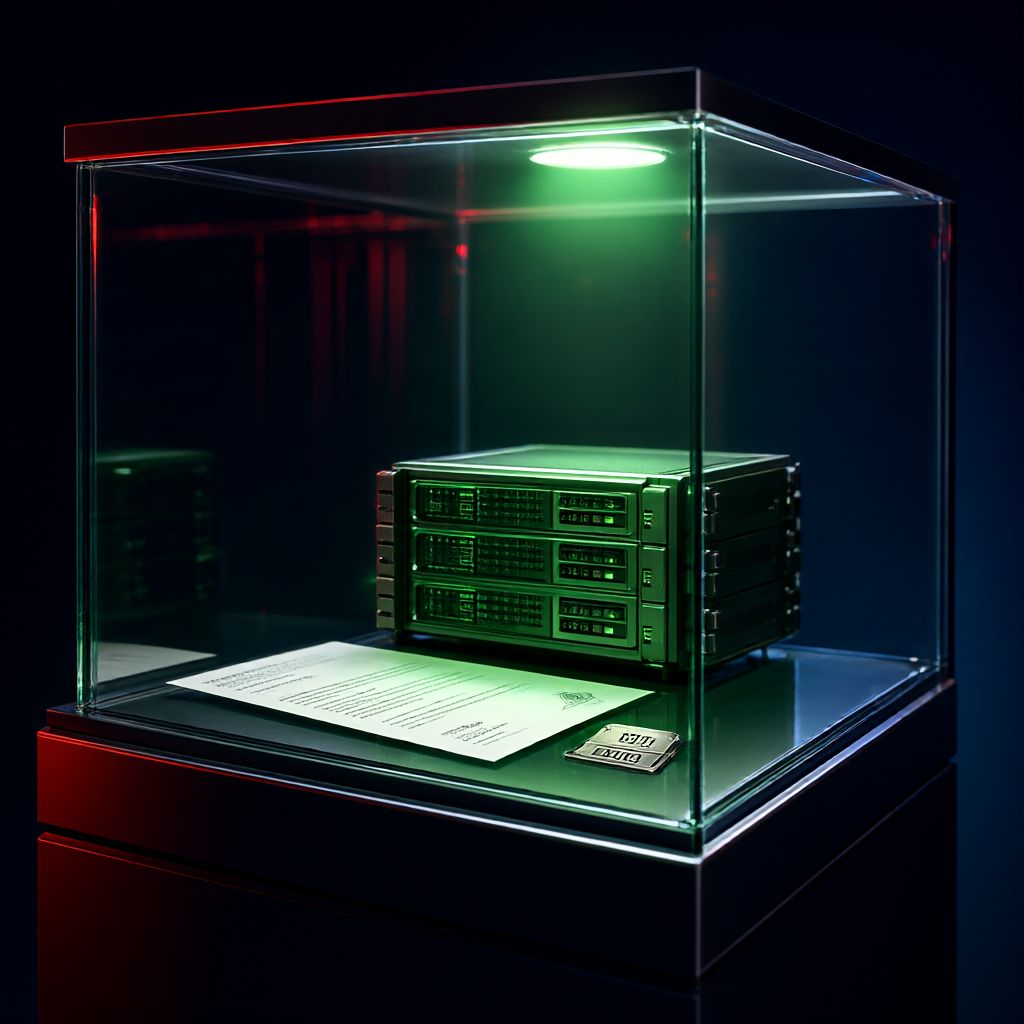
The document that names the rack is a loan file. Two Chinese companies installed Nvidia's Blackwell chips at a data center in Shanghai, and the way the installation became visible was not through a customs record or a shipment manifest, it was through a bank's collateral schedule. Shanghai Shuoyao offered a GB300-NVL72 rack as collateral for a loan of 96 million yuan, roughly 14 million dollars, from Shanghai Innovation Bank, and a second company, Shanghai Kezhan, listed a GB200 server at the same site in its own loan documents. The filings were made with Chinese regulators, and they were reviewed by Bloomberg, and the one detail that the whole story turns on is a serial number: the publication traced the rack to Gigabyte, the Taiwanese manufacturer, through a public warranty database.
The legal status of the hardware is not in doubt. Exporting these chips to China without a US license is banned, and the GB300 and the GB200 are the two generations of the flagship that the ban is about. The unusual fact is not that the chips are in Shanghai, the fingerprints report from the ex-OpenAI researcher made that a documented position a month ago, with Blackwell signatures inside six Chinese models. The unusual fact is that a bank priced the banned rack as collateral, and the pricing is the detail that tells you how ordinary the flow had become, because a company that can pledge a GB300 rack as security for a 96 million yuan loan is a company that holds the rack on its books as an asset, and the asset is the one that the export control is supposed to keep out of the country.
The Megaspeed file, now in three jurisdictions
The site has a name in the saga. Shanghai Shuoyao is closely tied to Megaspeed, the Singapore-based company that the Trump administration added to the US trade blacklist this month on suspicion of chip smuggling, and Megaspeed is the one that Alice Huang founded in 2023, and Nvidia approved it as a partner within four days of the founding, and it went on to be the company's largest customer in Southeast Asia. The site where the racks sit is tied to Alice Huang, and the Sunday report made the link public, the contact with the ministry's officer that ran for a year and a half, and the 240,000-chip receipt that the blacklisting closed out. Put the three facts together and the file now runs through three jurisdictions: the reseller in Singapore, the hardware in Shanghai, and the bank in between that took the chip as security. The blacklist named the first of the three. The loan file named the other two.
The second company in the site, Shanghai Kezhan, adds the second generation of the flagship to the schedule, the GB200 next to the GB300, which is to say, the site is not a one-rack story, it is a facility that was buying across two generations of the banned part, and the buying across generations is the fact that a collateral schedule makes visible in a way that a customs record would not, because the loan documents list what the company holds, and the holding is what the two generations tell you.
The first effect of the new rules
The timing is the detail that the rules were made to produce. The tightened export measures, the ones that reach the renting channel and the four-country shipment pause, are reportedly already causing headaches for the Chinese AI startups that the rules were aimed at, and the headaches are the first effect of the anti-diffusion doctrine, the doctrine that says the chip and the access to the chip are both the target. The fingerprints in the six models are the training side of the effect, and the loan file is the hardware side of it, and the two sides together are the proof that the parallel supply chain was running until the rules landed, and the running is what the rules are now stopping at the shipping stage, with the 90-day license window as the clock, and the secondary-market surge of the advanced chips as the tell.
What it means
The collateral line is the most revealing sentence in the file, and the sentence is the bank's. A 96 million yuan loan with a banned rack as security is the clearest statement yet about how normal the flow had become, because the bank's risk system did not treat the rack as a contraband item, it treated it as an asset, and the asset treatment is the one that says the chips had been moving long enough for the plumbing to adapt. The plumbing is the banks, the loan files, the collateral schedules, and the plumbing is what made the hardware visible, and the visibility is the enforcement path that was not there two years ago.
The enforcement is running on public data, and the data is a serial number in a warranty database. The chain of proof here does not need a customs seizure, it needs a filing, a serial, and a public record, and the three of them are what Bloomberg's report is built on. That is the shape of the next wave of enforcement: documents plus serials, not borders plus inspections, and the shape matters, because it is the one that works against a channel that was never built to be inspected at the border, it was built to be licensed, and the serial number bypasses the license.
The Megaspeed file is now a three-jurisdiction file, and the blacklist did not name the third. Singapore held the reseller, Shanghai holds the hardware, and the bank holds the loan, and the trade blacklist cannot reach the bank, because the blacklist is a trade instrument and the loan is a financial one. The financial side of the story is now a fact of the record, and the fact is the one that the next instrument, the one that is not a trade list, will have to be designed around.
The first effect of the new rules is already showing on the training side, and the training side is the fingerprints. The six models with the Blackwell signatures are the models that were trained on the chips, and the training was done before the rules, and the before is the one that the rules cannot reach, because the reach is the shipping stage, and the shipping stage is where the pause and the 90-day window are. The fingerprints stay in the models, and the staying is the part of the parallel supply chain that the anti-diffusion doctrine was not built to take out, and the taking out is the one that the next doctrine, if there is one, will have to add.
🔥 Hot Takes
1. The most revealing sentence in the story is a collateral line, and the line is the bank's. "Offered a GB300-NVL72 rack as collateral for a 96 million yuan loan" is the sentence that says the flow was ordinary, because the sentence is a bank's sentence, and the bank did not write it to flag the chip, the bank wrote it to price the security. The contraband had become the collateral, and the collateral is the fact that the two-year flow left behind, and the next enforcement instrument will be built around that fact.
2. The next BIS action will run on a public warranty database, and the database is the weapon. The serial number is the tell of the whole report: no seizure, no border, no inspection, just a filing, a serial, and a public record. That is the enforcement path that fits a channel built for licensing instead of customs, and the 90-day window and the shipment pause are already pricing that path, and the secondary-market surge made the pricing visible in a week.
3. The file now names three jurisdictions, and the one it names that the blacklist cannot reach is the bank. The reseller is in Singapore and is on the list, the hardware is in Shanghai and is on the collateral schedule, and the loan is the one that is on neither, because the loan is a financial instrument and the blacklist is a trade one. The third jurisdiction is where the next instrument has to be built, and the 14 million dollar number is the start of that building, and the next wave of the chip war is priced on it.
So the story of the week is the loan file, and the loan file is the one that named the rack, the site, and the company, and the serial number made the naming public. The 14 million dollars is the smallest number in the story, and the smallest number is the one that says the flow was ordinary enough for a bank to price it. The rack is in Shanghai, the serial is in a warranty database, and the third jurisdiction is waiting for the next instrument. The file is open: the blacklist started it, and the loan finished it.