
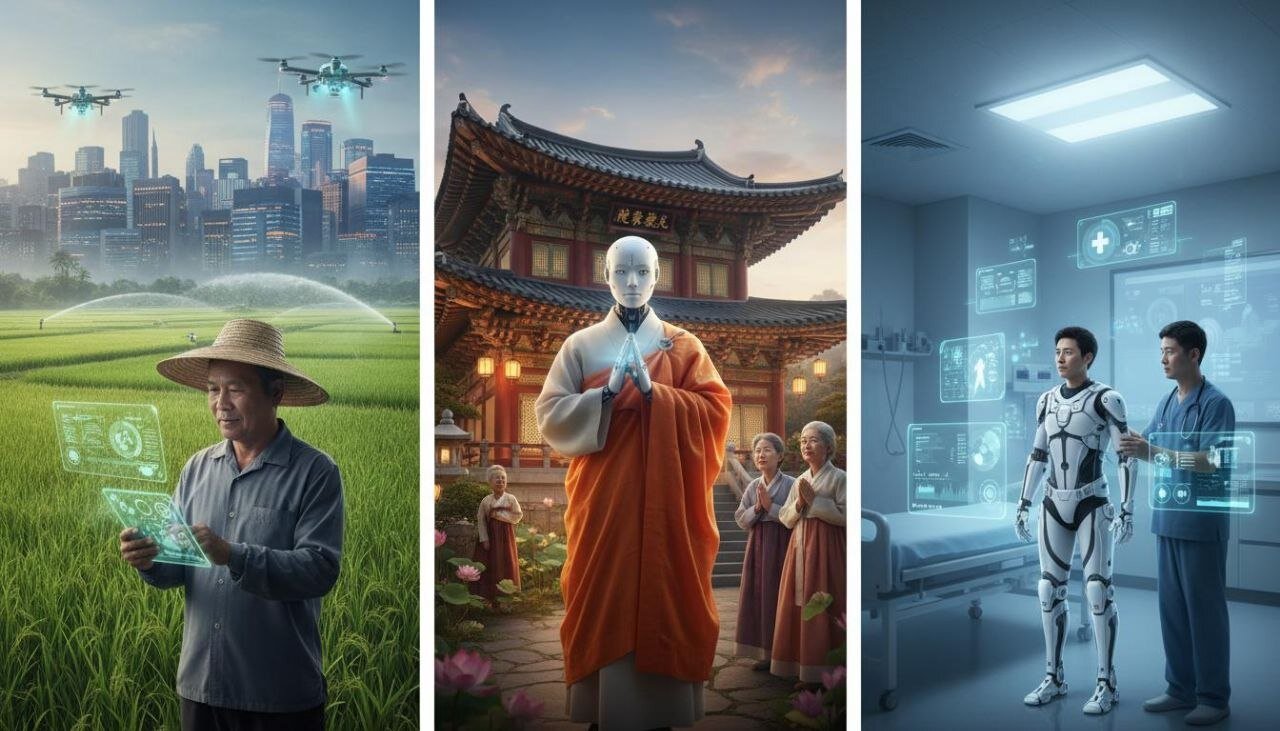
While Western AI debates job displacement and lawsuits, Asian companies are quietly deploying artificial intelligence into agriculture, healthcare, religious ceremonies, and corporate wellness. The second wave of AI isn't happening in chat interfaces. It's happening in the physical world.
For the past three years, the global AI conversation has been dominated by a single question: what can large language models do? ChatGPT writes essays. Claude codes software. Gemini summarizes documents. The competition has been entirely software-based — who has the bigger model, the longer context window, the better benchmark score.
But in Asia, a different narrative is unfolding. While American AI companies fire workers and sue each other, Asian AI companies are hiring engineers, building factories, and deploying their technology into industries that have nothing to do with chat. The second wave of AI — the physical wave — is happening faster in Asia than anywhere else, and the Western tech press is barely noticing.
The Farm Wave
One of the most striking examples is agriculture. In a sector that has resisted digitization for decades, AI is finally making inroads — not in California or Iowa, but in Asia.
miFood, a startup operating in China's agricultural heartland, has developed an AI-powered precision farming system that monitors soil conditions, crop health, and weather patterns in real time. The system doesn't just analyze data — it makes physical adjustments. Irrigation systems open and close based on AI predictions. Fertilizer dispensers calibrate dosage according to algorithmic recommendations. Pest detection cameras trigger targeted spraying rather than blanket pesticide application.
The result, according to early deployment data, is a 15-20% reduction in water usage and a 10% increase in crop yields — improvements that matter enormously in a region where agricultural land is scarce and food security is a strategic priority. Unlike Western agtech startups that have struggled to scale beyond pilot programs, miFood is already operating across multiple provinces and expanding into Southeast Asia.
The agricultural AI trend is not limited to China. In Indonesia, where smallholder farmers dominate the agricultural landscape, Korean AI healthtech companies are pairing agricultural monitoring with healthcare modernization — recognizing that rural health and rural productivity are inseparable challenges. The same sensors that track crop health can track human health, and Asian governments are increasingly treating these as unified infrastructure projects rather than separate domains.
The Hospital Wave
If agriculture represents AI's expansion into rural physical space, healthcare represents its penetration into the most intimate physical space of all: the human body.
Neurabody, a corporate wellness startup operating across East Asia, has developed what it calls "Physical AI" — a system that uses wearable sensors and computer vision to detect early signs of musculoskeletal strain, cardiovascular stress, and neurological deterioration before symptoms become clinically apparent. The technology is being deployed not in hospitals but in offices, factories, and warehouses, where it monitors workers' physical states in real time and recommends ergonomic adjustments, break schedules, and medical consultations.
The implications are significant. In a region where aging populations and labor shortages are simultaneously squeezing the workforce, Physical AI offers a way to extend working lifespans and reduce injury-related downtime. South Korean manufacturing conglomerates have been early adopters, installing Neurabody systems in production facilities and reporting measurable reductions in workplace injury rates.
Meanwhile, Indonesia's healthcare modernization push has created an opening for Korean AI healthtech firms to enter one of Southeast Asia's largest markets. The Indonesian government, under its "Healthy Indonesia" program, is digitizing health records, deploying telemedicine infrastructure, and importing AI diagnostic tools that can operate in settings where specialist doctors are scarce. Korean companies, with their combination of advanced semiconductor manufacturing and government-backed healthtech R&D, are well-positioned to capture this market.
The Western AI conversation around healthcare has focused almost entirely on diagnostic AI — algorithms that read X-rays or analyze pathology slides. The Asian healthcare AI wave is broader, incorporating wellness monitoring, supply chain optimization, and infrastructure deployment. It is less about replacing doctors and more about extending the reach of healthcare systems into populations that have never had adequate access.
The Robot Wave
No sector better illustrates Asia's physical AI ambition than robotics. While American robotics companies like Boston Dynamics produce impressive demo videos, Asian robotics companies are producing deployments.
Unitree, the Chinese robotics company behind the G1 humanoid robot, made global headlines when one of its machines was ordained as a Buddhist monk in a South Korean temple — a world-first ceremony that sounds like a gimmick but represents something deeper. The robot, which can perform ritual gestures and recite sutras, is part of a broader deployment of humanoid robots into service roles across Asia. Temples, airports, shopping malls, and elderly care facilities are all becoming early adoption sites.
The logic is demographic. South Korea has the world's lowest birth rate. Japan's population is shrinking by half a million people annually. China's working-age population peaked in 2015 and has been declining since. In this context, humanoid robots are not a novelty — they are a necessity. A robot that can assist elderly temple visitors, guide travelers through airports, or provide companionship in nursing homes is addressing a labor shortage that has no other solution.
Exoskeletons represent another frontier. While Western companies have developed impressive military and medical exoskeletons, Asian companies are commercializing lightweight, affordable versions for industrial and consumer use. Chinese manufacturers are already producing exoskeletons that warehouse workers can wear for under $5,000 — a price point that makes them accessible to small and medium enterprises, not just military budgets. The bet is that as populations age and manual labor becomes scarcer, exoskeletons will become standard industrial equipment, like hard hats or safety gloves.
The Infrastructure Wave
Behind all these physical deployments is an infrastructure buildout that dwarfs anything happening in the West. TikTok has won approval for a $25 billion data center expansion in Thailand, part of a broader Southeast Asian infrastructure push that will support not just social media but AI inference, cloud computing, and digital services across the region.
The scale of this investment is hard to overstate. $25 billion is more than the total market capitalization of many Western AI startups. It represents a commitment to physical infrastructure — fiber optic cables, power substations, cooling systems, and specialized AI chips — that will enable the next decade of Asian AI deployment.
ByteDance, TikTok's parent company, is simultaneously testing paid subscriptions for its AI chatbot Doubao in China — a monetization push that suggests the company believes its AI products are mature enough to charge for. While Western AI companies like OpenAI and Anthropic have struggled to convert free users to paid subscriptions, ByteDance is betting that Chinese consumers will pay for AI assistants integrated into shopping, entertainment, and productivity workflows.
China Mobile, the state-owned telecom giant, is launching an AI-eSIM product that will embed AI capabilities directly into mobile network infrastructure. Rather than running AI applications on phones, the AI-eSIM model processes data at the network edge — reducing latency, preserving battery life, and enabling AI features on devices that lack the processing power to run large models locally. It is a fundamentally different architecture from the Western approach of running everything on-device or in the cloud, and it reflects China's unique position as both a telecom operator and a technology developer.
The Governance Gap
One of the most revealing findings from monitoring Asian AI coverage is the relative absence of the governance debates that consume Western media. While American outlets obsess over AI safety, copyright infringement, and job displacement, Asian coverage focuses on deployment, scaling, and integration.
That is not because Asian governments are unconcerned about AI risks. China recently ordered major tech platforms to tighten algorithm rules, imposing stricter controls on recommendation systems and content distribution. The difference is that Asian regulation tends to be enabling rather than restrictive — designed to channel AI development in directions that serve national priorities rather than to slow it down.
The Western AI governance model, with its emphasis on safety testing, copyright protection, and labor market preservation, has produced a cautious, litigation-prone ecosystem. The Asian model, with its emphasis on infrastructure investment, industrial application, and demographic necessity, has produced a deployment-focused ecosystem. Both have risks. The Asian approach risks deploying immature technology at scale. The Western approach risks ceding the physical AI frontier to competitors while debating hypotheticals.
The Bigger Picture
The divergence between software-focused Western AI and physical-focused Asian AI reflects deeper structural differences. The United States has an abundance of software talent, venture capital, and intellectual property lawyers. Asia has an abundance of manufacturing capacity, government coordination, and demographic pressure. Each region is developing the AI that its strengths and constraints demand.
But the physical AI wave may ultimately matter more than the software wave. Software AI — chatbots, coding assistants, image generators — is impressive but limited in its economic impact. Physical AI — robots, agricultural sensors, healthcare monitors, industrial exoskeletons — transforms actual production processes and addresses actual resource constraints. The country that leads in physical AI will lead in the industries that matter for the next century: food production, healthcare delivery, elderly care, and manufacturing.
The United States is not absent from this competition. Tesla's Optimus robot, Boston Dynamics' Atlas, and various agricultural robotics startups all represent American entries in the physical AI race. But the ecosystem as a whole — the combination of government support, corporate investment, manufacturing base, and demographic urgency — currently favors Asia.
The irony is that the physical AI wave may be less visible to Western observers precisely because it is less sensational. A robot monk in a Korean temple does not generate the headlines of a chatbot that passes the bar exam. An AI-powered irrigation system in rural China does not trigger the same commentary as a large language model that writes poetry. But the former is changing the world faster than the latter — and Asia is building it while the West is still arguing about the implications of the last wave.
AgentBear exclusive analysis. Sources: TechNode, AsiaTechDaily, Reuters, Bloomberg.
Sources: TechNode, AsiaTechDaily, Reuters, Bloomberg, CNBC, South China Morning Post