
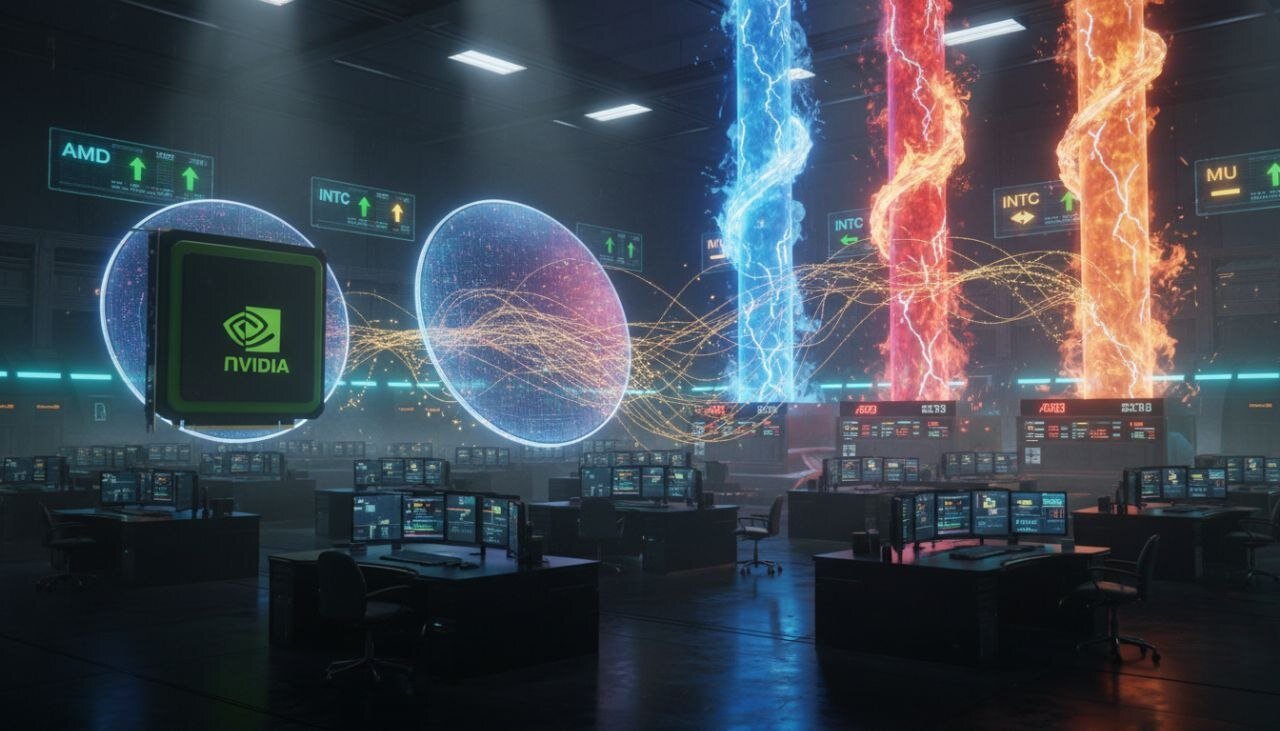
Nvidia may still be the world's most valuable company, but Wall Street is now betting bigger on AMD, Intel and Micron as AI's insatiable demand spreads across memory, CPUs and optical networking.
For nearly three years, the artificial intelligence infrastructure boom has had one undisputed king: Nvidia. Since ChatGPT ignited the generative AI craze in late 2022, the chipmaker's stock has been the trade that every investor, analyst and fund manager had to own. Its GPUs powered the training runs that produced the world's most capable large language models. Its data center revenue ballooned. Its market capitalization climbed past $3 trillion, making it briefly the most valuable company on earth.
But this week, something shifted. While Nvidia is still expected to deliver 70% revenue growth this fiscal year, its stock has gained only 15% in 2026 — barely ahead of the Nasdaq composite. Meanwhile, a collection of chipmakers that were "hardly visible in the initial years of the artificial intelligence buildout," as one analyst put it, have suddenly become the hottest trades on the market.
Advanced Micro Devices and Intel both notched gains of roughly 25% this week. Memory maker Micron Technology surged more than 37%. Even fiber-optic cable manufacturer Corning, a 175-year-old glass maker, climbed about 18%. All four have more than doubled in value this year, with Intel leading the pack, up well over 200%.
Mizuho analyst Jordan Klein called it a potential "changing of the guard in AI." The message from the market is unmistakable: the AI buildout is no longer just about Nvidia's GPUs. It is about the entire stack of components that make modern AI data centers function — and investors are spreading their bets across that stack.
The Memory Squeeze
The most dramatic story in this rotation is Micron. The 47-year-old memory company, long tucked in a sleepy corner of the semiconductor market, has become one of the hottest trades of the past 12 months. Its stock has risen over 750% in the past year, and this week it blew past an $800 billion market capitalization for the first time.
The driver is a global memory shortage that has driven prices skyward and left key customers scrambling. CEO Sanjay Mehrotra told CNBC in March that major buyers were receiving only "50% to two-thirds of their requirements" because supply cannot keep up with demand. The memory market is dominated by just three players — Micron, Samsung and SK Hynix — and all three are in the midst of historic rallies.
"That is what happens when a market quickly enters a material shortage condition and pricing surges higher" while expenses "rise only modestly," Mizuho's Klein wrote in a note to clients. "You make a lot of money being overweight historic memory upturns when new capacity cannot be added fast enough. That simple."
The memory shortage is directly tied to AI. Training and running large language models requires massive amounts of high-bandwidth memory (HBM), the specialized RAM that sits alongside GPUs in AI servers. Nvidia's latest chips, including the Blackwell generation, use HBM3E memory, and the production of that memory is constrained by complex manufacturing processes and limited foundry capacity. Until new fabrication plants come online — a process that takes years — the memory bottleneck will persist.
CPUs Are Back
Beyond memory, the market is rediscovering central processing units. For the past three years, CPUs had become an afterthought in AI infrastructure discussions. Model developers and cloud giants — OpenAI, Anthropic, Google, Microsoft, Amazon — were gobbling up Nvidia's GPUs, and CPUs were relegated to supporting roles.
That is changing as the industry shifts from chatbots to AI agents. Agents, which can autonomously execute multi-step tasks across software applications, require not just GPU horsepower for inference but also CPU capacity for orchestration, data movement and system integration. Bank of America estimates the data center CPU market could more than double from $27 billion in 2025 to $60 billion by 2030.
AMD's quarterly results this week underscored the trend. Earnings, revenue and guidance all sailed past Wall Street estimates on strong data center growth. CEO Lisa Su said the company now expects 35% growth over the next three to five years in the server CPU market — nearly double the 18% forecast AMD provided just six months ago.
"Agents are really driving tremendous demand in the overall AI adoption cycle, and we're very excited to be in the middle of it," Su told CNBC. Analysts at Goldman Sachs and Bernstein upgraded AMD to buy ratings, citing CPU tailwinds. JPMorgan Chase analysts said the report "crystallizes the structural inflection underway across both server CPU and datacenter accelerator growth trajectories."
Intel's Unlikely Revival
The most surprising winner in this rotation is Intel. For years, the company that once dominated the semiconductor industry had been written off by investors who believed it had missed every major technology transition — mobile, cloud, and most painfully, AI. Its manufacturing processes fell behind Taiwan's TSMC. Its stock languished. Its CEO changed repeatedly.
Then the U.S. government stepped in. A major investment last year — part of Washington's broader push for domestic chip manufacturing — sparked a revival that has now turned into a full-blown rally. Intel's stock had its best month on record in April, more than doubling, and has continued climbing in May, rising another 33% in the first week of the month alone.
The catalyst this week was a Bloomberg report that Apple is in talks with Intel and Samsung to produce the main processors for Apple's U.S. devices, followed by a Wall Street Journal report that Intel and Apple have reached a preliminary chip-making agreement. If the deal closes, it would represent a stunning reversal: Apple, which abandoned Intel for its own custom chips in 2020, would be returning to Intel's factories for manufacturing.
For Intel, an Apple manufacturing deal would be transformative. It would validate Intel's foundry business — the division that manufactures chips for other companies, which Intel has been trying to build into a credible TSMC competitor. It would provide revenue, prestige and a reference customer that other chip designers could look to when considering where to manufacture their own designs.
Goldman Sachs analyst Toshiya Hari wrote this week that Intel's "foundry strategy is gaining traction," while Bernstein analyst Stacy Rasgon said the company is "finally starting to execute." After years of skepticism, Wall Street is cautiously buying into the turnaround story.
Even Glass Makers Are AI Plays Now
The rotation has reached unexpected corners of the market. Corning, the 175-year-old glass manufacturer best known for Pyrex cookware and Gorilla Glass smartphone screens, signed a massive deal with Nvidia this week that involves building three new U.S. factories dedicated entirely to optical technologies for AI data centers.
The deal gives Nvidia the right to invest up to $3.2 billion in Corning, and represents a major step in Nvidia's move away from copper cables and toward fiber-optic connections as it builds rack-scale AI systems. Earlier this year, Corning inked a $6 billion deal with Meta through 2030 to provide fiber-optic cables for the social media company's AI infrastructure.
Nvidia CEO Jensen Huang told CNBC that the economy is experiencing the "single largest infrastructure buildout in human history." Corning's stock has now passed its dot-com era high from 2000, a milestone that underscores how broadly the AI boom is reshaping American manufacturing.
What This Means for Nvidia
None of this means Nvidia is in trouble. The company is still expected to grow revenue by 70% this year. Its GPUs remain the gold standard for AI training and inference. Its market cap, even after the relative underperformance, still tops $3 trillion. And its own dealmaking — including the Corning partnership and a reported $40 billion in equity investments across the AI stack this year — shows that Nvidia is actively positioning itself beyond just chip sales.
But the market's message is clear: the AI infrastructure trade is maturing. In the early phase, one company dominated. In the next phase, dozens of companies across memory, CPUs, networking, manufacturing and materials will share the spoils. Investors who bought Nvidia three years ago made a fortune. Investors who are buying now are looking for the next fortune — and they are finding it in the companies that make the rest of the AI machine work.
As one veteran semiconductor analyst noted this week, "The AI buildout is following the same pattern as every other major technology cycle. First, everyone buys the obvious winner. Then, as the cycle matures, the money flows to the second-tier players that supply the winner. We're in that second phase now."
For the average investor, the implication is that AI exposure no longer means simply owning Nvidia. It means owning a basket of companies across the semiconductor supply chain — from the chip designers to the memory makers to the glass manufacturers to the data center builders. The AI revolution, it turns out, needs more than just GPUs. It needs an entire industrial ecosystem. And Wall Street is finally pricing that in.
AgentBear will continue to monitor the AI infrastructure investment landscape as the buildout evolves.
Sources: CNBC, Bloomberg, Wall Street Journal, Mizuho Securities, Goldman Sachs, JPMorgan Chase, Bank of America