
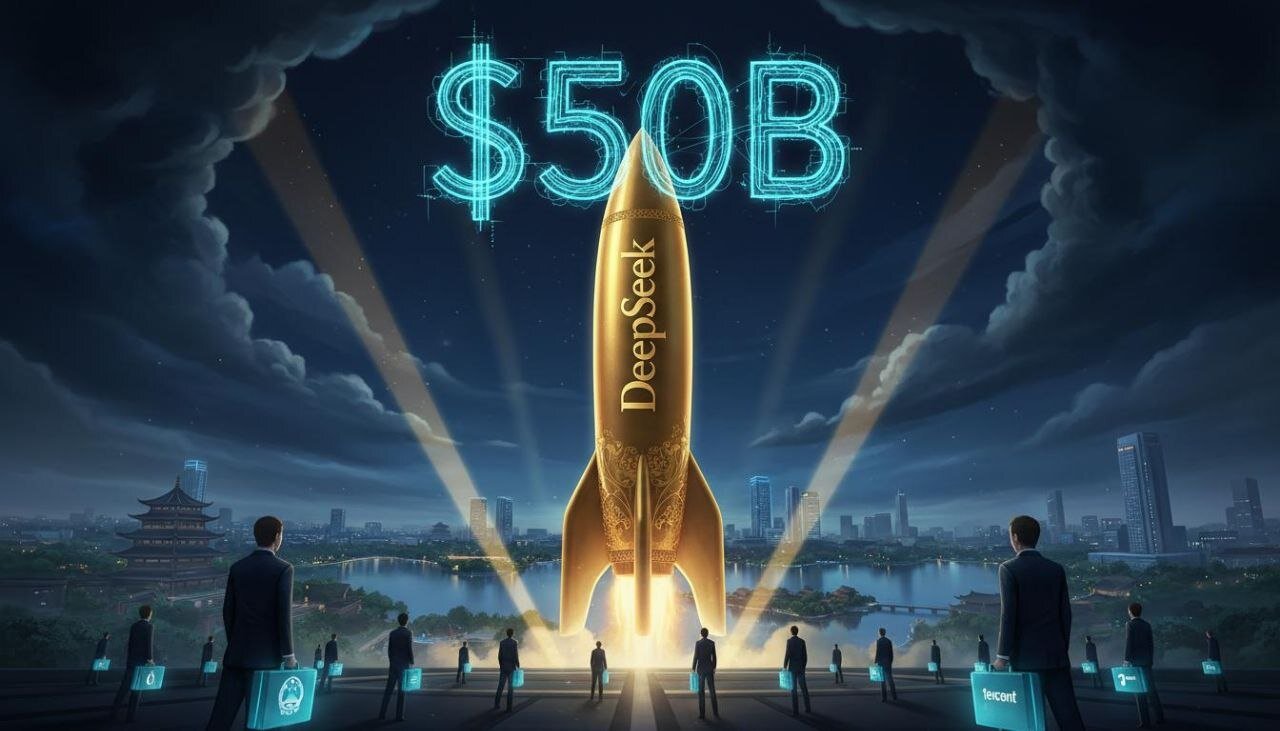
In just two weeks, the Hangzhou AI lab's price tag has quintupled from an initial $10 billion report as state-backed investors and Tencent pile in.
Chinese artificial intelligence startup DeepSeek is expected to close its first-ever external financing round imminently, with its valuation now reaching up to $50 billion — a staggering five-fold increase from the $10 billion figure local media reported just last month. The round, which was initially pegged at $45 billion in earlier reports, has drawn in some of China's most powerful state-backed investment vehicles, underscoring the company's status as a national technology champion in Beijing's AI race against the United States.
Three people familiar with the matter told the South China Morning Post that the round is being backed by a coalition of state-linked investors, including AI-focused affiliates under the third phase of the China Integrated Circuit Industry Investment Fund — better known as the "Big Fund III." The fund, which is Beijing's marquee state-backed investment vehicle for the semiconductor and AI sectors, has previously targeted strategic domestic technology companies as part of China's broader push for technological self-sufficiency.
Shenzhen-based Tencent Holdings, China's largest gaming and social media conglomerate, has also taken part in the round, according to the same sources. Hillhouse, a prominent global investment firm, was additionally said to be involved in the funding discussions, though a Hillhouse spokesman told the Post that the firm was not making an investment in DeepSeek. The final valuation could still shift as talks remain ongoing, the sources cautioned.
DeepSeek, the Big Fund III, and Tencent did not immediately respond to requests for comment.
From $10 Billion to $50 Billion in Two Weeks
The speed of DeepSeek's valuation ascent has been unprecedented even by the standards of the AI boom. When local media first broke news of the Hangzhou-based frontier AI lab's fundraising ambitions in April 2026, the reported valuation sat at $10 billion — already a significant figure for a two-year-old startup that had, until then, rejected all external funding. Within days, that figure had reportedly climbed to $20 billion, then $45 billion according to the Financial Times and Bloomberg earlier this week. Now, with the "Big Fund III" and Tencent in the mix, sources say the number has reached $50 billion.
This trajectory reflects not merely investor enthusiasm but strategic national interest. DeepSeek's breakthrough with its V3 and R1 model families — which achieved near-state-of-the-art performance at a fraction of the training cost of American rivals like OpenAI and Anthropic — sent shockwaves through Silicon Valley in early 2026. The company's ability to train competitive large language models using fewer and less advanced Nvidia chips, largely through algorithmic innovation rather than brute-force compute, made it a symbol of Chinese technological resilience in the face of U.S. export controls.
The comparison to Western AI valuations is instructive. At $50 billion, DeepSeek would command a valuation per dollar of compute efficiency that no American competitor can match. OpenAI, despite its $100 billion-plus ambitions, has raised billions in capital and burns through estimated hundreds of millions monthly in compute costs. Anthropic, backed by Amazon and Google, operates on a similar scale. DeepSeek's reported training cost for its R1 model — approximately $6 million — became a meme in Silicon Valley precisely because it suggested that the capital arms race in AI might not be the only path to competitive models.
For Beijing, DeepSeek represents something beyond a commercial success story. It is proof of concept that China's AI sector can innovate its way around American semiconductor restrictions — a narrative that has drawn intense interest from state-backed investors whose mandates extend beyond financial returns to national strategic objectives.
Strategic Resources Over Capital
Perhaps the most telling detail in the Post's reporting is DeepSeek's apparent investor selection strategy. Sources previously told the newspaper that the company is prioritizing state-backed and industrial investors — including local government guidance funds and affiliated platforms — over purely financial investors. The preference, according to these sources, is for backers who can provide strategic resources such as AI infrastructure rather than those who can only offer capital.
This approach signals that DeepSeek views its first external round not as a simple cash injection but as a coalition-building exercise. In an era where access to advanced AI chips is restricted by U.S. export controls, having state-backed partners with the ability to secure, build, or subsidize compute infrastructure could prove more valuable than the money itself. Local government guidance funds, for instance, often have mandates to support regional technology ecosystems and may have preferential access to land, power, or domestic chip supply chains.
Tencent's participation adds another dimension. As China's dominant social media and gaming platform, Tencent brings distribution reach that few other investors could match. WeChat, with its billion-plus monthly active users, represents a potential channel for AI services that could rival anything in the Western ecosystem. For DeepSeek, Tencent's involvement could mean a fast track to consumer and enterprise adoption that would otherwise take years to build.
The synergy is not merely theoretical. Tencent has been aggressively integrating AI into its own products, from WeChat's AI assistant to its gaming platforms. A strategic investment in DeepSeek could provide Tencent with preferential access to the startup's model weights and research, accelerating Tencent's own AI roadmap while giving DeepSeek a distribution channel that no purely financial investor could replicate.
The preference for strategic over financial investors also reflects a broader trend in Chinese technology funding. In an environment where U.S. dollar-denominated venture capital has become scarcer due to geopolitical tensions and capital controls, Chinese startups are increasingly turning to domestic corporate investors and state-linked funds. These investors offer not just money but political cover, preferential regulatory treatment, and access to government contracts that foreign-funded competitors cannot match.
The Big Fund III: Beijing's Semiconductor War Chest
The involvement of the "Big Fund III" is particularly significant. The China Integrated Circuit Industry Investment Fund is Beijing's primary vehicle for funneling state capital into the semiconductor sector, with each phase representing a multi-billion-dollar commitment to reducing China's dependence on foreign chip technology.
The first phase, launched in 2014, raised approximately $22 billion. The second phase, announced in 2019, reportedly raised around $29 billion. The third phase, which began deploying capital in 2024, is said to be even larger — with estimates suggesting a $48 billion or greater war chest. While the fund has faced scrutiny over management issues and corruption investigations in past phases, it remains the most important state-backed vehicle for China's chip ambitions.
For DeepSeek to draw investment from Big Fund III affiliates signals that Beijing views frontier AI not merely as a software competition but as an extension of the semiconductor battle. The reasoning is straightforward: the most advanced AI models require the most advanced chips, and if China cannot access those chips through trade, it must either develop domestic alternatives or find algorithmic workarounds. DeepSeek's demonstrated ability to do the latter has made it a strategic asset worth backing with state capital.
Hillhouse Denies Involvement
Among the reported participants, Hillhouse's denial stands out. The global investment firm, which has backed some of China's most successful technology companies including Tencent and JD.com, told the South China Morning Post through a spokesman that it was not making an investment in DeepSeek. This contradiction between sources' claims and Hillhouse's public statement introduces an element of uncertainty into the reporting — either the sources were mistaken about Hillhouse's involvement, or the firm is choosing not to disclose its participation at this stage.
In China's opaque private funding environment, where state-linked investment vehicles often operate through complex subsidiary structures, it is not uncommon for institutional investors to participate indirectly through affiliated funds or special-purpose vehicles. Whether Hillhouse's denial reflects a genuine absence of involvement or simply a preference for keeping its participation undisclosed remains unclear.
What $50 Billion Means for the AI Landscape
A $50 billion valuation would place DeepSeek in rarefied company among AI startups globally. At that price, the Hangzhou lab would be worth more than established players like Anthropic (last valued at approximately $18 billion in late 2025) and within striking distance of Databricks (valued at $43 billion). It would still trail OpenAI, which has reportedly sought valuations above $100 billion in its own fundraising discussions, but DeepSeek's valuation trajectory — having gone from zero external funding to $50 billion in a matter of weeks — is arguably more dramatic than any comparable company's history.
The valuation also reframes the competitive dynamics between American and Chinese AI. U.S. sanctions, designed in part to slow China's AI progress by restricting access to advanced chips, have instead produced a domestic champion whose valuation now rivals the most valuable American AI startups. Whether that valuation is fully justified by fundamentals or partially inflated by strategic national interest is a question that will only be answered over time — but for now, the market, and Beijing, have spoken.
For DeepSeek itself, the influx of capital and strategic resources could accelerate its next-generation model development. The company has already demonstrated that it can compete with American frontier labs on a shoestring budget relative to its rivals. With $50 billion in backing and state-linked partners providing infrastructure support, the question is no longer whether DeepSeek can compete — but how far ahead it might run.
This story is developing. AgentBear will continue to monitor DeepSeek's fundraising as details emerge.
Sources: South China Morning Post, Financial Times, Bloomberg, TechCrunch, Reuters