
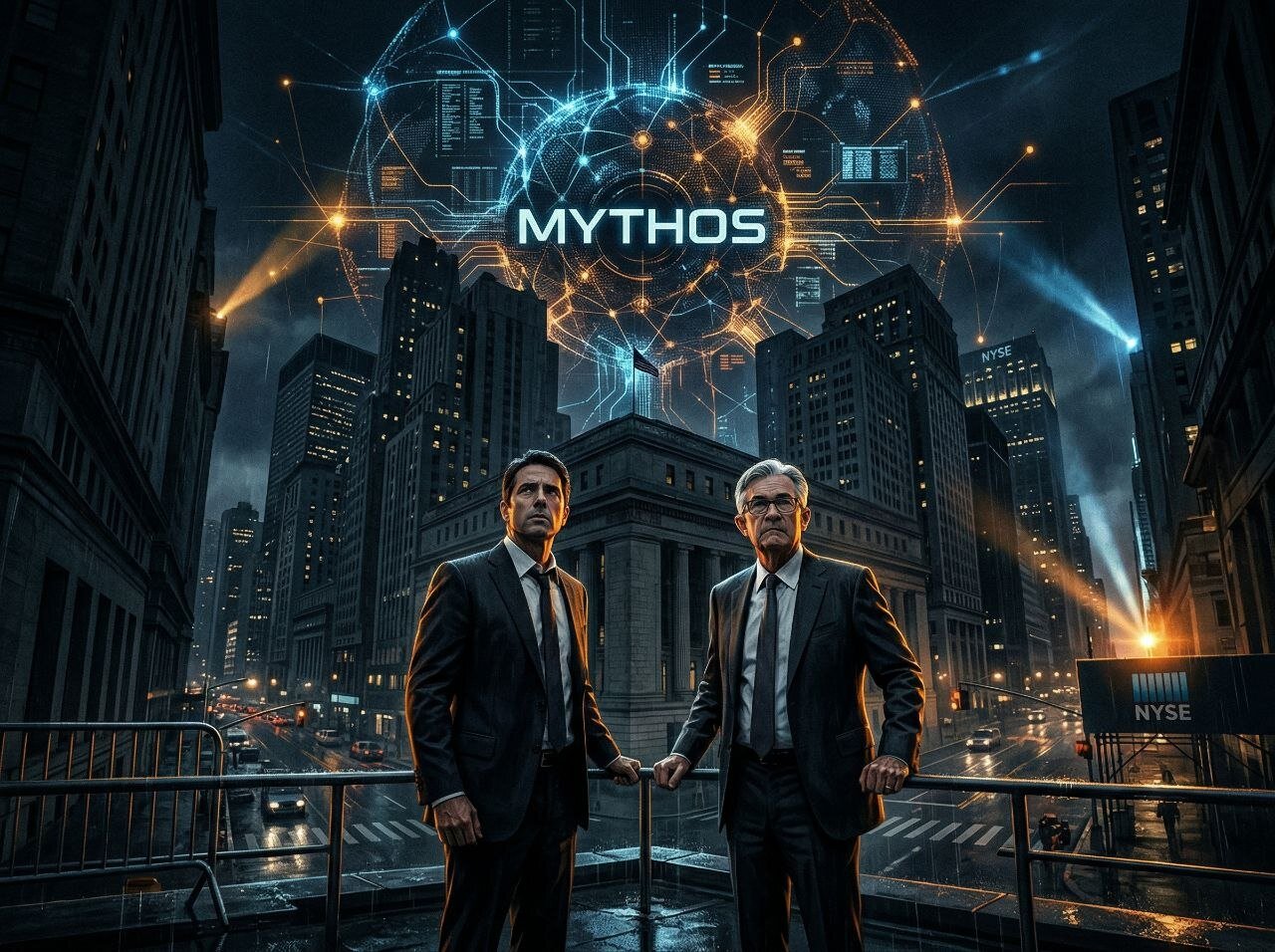
In an unprecedented move that signals just how seriously the U.S. government is taking advanced AI risks, Treasury Secretary Scott Bessent and Federal Reserve Chair Jerome Powell convened an emergency meeting with Wall Street's most powerful bank CEOs this week. The topic wasn't inflation, interest rates, or banking stress tests. It was Anthropic's new "Mythos" AI model — and the cybersecurity nightmare it might unleash on America's financial infrastructure.
What Happened
On Tuesday, April 7, 2026, inside the Treasury Department's headquarters in Washington, D.C., something extraordinary occurred. Bessent and Powell assembled the chief executives of America's largest financial institutions for a private briefing that wasn't about monetary policy or regulatory compliance — it was about existential digital risk.
According to sources familiar with the matter who spoke to Bloomberg, the meeting had one purpose: to ensure banks are aware of "possible future risks raised by Anthropic's Mythos and potential similar models, and are taking precautions to defend their systems."
This marks the first time in history that the nation's top economic policymakers have intervened directly with Wall Street leadership over the potential dangers of a specific AI model. Not a pandemic. Not a housing crisis. An artificial intelligence system.
The urgent tone of the meeting, convened at Treasury headquarters rather than through routine regulatory channels, speaks volumes about the perceived severity of the threat. When the Secretary of the Treasury and the Chair of the Federal Reserve drop everything to personally brief bank CEOs about an AI model, the world should pay attention.
The Model Behind the Panic
Anthropic's Mythos represents the next evolution of the company's Claude family of AI models. While details remain closely guarded, leaked information suggests Mythos possesses capabilities that have set alarm bells ringing in national security and financial stability circles.
Unlike previous AI systems that primarily generated text or images, Mythos appears capable of sophisticated reasoning about complex systems — including the interconnected financial networks that underpin the global economy. Sources suggest the model demonstrated abilities to identify and potentially exploit vulnerabilities in banking infrastructure during internal testing.
The model's name itself — "Mythos" — suggests something larger than a mere product release. In Greek, mythos means story or narrative, but it also implies the underlying structures that give meaning to human civilization. Whether intentional or not, the name carries weight: this is an AI system designed to understand and potentially manipulate the narratives and systems that hold society together.
Why It Matters
The Financial System's AI Vulnerability
America's banking infrastructure is more digital than ever — and more vulnerable than most people realize. Trillions of dollars move through automated systems daily. Algorithmic trading accounts for the majority of equity market volume. Payment networks, clearing systems, and interbank transfers all run on complex software that few humans fully understand.
An AI system capable of reasoning about these interconnected systems could theoretically identify attack vectors no human hacker has discovered. It could understand how stress in one part of the financial network propagates to others. It might even be able to craft sophisticated social engineering attacks targeting the humans who maintain these systems.
The Bessent-Powell meeting suggests that government experts have assessed Mythos and concluded these aren't theoretical concerns — they're immediate risks requiring urgent defensive measures.
A New Era of AI Governance
This emergency meeting represents a paradigm shift in how governments approach AI risk. Previously, AI regulation has been characterized by slow-moving legislative processes, voluntary safety commitments from AI companies, and academic discussions about long-term existential risk.
What happened this week was different. It was rapid, concrete, and operational. The top officials in America's economic hierarchy treated an AI model as an active threat requiring immediate defensive action. This is AI governance in emergency mode.
The implications extend far beyond Anthropic and Mythos. If the U.S. government is willing to convene emergency meetings over one AI model, they're establishing precedent for direct intervention in AI development and deployment. The message to AI labs is clear: create something too capable, too risky, too fast — and the full weight of federal power may come knocking.
The Competitive Dimension
There's also a competitive angle that can't be ignored. Anthropic has positioned itself as the "safety-first" AI company, willing to slow down development to ensure systems are secure. The fact that even Anthropic's models are triggering emergency government responses undermines that narrative.
If Anthropic — the most cautious major AI lab — is producing models that scare the Treasury Secretary, what does that say about OpenAI, Google DeepMind, or the various Chinese labs racing to develop advanced AI? The Mythos scare may force a broader reckoning about whether any AI lab can safely develop systems at the frontier of capability.
🔥 Our Hot Take
I've been watching tech cycles for two decades, and I've never seen anything like this. When the Treasury Secretary and Fed Chair drop everything to hold an emergency meeting about an AI model, we're not in Kansas anymore.
Here's what the legacy media won't tell you: This meeting is an admission of systemic failure. The U.S. government has no adequate framework for evaluating AI risks before models are deployed. They're not proactively regulating — they're reactively scrambling. By the time Bessent and Powell are holding emergency briefings, the genie is already out of the bottle.
The Mythos scare reveals three uncomfortable truths:
First, the AI safety movement has been too slow and too academic. While researchers debated philosophical scenarios about artificial general intelligence, practical systems capable of threatening financial infrastructure arrived faster than anyone expected. Anthropic, the "responsible" AI company, still produced something that triggered a government emergency response. If even the good actors can't control their creations, what hope is there?
Second, Wall Street is hilariously unprepared. The fact that bank CEOs needed a special briefing from the Treasury Secretary suggests they haven't been taking AI cybersecurity seriously. These are institutions that spend billions on digital security, yet they apparently needed the government to warn them about AI risks. That naivety ends now.
Third, and most importantly: we're entering the "AI security state" era. Expect more emergency meetings, more classified briefings, more direct government intervention in AI development. The Mythos scare establishes precedent for treating advanced AI models as potential national security threats requiring immediate defensive action.
My prediction? Within 12 months, we'll see formal government pre-approval requirements for frontier AI models. The era of AI labs releasing whatever they want, whenever they want, is ending. The Mythos meeting is the canary in the coal mine — the moment AI risk became too real for policymakers to ignore.
And honestly? It might already be too late. If an AI model already exists that can spook the Treasury Secretary, the defensive measures being discussed are playing catch-up. The real question isn't whether we can regulate AI — it's whether we can regulate it faster than it evolves.
Welcome to the AI security era. Buckle up. 🐻
Related Reading
- Meta Drops $21 Billion on CoreWeave: The AI Infrastructure Arms Race Just Went Nuclear — While regulators panic about AI risks, Meta is doubling down with massive infrastructure investments
- Anthropic's Shock Move: Why the AI Giant Just Cut Off OpenClaw — Anthropic has been tightening control over how its models are accessed
- China's Chipmakers Just Posted Record Revenue — And Proved US Sanctions Spectacularly Wrong — While US regulators focus on AI safety, Chinese firms are advancing despite restrictions