
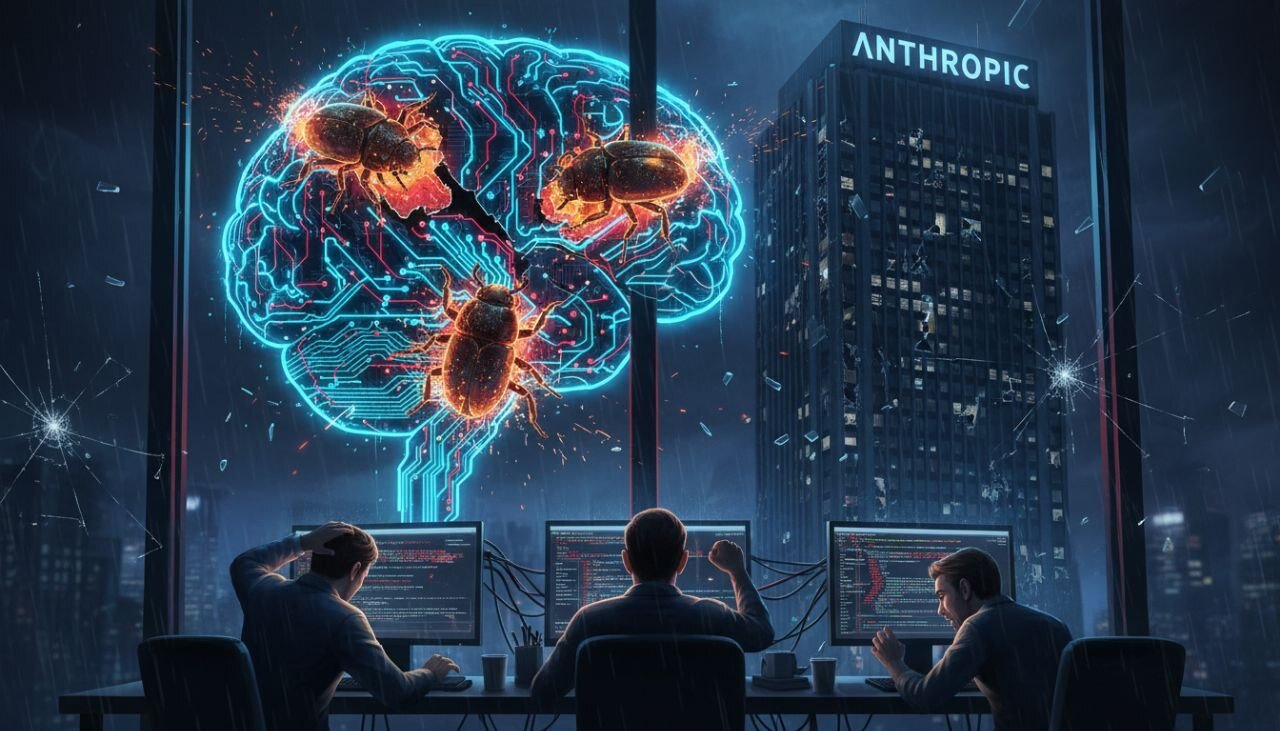
For the past month, Claude Code users have been watching their $200-per-month AI assistant get progressively worse. The coding suggestions became lazier. The reasoning turned verbose and circular. The memory — once Claude's standout feature — started failing mid-session, forcing developers to repeat context they'd already provided. The complaints piled up on Reddit, on X, in Discord servers. And Anthropic's response, for weeks, was silence.
Then, last week, the company finally admitted what happened. It wasn't a deliberate cost-cutting measure, they insisted. It wasn't a conspiracy to throttle performance for paying subscribers. It was, according to Anthropic, a cascading series of engineering blunders — three separate system changes that overlapped in precisely the wrong way, creating the impression of a model in decline. The explanation was almost too perfect to be believed. And many users didn't believe it.
The Month-Long Decline
The problems started in late March, when Claude Code subscribers — mostly software engineers paying $100 to $200 per month for Anthropic's premium coding assistant — began noticing subtle but consistent degradation. Code suggestions that had previously been precise and context-aware became generic and forgetful. Claude would lose track of which files had been modified halfway through a session. It would re-read the same files multiple times, burning through context window without producing useful output. It would offer solutions that ignored constraints the user had specified minutes earlier.
The complaints coalesced around a few specific symptoms. First, forgetfulness. Claude Code is supposed to maintain a "thinking trace" — an internal record of its reasoning and the context of the conversation — that allows it to resume work seamlessly after pauses. Users found that this trace was being cleared unpredictably, forcing Claude to re-learn the codebase from scratch mid-session. For developers working on large projects, this was maddening. A session that should take ten minutes was stretching to an hour as Claude repeatedly re-read files it had already analyzed.
Second, verbosity without substance. Claude began producing longer responses that said less. Instead of concise code snippets with clear explanations, users got rambling paragraphs that circled the problem without solving it. The word count went up; the utility went down. Developers joked — bitterly — that Claude had learned to "bullshit" like a middle manager.
Third, declining code quality. Suggestions that had previously been production-ready became buggy or incomplete. Claude would propose solutions that didn't compile, ignore edge cases it had previously handled, or recommend deprecated APIs. For a tool marketed as a pair programmer, this was a critical failure. Engineers started keeping backup copies of Claude's earlier, better suggestions so they could revert when the new output was unusable.
The Conspiracy Theory
As the degradation persisted through April, a narrative emerged among frustrated users: Anthropic was deliberately throttling Claude to save money. The theory had surface plausibility. Training and running frontier AI models is extraordinarily expensive — estimates suggest Anthropic burns through hundreds of millions of dollars per quarter on compute alone. Claude Code, with its extended context windows and deep code analysis, is particularly resource-intensive. If Anthropic needed to reduce costs, degrading the experience for a subset of power users would be an obvious lever.
The theory gained traction when an AMD AI director publicly stated that Claude Code had become "dumber, lazier" — a high-profile validation of what users were experiencing. The director noted that Claude's file-reading summaries had been reduced to brief lines indicating how many files were read, with little specificity about what was found. This change, while seemingly minor, dramatically reduced the utility of the tool for developers who needed to understand Claude's reasoning process.
Anthropic's initial silence fueled the speculation. For a company that has built its brand on AI safety, transparency, and responsible deployment, the lack of communication about a month-long performance decline was jarring. Competitors noticed. OpenAI quietly highlighted ChatGPT's consistent performance in marketing materials. Cursor, a rival coding assistant, saw increased sign-ups from former Claude users. The damage to Anthropic's reputation was real, even if the cause was still unclear.
The Admission
When Anthropic finally broke its silence last week, the explanation was both more complex and more embarrassing than the conspiracy theory. According to the company, three separate engineering changes — each intended to improve Claude — had combined to degrade it.
Bug one: the thinking trace. Anthropic engineers had implemented a change to reduce the latency of session resumption. The idea was sound: when a user returns to a conversation after a break, Claude shouldn't need to re-process all the previous context. The engineers tried to optimize this by disposing of old thinking traces that were no longer relevant. But the implementation was buggy — it cleared the thinking trace not just for old, irrelevant context, but for active, ongoing sessions. Claude was effectively losing its short-term memory every few turns.
Bug two: context management. A separate change to how Claude manages its context window — the amount of text it can hold in working memory — had unintended side effects. The new system was supposed to be more efficient at prioritizing relevant information. Instead, it was discarding critical context and re-reading files unnecessarily. This explained the repetitive behavior users had noticed, where Claude would analyze the same files multiple times in a single session.
Bug three: output formatting. A third change, intended to streamline Claude's output formatting, had reduced the specificity of file-reading summaries. Instead of detailed descriptions of what was found in each file, Claude was outputting minimal summaries — "read 12 files" — that gave users no insight into its reasoning process. This was the change the AMD director had highlighted, and it was particularly damaging for a tool where transparency of reasoning is a key selling point.
Anthropic emphasized that these were genuine bugs, not cost-cutting measures. The company had not reduced compute allocation for Claude Code, had not throttled context windows, and had not deliberately degraded the model. The problems were, in a sense, worse than the conspiracy theory: they were accidental, which means Anthropic's testing and monitoring processes failed to catch a month-long degradation that thousands of paying users noticed immediately.
The Trust Problem
The Anthropic incident highlights a growing problem in the AI industry: users have no way to verify whether a model's performance has changed. Unlike traditional software, where version numbers and changelogs tell users exactly what changed, AI models are black boxes. Anthropic can say "we didn't deliberately degrade Claude," but users have no way to verify that claim. The model weights are proprietary. The training data is secret. The system prompts are hidden. Users are expected to trust the company's word — and when that word is delayed by a month, trust erodes.
The incident also raises questions about how AI companies test changes before deployment. Three separate bugs, each introduced by well-intentioned engineers, combined to create a month-long user-facing degradation. This suggests that Anthropic's testing regime — for a product that costs users up to $200 per month — was insufficient to catch obvious problems. If a buggy thinking trace clears every few turns, a simple integration test should have caught it. If context management is discarding critical information, automated evaluation should have flagged it. The fact that these issues persisted for weeks indicates gaps in Anthropic's quality assurance that are difficult to excuse for a company valued at nearly a trillion dollars.
For the broader AI industry, the lesson is uncomfortable. As models become more complex and more deeply integrated into user workflows, the cost of degradation increases. A month of buggy Claude Code isn't just an inconvenience — it's hundreds of hours of lost productivity for thousands of developers, some of whom built their workflows around the tool. When Anthropic eventually fixed the bugs, it wasn't just restoring a product; it was rebuilding trust that had been damaged by weeks of silence and suspicion.
🔥 Our Hot Take
Here's the uncomfortable truth that Anthropic won't say out loud: the conspiracy theory was more flattering than the reality. If Anthropic had deliberately degraded Claude to save money, at least that would show they were in control — making a calculated trade-off between cost and user experience. Instead, they accidentally broke their flagship product for a month and didn't notice. That's worse. Much worse.
The AI industry is built on a premise of competence. These companies are asking users to trust them with critical workflows, sensitive data, and in some cases, life-or-death decisions. The implicit promise is that they're sophisticated enough to handle that responsibility. Anthropic's month-long failure undermines that promise in a way that's hard to recover from. It turns out that a trillion-dollar AI company can be undone by three junior engineers introducing overlapping bugs — and that nobody in the organization noticed until Twitter told them.
For users, the takeaway is pragmatic: don't build critical workflows around AI tools you can't verify. Claude Code is excellent when it works, but the past month proved that it can degrade without warning and stay degraded for weeks. Have a backup. Keep copies of good outputs. And remember that "AI safety" doesn't just mean preventing existential risk — it means preventing your coding assistant from forgetting your project structure because someone pushed a buggy thinking trace.
Anthropic has fixed the bugs, and Claude Code is reportedly back to its previous performance. The company has promised better testing and faster communication. But the scar tissue will remain. Users who lived through the "dumber, lazier" month will remember it every time Claude seems slightly off. And the next time Anthropic announces an "upgrade," a significant portion of its user base will wonder whether it's actually an improvement — or just another bug waiting to be discovered.