
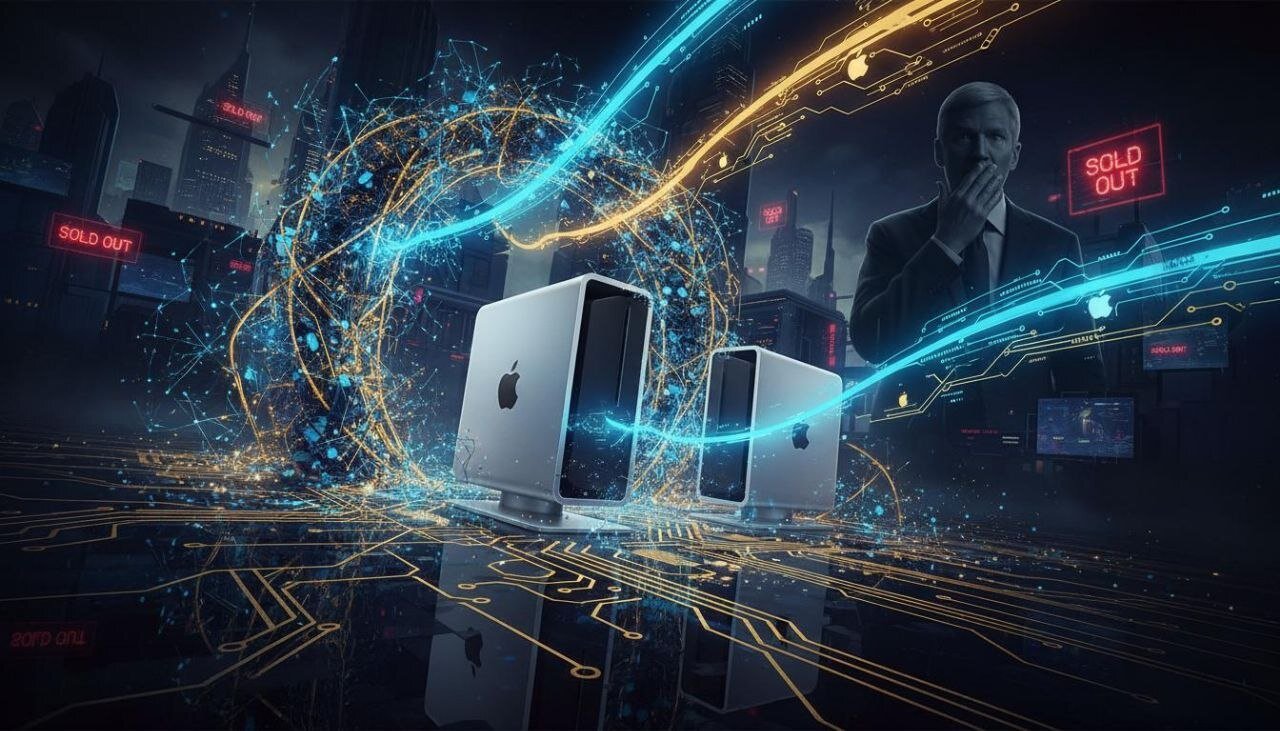
Tim Cook doesn't usually look surprised. The Apple CEO has spent fourteen years mastering the art of the calm, measured earnings call — the slight smile, the steady voice, the confident walkthrough of numbers that almost always beat expectations. But on Wednesday, something unusual happened. Cook admitted that Apple had been caught off guard. Not by a competitor. Not by a regulator. By its own customers.
The trigger was a surge in Mac sales that nobody at One Infinite Loop saw coming. During Apple's second-quarter earnings call, Cook revealed that Mac revenue grew 17% year-over-year — a remarkable figure for a product line that has spent the better part of a decade being described as "mature" or even "declining." Analysts had expected modest growth. They got something that looked more like a comeback.
But the real story wasn't the number itself. It was the reason behind it. According to Cook, a significant portion of that demand was driven by something Apple never marketed, never planned for, and certainly never built its supply chain around: people buying Macs to run local AI models.
The Accidental AI Machine
Apple has spent the last two years carefully positioning itself as an AI company. There was Apple Intelligence, the company's branded suite of on-device AI features. There was the M4 chip, with its dedicated Neural Engine capable of 38 trillion operations per second. There were the carefully staged demos showing Siri understanding context, Photos creating memories, and Mail summarizing threads.
What Apple did not anticipate was that users would ignore all of that and instead install open-source tools like OpenClaw, LM Studio, and Ollama to run large language models directly on their machines. They didn't foresee developers and enterprises buying Mac minis by the dozen to serve as compact AI servers. They didn't expect the Mac Studio — a machine designed for creative professionals — to sell out because it could run a 70-billion-parameter model locally without breaking a sweat.
"We are seeing demand for Mac that is driven in part by AI," Cook said on the call, in what might be the understatement of the quarter. "It's an area where we're very excited." What he didn't say — but what the supply chain data makes obvious — is that Apple was so unexcited about this particular use case that they didn't make nearly enough machines to meet the demand.
Sold Out and Marked Up
The evidence of Apple's surprise is sitting on eBay right now. Base-model Mac minis, which retail for $599, are selling for $850 to $1,100 on the secondary market. The Mac Studio, which starts at $1,999, is fetching premiums of $400 to $600. These are not collectible items. They are not limited editions. They are standard configurations of machines that Apple mass-produces — or at least, tries to.
The shortages are not uniform. Apple's own online store shows delivery times of three to four weeks for the Mac mini and four to six weeks for the Mac Studio. The higher-end configurations, with more unified memory, are even harder to find. This matters because AI workloads are memory-hungry. A 70B-parameter model needs at least 40GB of RAM to run smoothly. Apple's unified memory architecture means that a Mac with 64GB or 128GB of RAM can handle models that would require multiple GPUs on a PC. The shortage is most acute precisely where the AI demand is strongest.
Enterprise buyers are part of the story. Several AI startups and research labs have reportedly placed bulk orders for Mac minis to serve as inference nodes — small, efficient machines that can run models locally without sending data to the cloud. Apple's silicon efficiency, which the company has long touted as a battery-life feature for laptops, turns out to be equally valuable as a cost-per-inference feature for servers. A Mac mini drawing 50 watts can outperform a PC drawing 300 watts on certain AI workloads. The math is not complicated.
Why This Matters
Apple's surprise is significant because it reveals a strategic blind spot. The company has been so focused on its own AI narrative — Apple Intelligence, private cloud compute, the carefully curated ecosystem — that it missed a groundswell of organic adoption happening right under its nose. Users didn't need Apple's marketing to tell them that a machine with 128GB of unified memory and a 20-core Neural Engine might be good at AI. They figured it out themselves.
This is not the first time Apple's customers have outrun the company's own vision. The original iPhone was designed as a phone, an iPod, and an internet communicator. What users turned it into — a platform for apps, a camera, a social device — was something Apple resisted at first, then embraced. The iPad was supposed to be a consumption device for browsing and video. Users turned it into a creation tool for art, music, and design. The Mac, it seems, is following the same pattern. Apple built a creative workstation. Users turned it into an AI compute node.
The question is what Apple does next. The company could embrace this accidental use case, expanding the Mac lineup with configurations explicitly optimized for AI workloads — more memory, better cooling, maybe even rack-mountable designs for data centers. Or it could try to steer users back toward its own AI products, hoping that Apple Intelligence and private cloud compute will satisfy the demand that is currently being met by open-source tools running locally.
The smart money is on a hybrid approach. Apple will likely continue to promote its own AI features for mainstream users while quietly making the Mac more capable for power users who want to run their own models. The company has already shown signs of this with the M4 Mac mini's redesign, which includes better thermal management and the ability to support up to 64GB of memory in the base model. The next Mac Studio will almost certainly push that further.
The Bigger Picture
The Mac AI surge is part of a broader shift in how people think about computing. For the past two years, AI has been synonymous with the cloud — ChatGPT, Claude, Gemini, all running on distant servers accessed through a browser. But as models get smaller, more efficient, and easier to run locally, that assumption is being challenged. A Mac Studio with 192GB of unified memory can run a model comparable to GPT-3.5 entirely on-device, with no internet connection, no subscription fee, and no data leaving the machine.
For enterprises, this is a security and compliance dream. For developers, it's a cost-saving reality. For privacy-conscious users, it's a necessity. And for Apple, it's a market that opened up without the company lifting a finger — because the hardware was already capable, even if the marketing didn't say so.
The supply chain will catch up. Apple's manufacturing partners will adjust. The eBay premiums will fade. But the underlying dynamic — that the Mac has become one of the best machines for running local AI, entirely by accident — is not going away. Apple may not have planned for this revolution, but its silicon delivered it anyway.
🔥 Our Hot Take
Here's the thing Apple won't say out loud: their best AI product isn't Apple Intelligence. It's the Mac. Not because of anything they did intentionally, but because the M-series chips — designed for video editing and creative workflows — happen to be perfectly suited for running neural networks. The Neural Engine, the unified memory architecture, the power efficiency — all of it just works for AI, even though Apple never really marketed it that way.
The irony is delicious. Apple spent billions building a cloud AI strategy, negotiating with OpenAI, building private cloud compute infrastructure, and carefully staging AI demos. Meanwhile, users were buying Mac minis by the pallet and turning them into AI servers without Apple's help, permission, or even awareness. The company that prides itself on controlling the user experience has discovered that its most passionate users are ignoring the official experience entirely.
What happens next depends on whether Apple can swallow its pride and embrace this accidental use case. The Mac AI revolution is here. The only question is whether Apple will lead it, follow it, or try to ignore it until it goes away. History suggests that ignoring it is not really an option. The users have already voted — with their wallets, and with the sold-out signs on every Apple Store shelf.