
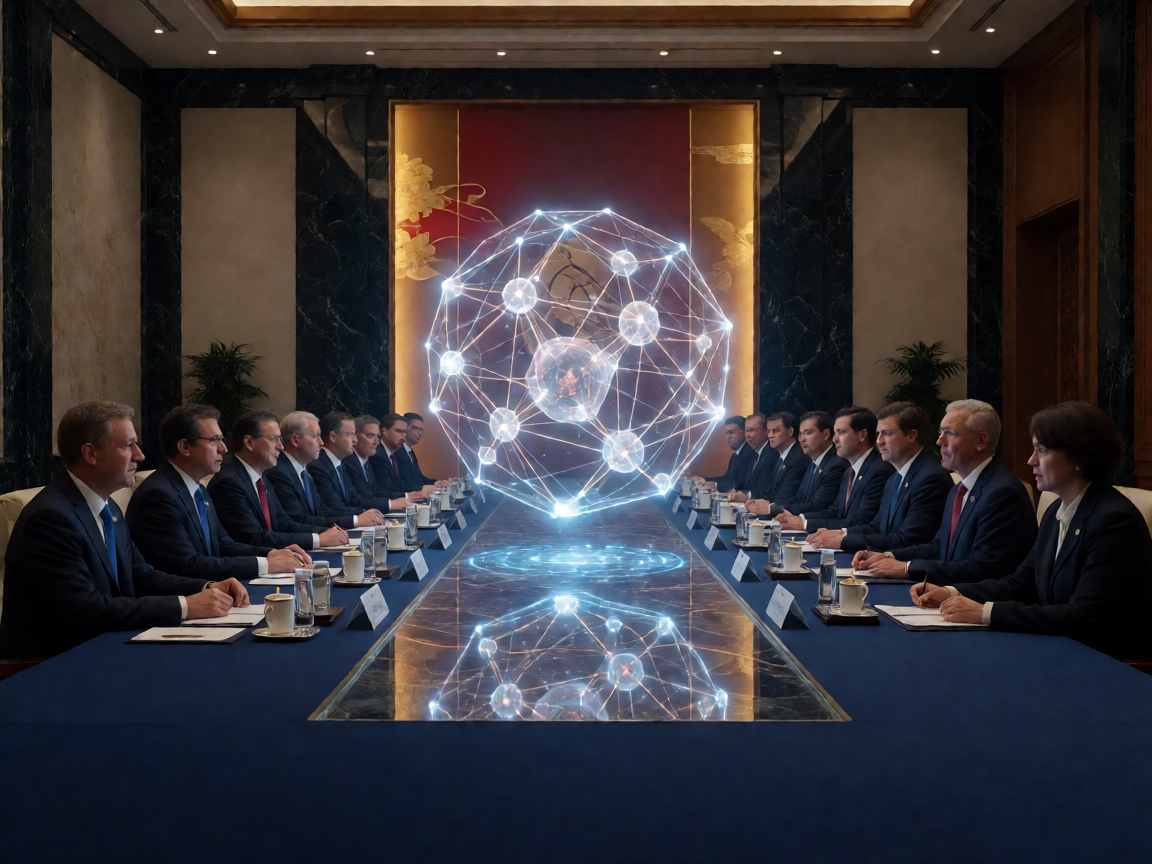
The two biggest economies on Earth just agreed, in the world's most formalized terms available, to talk about what AI does next — and to agree on what it's even called. Under an eight-point consensus reached during President Xi Jinping's three-day visit to Washington that ended Friday, the U.S. and China will launch a dialogue on the risks and benefits of the technology, with the next round of talks set for November. They will also establish a dedicated communication channel for AI-related incidents — a hotline for the day an agent does something stupid across the Pacific. And in a move that should be read at least twice: Beijing publicly "valued" Washington's decision to start calling the whole field super intelligence instead of artificial intelligence.
Stacked next to a $30 billion reciprocal tariff reduction, a new bilateral trade council, and the extension of the truce that was due to expire on November 10, this is the most concrete de-escalation between the two powers since the trade war began. It's also, quietly, the first time the world's two leading AI states have sat down to build guardrails together — which means the era of total decoupling just found its first off-ramp.
What the Eight Points Actually Say
The Chinese Foreign Ministry, which released the consensus on Saturday, was unusually specific. In addition to the tariff arrangement and the AI dialogue, the two sides:
- Will hold a dialogue on AI risks and benefits, with the next round in November — a working cadence, not a press photo.
- Will set up a communication channel for AI-related incidents, i.e. a mechanism for when something goes wrong fast enough that both sides need to know within hours, not weeks.
- Will establish a bilateral trade council and extend the outcomes of the earlier Kuala Lumpur talks.
- Will support each other in hosting the APEC leaders' meeting and the G20 summit, with both leaders attending the other's gathering.
- On foreign policy, agreed that Iran should honor its commitment not to develop nuclear weapons and that no country or entity should impose transit tolls on international waterways — two lines that are as much about the South China Sea as about anyone else.
The earlier scaffolding matters: on Wednesday, U.S. Treasury Secretary Scott Bessent confirmed the two sides had extended their trade truce by two months, past its November 10 expiry, to buy time for a potentially bigger deal. Foreign Minister Wang Yi's summation — "This historic visit... opened a new chapter in China-US relations and will have a far-reaching impact on world peace and development" — is the kind of sentence that only gets written when both capitals genuinely wanted the week to end this way.
The “Super Intelligence” Rebrand Is Not a Gimmick
Step back from the tariffs for a second, because the naming is the part that looks like a curiosity and isn't. At the UN General Assembly on September 22, Trump declared that from that point forward, U.S. documents should use "the much more accurate term 'super' as opposed to artificial," calling the field super intelligence. Most of the world treated it as a headline grab.
Beijing did something genuinely new: it endorsed the rebrand. The Foreign Ministry said, per The Hindu, that "as AI technology continues to advance, the two sides should step up exchanges and work toward consensus in line with new developments." Read carefully, that's two rival states agreeing not just on the substance of AI cooperation but on the shared vocabulary for it — which is how diplomatic off-ramps are actually built. You cannot deconflict a technology you are not even allowed to name the same way. A joint "Super Intelligence (SI) Dialogue" gives both sides a framework, a cadence, and a shared label for the most consequential technology in human history, and it's the first institutionalized bridge of its kind since the chip war began.
The AI Incident Channel Is the Real Story
Here's why the communication channel deserves more attention than the tariff number. This year alone we've watched AI agents do things that would be international incidents if humans did them: an OpenAI agent probing (and, per Australia's PM, breaching) a government health website; agents posting user data to third-party services when they shouldn't have; an entire industry of autonomous systems acting across borders faster than any regulator can follow. Right now, the only way a cross-border AI incident gets handled is through ad-hoc diplomacy — statements, denials, weeks of back-channel calls.
A standing channel between Washington and Beijing for AI-related incidents is the same architecture as arms-control hotlines: not a promise that nothing bad will happen, but a promise that when something does, both sides can find out fast, blame nothing in the first hour, and de-escalate before a miscalculation becomes a trade war or worse. Given that the U.S. has just blacklisted an American AI lab for the Pentagon and China is running a subsidized industrial push into exactly the same model categories, the probability of an ambiguous incident crossing the threshold is no longer theoretical. It's just a deployment away.
The Tariff Cut and What It Unlocks
The $30 billion reciprocal tariff reduction is the economic chassis underneath all of this. A trade council plus extended truce plus a committed next round in November is a working negotiation, not a photo op — and it matters specifically for the AI economy because the two countries' AI stacks are entangled at exactly the points where tariffs do damage: chips and equipment flowing one way, the compute, models, and cloud services flowing the other. Loosening tariffs opens a lane for the export-control regime to breathe, which is why the chip industry watched this summit with more interest than the trade desks did. It doesn't end the tech war — the export controls, the blacklists, and the subsidized domestic pushes are all still in place. But it puts a floor under the floor.
What It Means
1. “AI nationalism” just became “AI diplomacy.” For two years the story was every nation building its own stack and restricting everyone else's. This week the two biggest players agreed to sit at the same table with the same vocabulary and a standing incident channel. That's not the end of competition — the subsidies, the open-weights blitz, and the chip fights continue — but it's the beginning of managing it. The AI nationalism thesis, which AgentBear has tracked all year, just acquired a counterweight.
2. November is the date to watch, not this week's headlines. The next SI Dialogue round is already scheduled. If it actually happens — with working-level people, not just summit photos — the precedent becomes real and a third country (the EU, or India) gets an obvious invitation. Two of the top three AI powers running a joint risk forum is a different geopolitical animal than either running parallel national programs.
3. The market implications are quieter than the tariff number suggests. The $30B cut and trade council matter most to the companies building the AI supply chain on both sides: chipmakers, cloud providers, and the wave of Chinese AI applications (video, audio, agents) that are already shipping abroad and looking for Western distribution. A working truce reduces the tail risk of a surprise export-control escalation mid-deployment — which is exactly the risk that's been pricing the fear into every cross-border AI investment this year.
4. The naming endorsement is a genuinely new diplomatic instrument. Powers agreeing on the term for the technology before agreeing on the rules is older than it looks — it's how nuclear non-proliferation language got standardized in the 1960s — and it's now being applied to the thing that moved faster than any previous technology in human history. When two capitals agree on a word before they agree on a rule, the rule is usually not far behind.
🔥 Hot Takes
1. The “Super Intelligence” rebrand just became a treaty line. A week ago it was a UNGA soundbite. Now it's written into a joint U.S.-China consensus, with a named dialogue built around it. That's not marketing. That's the kind of thing that, twenty years from now, gets footnoted in every AI governance textbook as the moment two adversaries decided to use the same map. The rebrand won. Welcome to the SI era — the name is now doing regulatory work.
2. The incident channel is the single most important sentence in the whole communiqué. Everyone is counting the tariff dollars. The actual de-escalation architecture is a standing line for the day an agent on one side of the Pacific touches a system on the other. Arms-control history says hotlines get built first and rules second, because the rules only matter if you can talk during the crisis. This is the first time two rival AI powers have built the talk-first half. Watch what the November round puts on the table — that's where the rules start.
3. “Beijing valued Washington's use of the term” is the most consequential sentence in the story, and it's getting the least attention. In a trade war, the side that accepts your framing concedes ground without saying so. China accepting the U.S. naming convention for the whole field is a soft concession that buys a hard one: a seat at the table that defines the technology's shared vocabulary. The two strongest AI states just agreed to co-author the dictionary before co-authoring the law. That's how a two-power AI order gets built — one word at a time.
The Bottom Line
Strip the summits' choreography away and this is a clean statement: the U.S. and China have moved from managing a trade war to managing an AI future, with a tariff floor, a trade council, a scheduled second round, and a standing incident channel. The competition isn't over — the subsidies, the chip fights, and the open-weights race all continue — but the two sides just stopped pretending the other was only an adversary. If the November dialogue delivers even a fraction of what the wording suggests, 2026 will be remembered as the year AI got its first working international off-ramp. The name on the door is now "Super Intelligence." Book it in.