
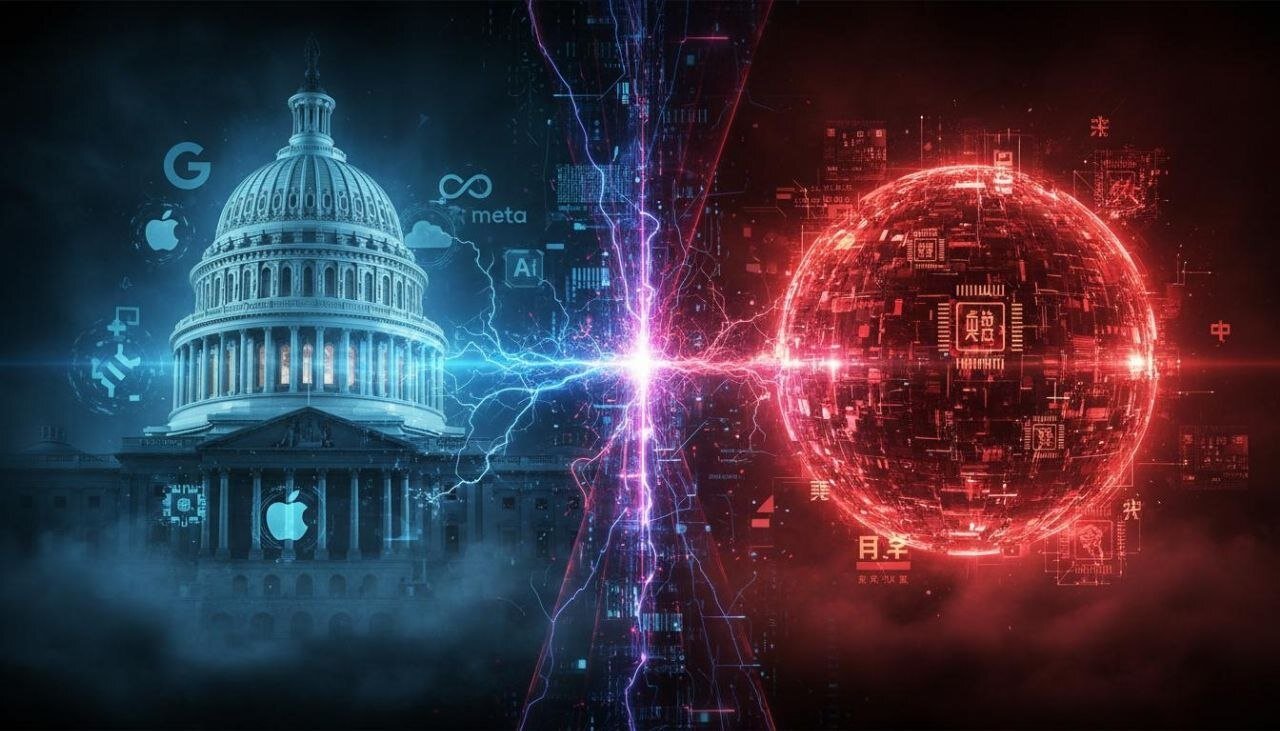
Something unusual happened in Washington between April 23 and May 1, 2026. In the span of just eight days, four separate government entities launched investigations, sent warning letters, and accused China of running what they called "industrial-scale campaigns" to steal American artificial intelligence.
That's not normal. That's not organic. That's coordinated.
And buried beneath the headlines about Chinese espionage and AI theft lies a more uncomfortable truth: the United States may be losing the AI race it started — and the "theft" narrative might be cover for a policy that spectacularly backfired.
The Coordinated Crackdown: A Timeline
Let's look at what actually happened, day by day:
April 23, 2026: The White House Office of Science and Technology Policy issues a memo to federal agencies accusing China of "deliberate, industrial-scale campaigns to distill U.S. frontier AI systems." Michael Kratsios, Trump's science and technology advisor, promises to "enhance engagement with the private sector" to counter foreign distillation attacks.
April 24, 2026: DeepSeek releases V4 — optimized to run on Huawei's Ascend chips, not Nvidia's GPUs. The model costs $3.48 per million tokens versus OpenAI's $30. Nvidia CEO Jensen Huang, on a podcast, calls this a "horrible outcome for the U.S."
April 29, 2026: Reuters reports that major Chinese tech firms are scrambling to secure Huawei AI chips after the DeepSeek V4 launch. The same day, the House Homeland Security Committee launches an investigation into what it calls "Chinese infiltration of America's AI industry."
April 30, 2026: Senators Jim Banks and Chuck Grassley send letters to nine AI companies warning that China is "actively targeting America's AI sector" for espionage. The Select Committee on the Chinese Communist Party opens a joint investigation into Airbnb and Anysphere over "national security risks posed by Chinese AI models."
May 1, 2026: China blocks Meta's $2 billion acquisition of Manus, an AI agent company founded in China. Beijing imposes exit bans on the founders, preventing them from leaving the country.
Eight days. Five government actions. Two corporate blockades. One clear message from both sides: the AI ecosystem is splitting in half.
The "Distillation" Panic
The White House memo, authored by Michael Kratsios, centers on a technical term most Americans have never heard: distillation.
Distillation is when you train a smaller AI model on the outputs of a larger one. It's a standard, legal technique used across the industry. OpenAI distills its own models. Google does it. Startups do it to create cheaper versions of expensive frontier models.
But the White House frames it as theft: "Models developed from surreptitious, unauthorized distillation campaigns... enable foreign actors to release products that appear to perform comparably on select benchmarks at a fraction of the cost."
The evidence? Anthropic claimed in February that DeepSeek, Moonshot AI, and MiniMax overwhelmed Claude with 16 million exchanges from 24,000 fraudulent accounts. OpenAI sent a letter to Congress saying it saw evidence of "ongoing attempts by DeepSeek to distill frontier models."
Here's what's not mentioned in the memo: distillation doesn't replicate full performance. The White House admits this in its own document. A distilled model is cheaper and smaller precisely because it's less capable. It can't reason as deeply, can't handle as many edge cases, can't scale to the most complex tasks.
So why the panic? Because the Chinese models don't need to match GPT-5.5 or Claude Mythos. They just need to be good enough for most use cases — and cheap enough to dominate markets where cost matters more than cutting-edge capability.
DeepSeek V4-Pro costs $3.48 per million tokens. OpenAI charges $30. Anthropic charges $25. Even Moonshot's Kimi costs $4. That's not "theft" pricing — that's efficiency.
The Real Story: Export Controls Backfired
In 2022, the Biden administration imposed export controls on advanced AI chips to China. The Trump administration tightened them further in 2025. The goal: slow Chinese AI development by denying access to Nvidia's best GPUs.
The result? Chinese developers got smarter.
Cut off from top-tier hardware, DeepSeek and its rivals had to optimize for efficiency. They developed algorithms that achieve comparable performance with fewer chips, less memory, and less power. Jensen Huang admitted as much: "The best AI researchers in the world, because they are limited in compute, also come up with extremely smart algorithms."
Now those efficient models are circulating globally — not because they were stolen, but because they're open source. DeepSeek releases its weights for free. So does Qwen. So do MiniMax and Knowledge Atlas. Any developer anywhere can download them, fine-tune them, and deploy them locally.
The export controls created a paradox: by trying to slow China down, the U.S. may have accelerated the global shift toward cheaper, more accessible AI that doesn't depend on American hardware or American cloud providers.
Nvidia B300 servers now sell for $1 million each in China — nearly double the U.S. price — because the crackdown on chip smuggling dried up black-market supply. Chinese companies aren't stopping development. They're just paying more, getting creative, and increasingly turning to Huawei's Ascend processors as an alternative.
"Singapore Washing" and China's Counter-Blockade
The Meta-Manus deal reveals the other side of the wall going up.
Manus, founded in China by Xiao Hong and Ji Yichao, created an AI agent that completes tasks autonomously rather than just responding to prompts. It went from $0 to $100 million faster than any company, raised $75 million from U.S. venture firms, then moved its headquarters to Singapore to escape Beijing's oversight.
When Meta announced a $2 billion acquisition in December 2025, China's National Development and Reform Commission blocked it. The founders got exit bans. The message was clear: you can't take Chinese AI talent or technology offshore, even if your company is legally based in Singapore.
Experts call this "Singapore washing" — the belief that relocating to Singapore insulates Chinese companies from Beijing's reach. It doesn't. As NYU professor Winston Ma told Newsweek: "Once they were physically in China, Singapore's corporate domicile became irrelevant."
Beijing is treating AI companies the way it treats TikTok: strategically sensitive, regardless of corporate restructuring. The acquisition channel is now "effectively closed at the frontier," according to Singapore's DZT Research.
And Beijing is matching Washington tit-for-tat. If the U.S. won't let China buy Nvidia chips, China won't let the U.S. buy Chinese AI companies. The tech ecosystem is bifurcating into two parallel universes.
The China Conspiracy That Isn't a Conspiracy
Here's where the "conspiracy" angle gets interesting — because the actual coordination is happening in plain sight.
The White House, Senate, House committee, and DOJ all moved within the same week. They all used the same language: "industrial-scale," "deliberate campaigns," "systematic extraction." They all targeted the same threat vector: Chinese AI companies catching up too quickly.
But the timing suggests something else. DeepSeek V4 launched April 24 — the same week as the White House memo. The memo didn't trigger the DeepSeek launch; the DeepSeek launch may have triggered the memo.
Consider: if Chinese AI companies are genuinely just stealing American models through distillation, why are their models cheaper and more efficient? A stolen car doesn't get better gas mileage than the original. If DeepSeek's advantage came purely from copying OpenAI, it should cost the same or more to run (you still need the same compute). Instead, it costs 90% less.
The more logical explanation: Chinese labs developed genuinely different approaches to training and inference — approaches born from necessity under export controls, refined through open-source competition, and now being deployed at scale.
The "theft" narrative serves a political purpose. It justifies tighter restrictions. It rallies allies. It shifts blame from a policy that didn't work to an enemy that acted badly. It's not entirely false — some distillation almost certainly happens — but it may be a smaller piece of the puzzle than the coordinated messaging suggests.
What Happens Next
The bifurcation is accelerating. Both sides are building walls:
- Hardware: U.S. blocks Nvidia exports → China builds Huawei Ascend ecosystem → U.S. allies pressured to choose sides
- Software: Chinese models go open source globally → U.S. companies close their models tighter → two incompatible AI stacks emerge
- Talent: China blocks AI founders from leaving → U.S. restricts Chinese researchers → brain drain becomes brain barrier
- Capital: Cross-border AI acquisitions freeze → each side funds its own ecosystem → two separate investment markets
Nvidia's Huang warned about the endpoint: "The day that DeepSeek comes out on Huawei first, that is a horrible outcome for [the U.S.]" We're not there yet — Huawei chips still lag Nvidia's best — but the trajectory is clear.
The Pentagon clearly sees this as existential. On May 1, it announced deals with seven AI companies (Microsoft, Amazon, Google, OpenAI, but notably not Anthropic) for classified military AI work. Anthropic refused over concerns about "domestic mass surveillance or fully autonomous lethal weapons" — and got labeled a "supply-chain risk" by the Pentagon for its trouble.
That tells you the stakes. The U.S. isn't just trying to win the AI race. It's trying to ensure the AI that powers its military comes from companies it controls, running on chips it controls, trained by people it can vet.
Hot Take: Who Actually Wins?
The conventional wisdom is that the U.S. leads in AI and China is catching up. But the DeepSeek V4 release, the chip pricing, and the open-source ecosystem tell a different story.
China wins on cost. Its models are 10x cheaper. That matters enormously for global adoption. Developers in India, Brazil, Africa, and Southeast Asia — markets that will drive the next billion AI users — care more about price than peak performance.
The U.S. wins on frontier research. GPT-5.5, Claude Mythos, and Google's next models still push the boundaries of what's possible. The absolute best AI will likely remain American for the foreseeable future.
But "best" and "most widely used" are not the same thing. Android wasn't the best smartphone OS when it won the global market. It was the cheapest and most accessible.
The real question isn't who builds the best model. It's who sets the standards, who controls the infrastructure, and whose ecosystem becomes the default for the majority of the world.
If Chinese open-source models dominate the developing world because they're free and cheap, while American closed models dominate wealthy nations because they're better, we don't get one winner. We get two separate internets — one running on American AI, one on Chinese AI, with increasing friction between them.
That's the endgame nobody's talking about: not one AI winner, but two incompatible AI worlds. And the walls are going up faster than most people realize.
Caught in the Middle: What This Means for Everyone Else
While Washington and Beijing trade accusations, the rest of the world is being forced to choose sides — or risk getting shut out of both ecosystems.
European AI labs like Mistral and Aleph Alpha are racing to build "sovereign" AI that doesn't depend on either American or Chinese infrastructure. But they're struggling to match the funding, compute, and talent pools of the two superpowers. The EU's AI Act, meant to ensure safety and transparency, may end up ensuring irrelevance if it slows European labs down while American and Chinese competitors sprint ahead.
Developing nations face an even starker choice. American AI is better but expensive, often requiring cloud contracts with U.S. providers and compliance with U.S. export rules. Chinese AI is cheaper and open-source, but comes with geopolitical baggage and potential data sovereignty concerns. A startup in Nairobi or Jakarta doesn't care about the Pentagon's classified network strategy — it cares about which model it can afford to run on its budget.
This creates what economists call network effects: the more people use one ecosystem, the more valuable it becomes, and the harder it becomes to switch. If the developing world standardizes on Chinese open-source models because they're free, while the developed world standardizes on American closed models because they're better, we don't just get two AI worlds. We get two economies — two sets of standards, two supply chains, two regulatory regimes, and increasingly limited trade between them.
The businesses caught in the middle are already feeling it. Multinational corporations are scrambling to build "AI neutrality" into their architecture — using both American and Chinese models depending on which region they're operating in. But that's expensive, complex, and creates compliance nightmares. Most companies will eventually pick a side, just as most companies picked sides during the previous tech cold war between iOS and Android, or between AWS and Alibaba Cloud.
And for individual developers? The golden age of freely mixing and matching the best tools from anywhere may be ending. A developer in San Francisco might soon find that Chinese models are technically accessible but legally risky to use for commercial projects. A developer in Shenzhen might find that American APIs are blocked or prohibitively expensive. The open internet was already fragmenting. AI is accelerating that fragmentation into something that looks more like the Cold War's divided world than the globalized web we grew up with.
The irony? Both Washington and Beijing claim they're doing this to protect their citizens and ensure AI safety. But the result may be the opposite: two competing AI ecosystems racing for dominance, each less accountable to the other, each with incentives to cut corners on safety in order to win. When the U.S. and USSR competed on nuclear weapons, the resulting arms race produced enough warheads to destroy civilization multiple times over. An AI arms race between two equally paranoid superpowers might not be any safer.
The coordinated crackdown of April 2026 wasn't just about Chinese espionage. It was a signal that the AI race has entered a new phase — one where the finish line isn't a better model, but control over the infrastructure that everyone else depends on. And both sides are playing to win.
Related Reading
- The Quiet AI Capture Nobody's Talking About — How private AI vendors embed in Pentagon workflows
- Anthropic Accidentally Dumbed Down Claude for a Month — When engineering bugs make frontier AI unreliable
- ByteDance's Secret Drug Lab Just Used AI to Crack an 'Undruggable' Target — How China's tech giants are applying AI beyond chatbots