
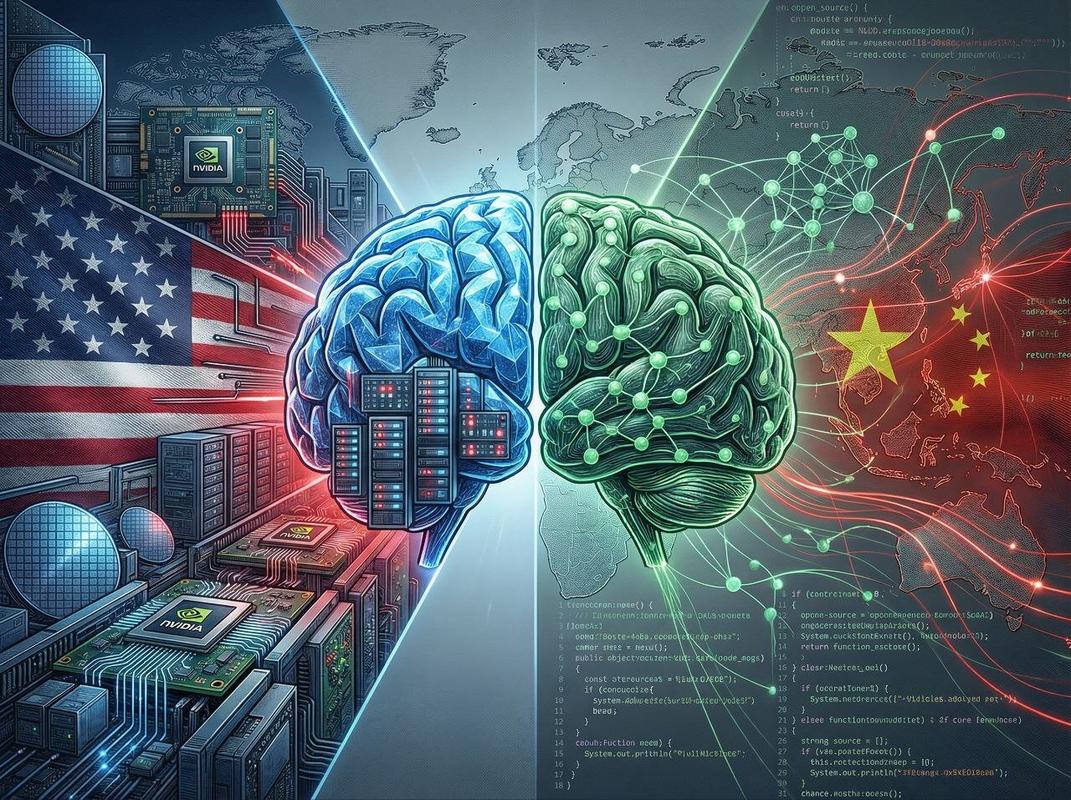
In a report that landed like a tactical nuke in Washington policy circles on March 23, 2026, the US-China Economic and Security Review Commission finally said what Silicon Valley has been whispering for months: the strategy is not working.
The congressional advisory body issued a stark warning to America's biggest AI companies — Google, OpenAI, Anthropic, and others — that China's AI ecosystem is no longer just catching up. It is "zooming ahead" in ways that chip export restrictions alone cannot stop. The commission's verdict is unambiguous: China's dominance in open-source artificial intelligence is generating a "self-reinforcing competitive advantage" that allows Chinese companies to challenge US rivals despite being cut off from the world's most advanced AI chips.
This is not a technical report. It is a confession.
The Strategy That Failed
Since 2022, the US government has imposed increasingly strict export restrictions on China, blocking access to NVIDIA's most advanced AI processors — the H100s, the A100s, and now the Blackwell architecture. The theory was elegant in its simplicity: starve China of compute, and you slow their AI development. Without the best chips, Chinese labs would fall behind. American AI supremacy would be preserved through hardware dominance.
It made sense on paper. AI training is compute-intensive. The biggest models require tens of thousands of high-end GPUs running in parallel. If China cannot buy those GPUs, they cannot train competitive models. QED.
Except that is not what happened.
Chinese companies including Alibaba, Moonshot AI, and MiniMax have developed large language models that now dominate worldwide usage rankings on platforms like HuggingFace and OpenRouter. These models were trained under severe compute constraints. They were developed with inferior hardware, by labs that had to smuggle chips through shell companies or make do with downgraded export-compliant processors. And they are still winning.
The commission's report puts it bluntly: "This open ecosystem enables China to innovate close to the frontier despite significant compute constraints. Chinese labs have narrowed performance gaps with top Western large language models."
In other words, the chip ban bought time — but China used that time to build a different kind of advantage.
The Open-Source Flywheel
Here is the mechanism that Washington did not anticipate. By releasing models as open source, Chinese AI companies make their technology freely available to developers and businesses around the world. That seems like generosity. It is not. It is market capture.
When a Chinese lab releases an open-source model, three things happen:
First, adoption scales rapidly because the price is zero. Developers do not need to pay API fees or sign enterprise contracts. They download the weights, fine-tune for their use case, and deploy. The friction that slows adoption of Western models — procurement processes, budget approvals, vendor evaluations — simply does not exist.
Second, the global developer community improves the models. They submit pull requests. They optimize inference. They create derivative versions for specific domains. The Chinese base model gets better not just because the original lab works on it, but because thousands of engineers worldwide are effectively unpaid labor, extending and refining the technology.
Third, and most importantly, the model becomes infrastructure. Developers build applications on top of it. Startups found companies using it. Enterprises integrate it into workflows. Each of these dependencies makes the ecosystem stickier. Switching costs rise. The Chinese model becomes the default, and Western alternatives become unnecessary.
The commission recognized this dynamic with clinical precision: "Open model proliferation creates alternative pathways to AI leadership." What they mean is that leadership no longer requires having the best chip. It requires having the most widely adopted model. And adoption is driven by accessibility, not capability.
The Deployment Gap Nobody Talks About
The report contains a warning that should keep American AI researchers up at night. As the industry shifts from conversational AI toward agentic AI and embodied AI, the commission suggests China may hold a structural advantage that is harder to overcome than a chip gap.
Here is what that means in plain English.
ChatGPT is conversational AI. You type, it responds. The training data comes from text scraped from the internet. Books, websites, Reddit threads. The model learns language patterns and reasoning from this static corpus.
But the next phase of AI — agentic and embodied — requires different training data. Agentic AI takes actions in the world. It books flights. It manages schedules. It operates software. Embodied AI controls physical systems. It navigates warehouses. It operates machinery. It drives vehicles.
Training these systems requires operational data. Not text from the internet, but logs of real-world actions and their outcomes. And China has a structural advantage here that no amount of NVIDIA GPUs can overcome: scale of deployment.
Beijing's strategy of deploying AI across manufacturing, logistics, factories, and robotics at massive scale is generating real-world operational data of a kind that is difficult to replicate in a lab. Every robot arm in a Chinese factory. Every autonomous delivery vehicle. Every AI-optimized supply chain. These systems are generating training data through actual operation — and that data feeds back into model improvement.
The commission notes this with concern: "There's a bit of a deployment gap in the embodied AI space between the US and China." That is diplomatic understatement. The gap is not "a bit." It is a chasm.
American AI labs train models on synthetic data and internet text, then hope they work in the real world. Chinese AI labs deploy in the real world, harvest the operational data, and use it to train better models. One approach is theoretical. The other is empirical. History suggests empiricism wins.
The Geopolitical Implications
Let us be clear about what this report represents. The US-China Economic and Security Review Commission is not a neutral academic body. It is a bipartisan congressional commission specifically chartered to monitor the national security implications of the US-China trade and economic relationship. When this body says that current policy is failing, it is not engaging in theoretical debate. It is sounding an alarm.
The implications are profound.
For three years, the bipartisan consensus in Washington has been that export controls on advanced semiconductors would maintain American AI leadership. Republicans and Democrats disagreed on many things, but they agreed on this. The CHIPS Act. The export restrictions. The diplomatic pressure on allies to join the embargo. All of it was predicated on the assumption that compute is the bottleneck.
That assumption is now in question.
If China can build competitive AI without American chips, then the entire strategy needs rethinking. The billions spent on domestic semiconductor manufacturing. The diplomatic capital expended convincing Japan and the Netherlands to join restrictions. The enforcement resources dedicated to catching smugglers. All of it becomes less effective if the target achieves its goals anyway.
Worse, the strategy may be counterproductive. By forcing China to develop workarounds, the US may have accelerated exactly the innovation it sought to prevent. Chinese labs had to become more efficient. They had to develop training techniques that work with less compute. They had to build distributed systems that aggregate lower-grade processors. Necessity became the mother of invention.
The commission's report does not explicitly say this. But the implication is clear. The policy has not just failed. It may have backfired.
What the US Could Do Instead
If restricting hardware access is not working, what are the alternatives? The commission does not offer specific policy prescriptions, but the contours of a different strategy are visible.
First, compete on openness. The paradox of the current situation is that Chinese companies are winning with open source while American companies are hoarding their best models. OpenAI's GPT-4, GPT-5, and o-series models are proprietary. Google's Gemini is proprietary. Anthropic's Claude is proprietary. The most capable American models are locked behind APIs and enterprise contracts.
Meanwhile, China's best models are available for download. Anyone can use them. Anyone can modify them. The global developer mindshare is shifting toward the open ecosystem because that is where the friction is lowest.
If the US wants to compete, American companies may need to release competitive open-source models. Not dumbed-down versions. Not last-generation technology. Current frontier models, freely available. This would be a radical shift in business strategy for OpenAI and Anthropic, but it may be necessary to prevent ecosystem lock-in.
Second, accelerate deployment. The commission identifies the "deployment gap" in embodied AI as a critical vulnerability. Closing this gap requires getting American AI systems into physical operation at scale. That means robots in factories. Autonomous vehicles on roads. AI-optimized logistics networks. The training data generated by these deployments is the fuel for the next generation of models.
The US has advantages here — capital markets, entrepreneurial culture, regulatory flexibility compared to Europe. But it needs to use them. The current focus on chatbots and image generators may be a distraction from the deeper competition in industrial AI.
Third, invest in efficiency research. If Chinese labs are innovating under compute constraints, American labs should be innovating from a position of abundance. The US has the best chips. It should be pushing the frontier of what is possible with them. Research into more efficient training algorithms, better data curation, and novel architectures could extend the lead that hardware advantage provides.
But this requires recognizing that the competition is not just about who has the biggest model. It is about who has the most widely adopted model, the best operational data, and the most efficient training regime. These are different metrics, and the US is not winning on all of them.
🔥 The Hot Take: Washington Is Fighting the Last War
There is a pattern in technological competition. The incumbent power tries to maintain advantage by controlling the old bottleneck. The challenger wins by making that bottleneck irrelevant.
In the 1980s, the US tried to maintain semiconductor dominance by restricting exports to Japan. Japan developed different manufacturing techniques and became competitive anyway. In the 1990s, American auto companies tried to maintain market share through protectionism. Japanese and Korean manufacturers built better cars and won on quality. The pattern repeats because the psychology of incumbency is consistent: when you are ahead, you believe the game is about preserving your lead. When you are behind, you believe the game is about changing the rules.
China is changing the rules.
The US assumed AI competition would be won by whoever had the most compute. That assumption made sense when the frontier was defined by model size. GPT-4 required more compute than GPT-3. GPT-5 required more than GPT-4. The trend seemed clear.
But China looked at that arms race and decided not to play. Instead, they optimized for efficiency, accessibility, and deployment velocity. They accepted that they would not have the biggest model and focused on having the most useful model, the most deployed model, the model with the best real-world training data.
This is not surrender. This is strategy.
The commission's report is a wake-up call because it signals that Washington is finally recognizing the game has changed. The question is whether American AI companies can change with it. OpenAI has built a $150+ billion valuation on the premise that scale is everything. If scale is no longer the only thing — if efficiency, accessibility, and deployment matter just as much — then the business model needs to evolve.
Some will argue that the solution is more restrictions. Tighter export controls. Better enforcement. Secondary sanctions on countries that help China evade restrictions. This is the instinct of a power that believes it can still control the game through coercion.
But the report suggests a different conclusion. The open-source genie is out of the bottle. Models can be trained on smuggled chips, in data centers across Southeast Asia, using distributed compute that is hard to track and harder to stop. The era of controlling AI development through hardware restrictions is ending. The new era will be defined by software, data, and deployment velocity.
On those metrics, the US is not guaranteed to win. That is what the commission is saying. And that is what should worry everyone who cares about the future of AI.
What Happens Next
The commission's report will be read in Beijing as validation. It will be cited in Chinese state media as evidence that American containment is failing. That interpretation is self-serving but not wrong.
In Washington, the report will trigger a debate that has been simmering for months. Hawks will argue for stricter controls, more enforcement, secondary sanctions. Doves will argue for a different approach — competition through openness, acceleration through deployment, winning by building rather than blocking.
The outcome of that debate will shape the next phase of AI development. If the US doubles down on restriction, it may slow China further but will not stop them. If the US pivots to competition, it will need to accept that the rules of the game have changed — and that winning requires playing by those new rules.
One thing is certain. The era of assuming American AI supremacy is over. The commission has made that official. What comes next is anyone's guess.
But if history is any guide, the side that recognizes reality faster tends to win. China recognized that compute constraints required a different approach. They adapted. The US is still debating whether adaptation is necessary.
That lag — between reality and recognition — is where competitions are lost.