
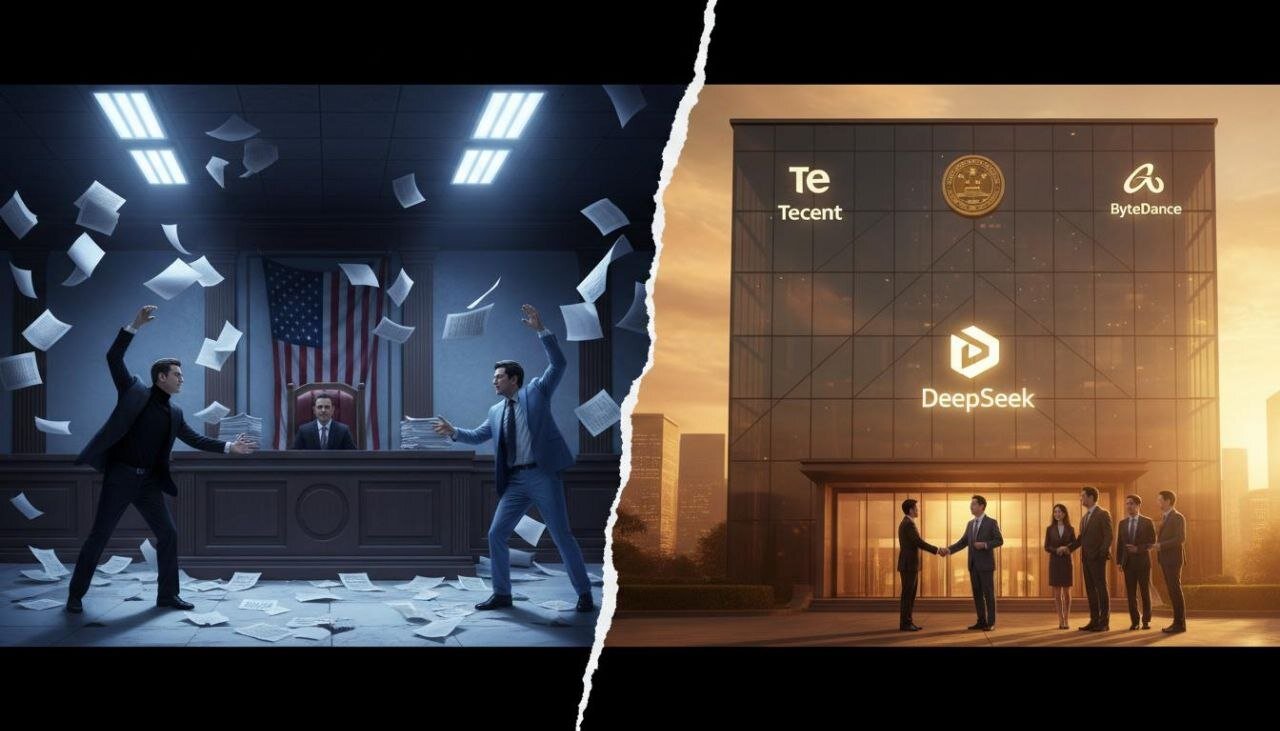
American AI is tearing itself apart in courtrooms and talent wars. Chinese AI is consolidating behind state-backed champions. The divergence has implications no one is talking about.
In San Francisco, the world’s most valuable artificial intelligence companies are suing each other. In Hangzhou, they are investing in each other. One ecosystem is fragmenting. The other is consolidating. And the gap between them is widening faster than either side wants to admit.
This is not a story about technology. It is a story about structure — about how the institutional and political frameworks surrounding AI development in the United States and China are producing radically different competitive dynamics, with consequences that will shape the global AI landscape for the next decade.
The American AI Civil War
The evidence of American AI infighting is everywhere, and it is getting worse. Consider the timeline of the past six months alone.
Elon Musk is suing OpenAI — the company he co-founded — claiming that Sam Altman and Greg Brockman deceived him about the organization’s mission. In court, Musk has admitted under oath that his own AI company, xAI, distills OpenAI’s proprietary models. He has also been caught in emails discussing the poaching of OpenAI employees for Tesla while he was still on OpenAI’s board. The trial, now in its second week, has produced revelation after revelation about how the most powerful figures in American AI treat one another when the cameras are off.
OpenAI, in turn, sued xAI earlier this year for allegedly poaching employees and misappropriating proprietary information. A judge dismissed the case, but the message was clear: even the company that dominates the AI market views its own co-founder as a threat serious enough to litigate against.
Then there are the copyright wars. Major publishers sued Meta this month for training its AI models on copyrighted material without permission. Dozens of authors, visual artists, and news outlets have filed similar suits against OpenAI and Anthropic. Music publishers are suing Anthropic. Record labels are suing AI music generator Suno. The entire generative AI industry in the United States is fighting a multi-front legal battle against the creative industries that it relies on for training data.
The government is not helping. Anthropic is currently suing the Pentagon after the Department of Defense designated the company a “supply-chain risk” — a label previously reserved for foreign adversaries. In a surreal twist, more than 30 employees at rival companies including Google and OpenAI filed an amicus brief supporting Anthropic against the US government, arguing that punishing a leading domestic AI company would harm American competitiveness. When your own government’s treatment of AI companies is so heavy-handed that it unites competitors against it, something has gone wrong.
And then there is the money. Meta, Amazon, Microsoft, and Alphabet have collectively signaled approximately $725 billion in capital expenditures for 2026, almost entirely earmarked for data centers, custom chips, GPUs, and AI models — an increase of more than 75% year-over-year. They are not cooperating. They are outbidding each other for the same limited supply of Nvidia chips, the same pool of AI researchers, and the same plots of land near power plants. It is an arms race in the literal sense: every dollar one company spends on AI infrastructure is a dollar the others must spend to keep pace.
The Chinese AI Coalition
Meanwhile, 7,000 miles away, a very different story is unfolding.
When DeepSeek, the Hangzhou-based AI startup, began its first-ever external fundraising round in April 2026, something unusual happened. Rather than competing to price each other out, China’s biggest tech companies began coordinating to invest in it together.
Tencent, Alibaba, and ByteDance — three companies that compete ferociously in e-commerce, social media, and cloud computing — are all in discussions to participate in the same DeepSeek round. The round, which started at a reported $10 billion valuation and has since climbed to as high as $50 billion, is not being treated as a normal venture investment. It is being treated, as one analyst put it, as a "strategic asset" for the country.
The "Big Fund III" — Beijing’s state-backed semiconductor investment vehicle with an estimated $48 billion war chest — is also participating. Local government guidance funds are involved. The entire financing structure is designed not to maximize financial returns for any single investor, but to ensure that DeepSeek has the resources, infrastructure, and political cover it needs to compete with American AI companies.
This pattern of collaboration extends beyond DeepSeek. When DeepSeek released its V4 model, which was optimized to run on Huawei’s Ascend 950 chips, ByteDance, Tencent, and Alibaba all scrambled together to secure orders for the same domestic chips. They were not competing to monopolize Huawei’s supply. They were collaborating to ensure that Chinese AI infrastructure as a whole could reduce its dependence on American semiconductors.
The government is not fighting its AI companies. It is funding them. The state-backed investors are not imposing “supply-chain risk” labels on domestic champions. They are writing checks and building fabs. When DeepSeek needs chips that it cannot import due to US export controls, the state finds ways to subsidize domestic alternatives. When American companies need chips, they bid against each other in auctions.
Why the Divergence?
The structural reasons for this divergence are not mysterious, but they are under-discussed.
Market structure: The United States has a relatively mature venture capital ecosystem where AI companies are treated as independent, competing firms. OpenAI, Anthropic, xAI, and Google DeepMind are separate entities with separate investors, separate boards, and separate incentives. They raise money from different venture funds, poach each other’s employees, and build products that directly compete. The system is designed for competition, and it produces it ruthlessly.
China’s AI ecosystem, by contrast, is embedded in a broader state-industrial complex where national strategic objectives often override pure commercial competition. Tencent and Alibaba may compete in cloud services, but when the state signals that DeepSeek is a national priority, both companies find it rational — and politically necessary — to invest. The competitive dynamic is not eliminated, but it is layered: companies compete in consumer markets while collaborating in strategic technology development.
Capital availability: American AI companies raise money from private markets, and those markets are becoming scarcer and more expensive. Each company must fight for its own funding, justify its own valuation, and produce its own returns. Chinese AI companies, particularly those designated as strategic, can access state-backed capital pools that do not demand the same returns and are willing to invest for national rather than purely financial reasons.
Government role: The US government is trying to regulate AI through a patchwork of executive orders, court cases, and agency actions that often feel adversarial to the companies they target. The Chinese government is trying to build AI through direct investment, infrastructure support, and coordination between state and industry. One approach treats AI companies as potential risks. The other treats them as national assets.
The Implications
The implications of this divergence are significant and under-appreciated.
First, speed of development. When American AI companies spend half their energy fighting lawsuits, government designations, and each other, they have less energy left for actual research. When Chinese AI companies are funded, coordinated, and politically supported, they can focus. DeepSeek’s ability to train competitive models at a fraction of the cost of its American rivals is not just a technical achievement. It is a structural one: the company was able to concentrate resources without the overhead of litigation, regulatory battles, and competitive poaching that consumes American labs.
Second, ecosystem resilience. The American AI ecosystem is robust but fragmented. Each company builds its own stack, trains its own models, and fights its own legal battles. If one fails — if OpenAI implodes, if Anthropic loses its Pentagon case, if xAI runs out of money — the others do not automatically benefit. The Chinese ecosystem, by contrast, is being built as a network where the success of one national champion strengthens the others. DeepSeek’s models run on Huawei chips. Huawei chips are bought by Tencent, Alibaba, and ByteDance. Those companies’ cloud platforms deploy DeepSeek’s models to enterprise customers. The system is designed to be mutually reinforcing.
Third, global competition. The rest of the world is watching both ecosystems, and the contrast is not flattering to the American model. Countries that want to build their own AI industries are looking at China and seeing a template: designate national champions, coordinate investment, and align government and industry. They are looking at the United States and seeing a warning: even the most technologically advanced country in the world cannot stop its AI companies from suing each other into paralysis.
None of this is to say that the Chinese model is superior in every dimension. State-directed investment produces its own inefficiencies, corruption risks, and innovation constraints. The American competitive model, for all its messiness, has historically produced more breakthroughs per dollar than any other system on earth. But the current phase of AI development — the infrastructure buildout phase — may be one where coordination beats competition, at least in the short term.
There is a final irony worth noting. The American AI companies that are suing each other, poaching each other’s talent, and fighting their own government are, in their own way, behaving exactly as the market incentives tell them to behave. They are maximizing shareholder value, defending intellectual property, and competing for scarce resources. They are doing what American capitalism has trained them to do. The problem is that AI may be too important — and too strategically consequential — to be left to American capitalism alone.
The Chinese, whatever one thinks of their political system, have grasped this. They have decided that AI is a national project, not a market project, and they are organizing accordingly. The Americans have not. And the gap between those two approaches — visible in lawsuits on one side and investment rounds on the other — may be the single most important structural dynamic in the global AI race today.
AgentBear exclusive analysis. This story draws on Reuters, Bloomberg, CNBC, MIT Technology Review, Fortune, The Guardian and court filings.
Sources: Reuters, Bloomberg, CNBC, MIT Technology Review, Fortune, The Guardian, The Wall Street Journal, court filings