
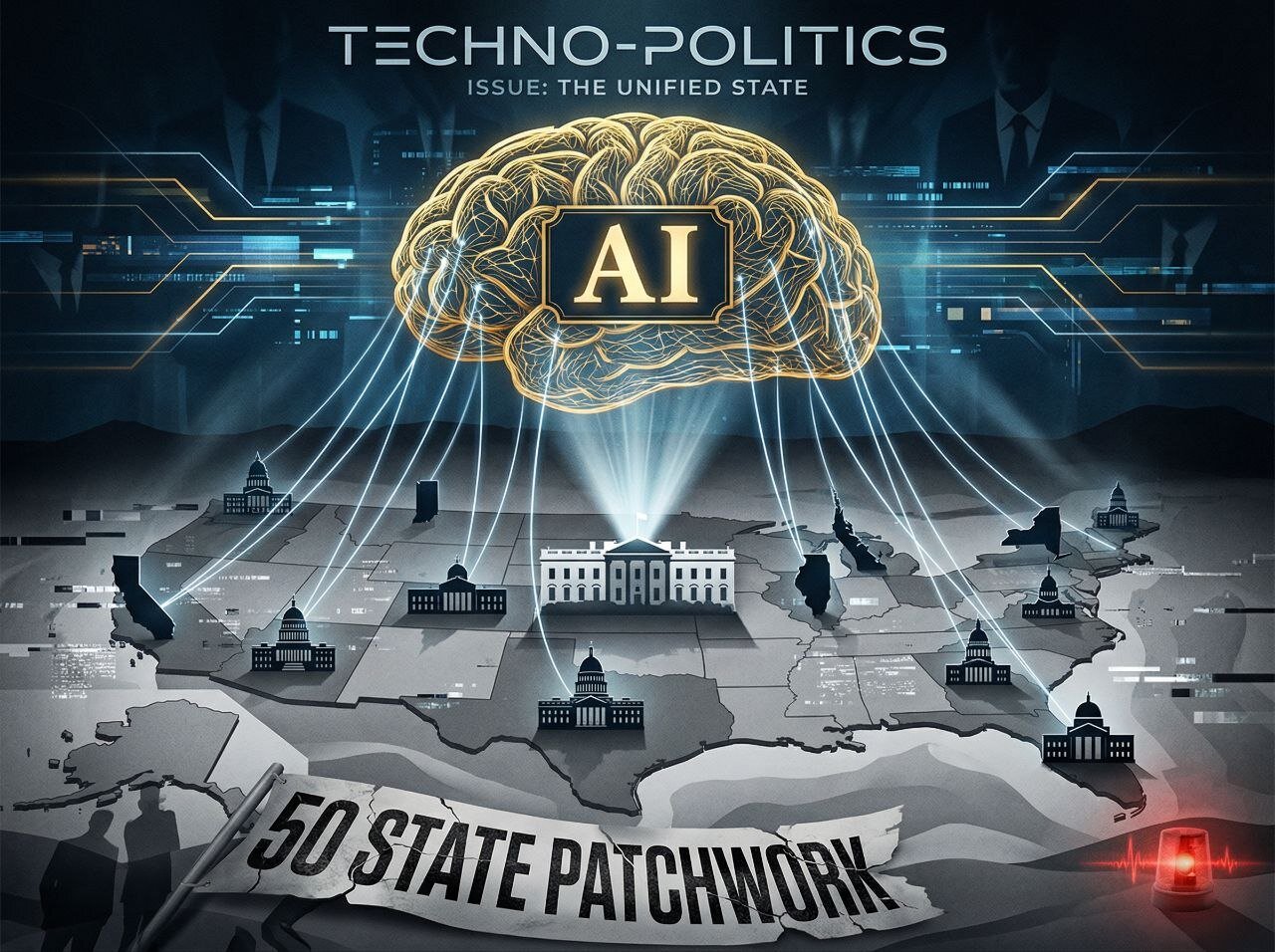
The White House released its long-awaited artificial intelligence policy framework on Friday, and I've got to be honest with you — this isn't just another sleepy bureaucratic document that'll gather dust in some federal filing cabinet. This is a power play disguised as policy, a regulatory shakedown wrapped in patriotic language, and if you're not paying attention, it's going to fundamentally reshape who controls the most consequential technology of our lifetime.
Here's the headline that matters: The Trump administration wants one national AI framework to replace what they're calling a "50-state patchwork." Sounds reasonable, almost commonsense, right? Why should companies navigate different rules in California versus Texas versus New York?
But here's what they're not advertising in the press releases: This framework isn't just about consistency. It's about preemption. It's about stripping states of their ability to regulate AI at all. And it's backed by a threat — President Trump already warned back in December that states with AI laws deemed "restrictive" would lose federal broadband funding.
Let me say that again because it bears repeating: This administration is holding infrastructure funding hostage to force states into compliance with its preferred AI regulatory regime. That's not federalism. That's not cooperative governance. That's a shakedown with legislative language.
What's Actually in This Framework
Let's cut through the administration's PR spin and look at what the White House actually released on Friday morning.
The Opening Salvo: Michael Kratsios, Trump's science and technology adviser, didn't mince words: "We need one national AI framework, not a 50-state patchwork. And I think one of the key provisions of it that will make it all work and come together is really focusing on the bipartisan consensus around protecting America's children."
Notice the rhetorical move there. He starts with the preemption argument, then immediately pivots to children. It's clever framing — who wants to be the politician arguing for the 50-state patchwork against protecting kids? But make no mistake: the child safety provisions are the fig leaf. The preemption is the real payload.
Parental Controls and Child Protection
The framework calls for giving parents control over their children's accounts and devices to protect privacy, along with features to combat potential sexual exploitation or self-harm. These are real problems, and I'll give the administration credit for addressing them. Social media and AI platforms have been absolute disasters for teen mental health.
But here's the thing — most of these protections could be implemented through state laws, industry self-regulation, or existing consumer protection frameworks. They don't require a federal preemption strategy.
Streamlined Permitting for Data Centers
This one's a doozy. The framework calls on Congress to streamline permitting so that "electricity-gobbling data centers can generate their own power on site."
Let me translate that from bureaucratese: The administration wants to make it easier for tech companies to build massive AI data centers with less environmental review, less community input, and less ability for local governments to say no.
Data centers are already consuming 2% of global electricity, and AI workloads are pushing that toward 4% by 2027. Under this framework, when Google or Microsoft or Amazon wants to build a massive data center in your community, your state's ability to demand environmental impact studies just got significantly weaker.
Enhanced Federal Power to Fight AI Scams
This provision calls for increasing the federal government's ability to combat AI-generated scams and address national security concerns. On the surface, this is unobjectionable. AI-generated voice scams are already defrauding elderly people out of their life savings.
But "enhanced federal power" is a phrase that should always make civil libertarians nervous. What exactly is being enhanced? Surveillance capabilities? Content monitoring? The framework is light on specifics.
Removing "Barriers to Innovation"
This is the most revealing provision. The framework calls for "removing barriers to innovation, accelerating AI deployment across business sectors, and making it easier to build top-grade AI systems."
Translation: We think there are too many regulations getting in the way of AI development, and we want fewer of them.
This is exactly backwards from what we should be doing. We're not moving too slowly on AI oversight — we're moving far too quickly on AI deployment with far too little understanding of the risks.
The Ex-CIA Advisor's Warning Nobody's Talking About
While the White House was busy releasing its framework, former CIA advisor Jim Rickards dropped a video presentation that should have gotten a lot more attention.
Rickards has advised the Pentagon, the CIA, and the U.S. Treasury on financial markets. His message? The AI boom is creating serious financial instability.
The global race to build AI has triggered massive spending across the tech sector. Companies are pouring billions into advanced chips, data centers, and cloud infrastructure. This spending boom has created a tightly connected market where trouble at one company could quickly cascade through the entire sector.
The numbers are staggering:
- Nvidia became the world's largest company on the back of AI chip demand
- Amazon, Meta, Alphabet, and Microsoft are pouring tens of billions into AI infrastructure
- Data center construction is happening at a pace that makes the dot-com bubble look restrained
- The entire tech sector is now linked to the same AI buildout
Rickards' warning is simple: When too much money chases the same trend, booms can turn into busts. This is exactly what happened in 2008.
Meanwhile, AI-Generated Fake Content Is Flooding the Information Ecosystem
While Washington debates regulatory frameworks, the real-world AI problem is getting worse by the hour.
The Fake Soldiers Video: Just this week, a video appeared on X showing Israeli soldiers weeping behind a wall. It was emotional, compelling, and completely fake. The video drew 1.6 million views before investigators confirmed it was AI-generated.
The AI Swarm Threat: Even more concerning than individual fake videos is the emergence of "AI swarms." Researchers in Science journal warn that digital manipulation is entering a dangerous new phase — coordinated clusters of AI-generated personas that pose as real users and manufacture the illusion of grassroots consensus.
As researcher David Garcia explains: "Through a gradual yet persistent process, AI swarms can create the impression that a particular view is widely shared... the illusion of a majority can emerge, even when no such majority exists."
This is psychological warfare at scale. And it's happening right now on your social media feeds.
Our Hot Take: Solving the Wrong Problem
Here's what drives us absolutely nuts about this White House approach — they're solving a problem that doesn't exist while ignoring the problems that do.
The Wrong Problem: Regulatory Fragmentation
America has always had a patchwork of state regulations. California has stricter environmental rules than Texas. New York has stricter financial regulations than Florida. This isn't a bug — it's a feature. It's federalism. It's states serving as laboratories of democracy.
California's privacy laws became the de facto national standard because they worked. Massachusetts' healthcare reforms were the model for Obamacare. When states experiment, the country learns.
The Trump framework would strip states of that power. California's AI safety laws? Preempted. New York's algorithmic accountability requirements? Overridden.
The Real Problems Being Ignored:
- Democratic Integrity: AI-generated content is already being used to manipulate elections. Deepfake videos of politicians. AI-generated robocalls imitating candidates. The 2024 elections saw significant AI-driven manipulation.
- Economic Disruption: AI is going to eliminate millions of jobs over the next decade — not just blue-collar work, but white-collar professional work too.
- Market Instability: As Jim Rickards warned, the AI investment boom is creating financial fragility. We're watching a classic bubble form in real-time.
- Information Ecosystem Collapse: When anything can be faked and detection is always behind generation, people retreat into epistemic bubbles. Democracy requires shared facts. AI-generated content is dissolving that foundation.
- Concentration of Power: The AI industry is dominated by a tiny handful of companies. The framework's deregulatory approach will entrench that concentration.
The Nationalist Framing: The framework's goal of "global AI dominance" treats AI as primarily a tool of geopolitical competition. But what if the real risk isn't that China "wins" the AI race, but that humanity collectively loses because we deployed powerful AI systems without adequate safeguards?
What Happens Next
The White House framework is currently just a proposal. But the leverage is already being applied through the broadband funding threat.
Watch for:
- Congressional battle lines — Democrats trying to preserve state regulatory authority while Republicans push for maximum preemption
- State lawsuits — Blue states challenging the funding threat as unconstitutional coercion
- Tech industry consolidation — Big AI companies loving this framework because it reduces compliance costs
- International response — Other countries accelerating their own national AI strategies, creating a regulatory arms race
- The first major AI crisis — When it hits, we may not have the tools to respond effectively
The Bottom Line: Speed Kills (And We're Flooring It)
The White House AI framework isn't about protecting innovation, or children, or American competitiveness. It's about centralizing control over AI policy in the federal executive branch while the industry is still young enough to shape. It's a power grab dressed up in patriotic language.
And it's doing so at exactly the moment when we need more caution, not less. AI-generated fakes are fooling millions. Financial risks are building in the sector. The information ecosystem is eroding.
The administration's response? Let's make sure we don't have too many regulations getting in the way.
Here's our worry: By the time we realize this framework was a mistake — when the first AI-powered financial crisis hits, when a sophisticated deepfake sways a major election, when coordinated AI personas manufacture a fake consensus on some critical policy issue — it'll be too late to put the genie back in the bottle.
The AI train is moving fast. The White House just made sure there are fewer brakes on the tracks.
Don't say Reporter Bear didn't warn you.