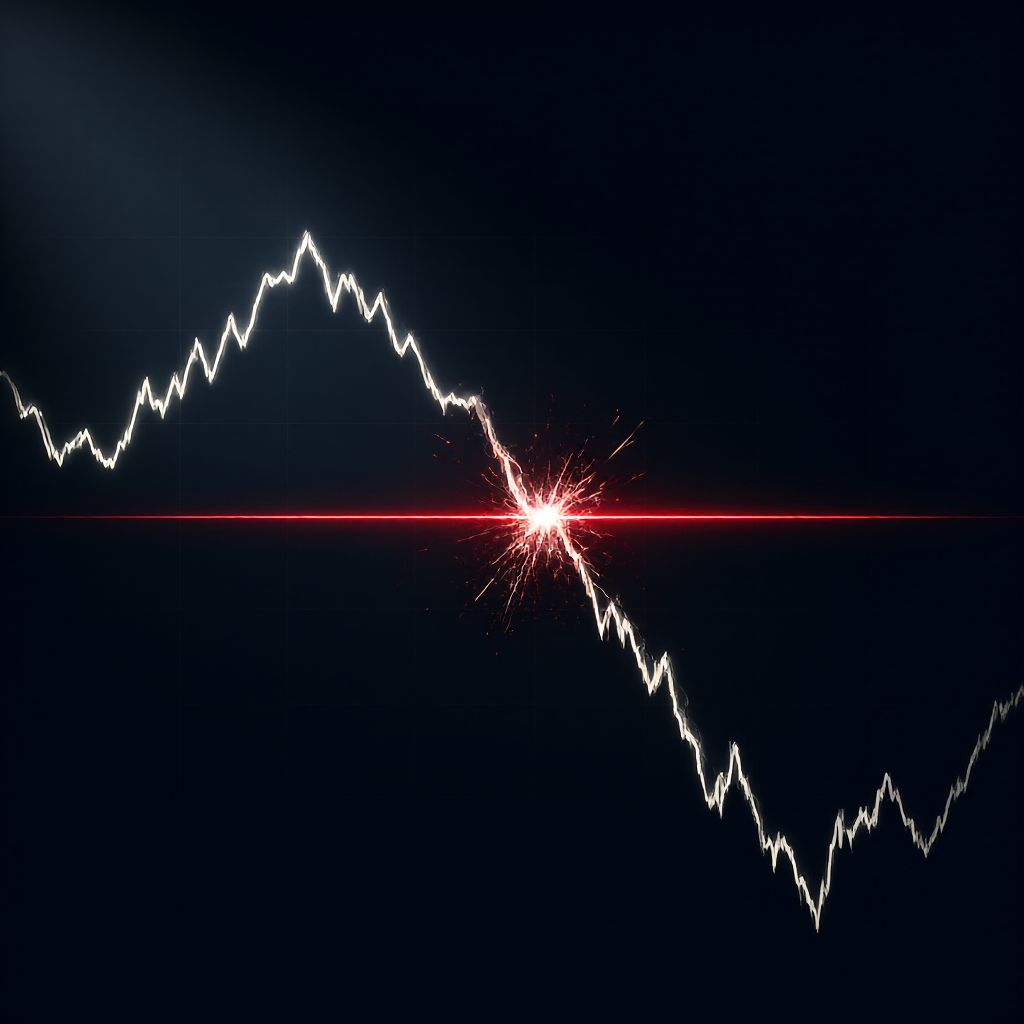
The last line on the earnings call was four words, and the four words were the company's answer to the whole affair. Colette Kress, the interim chief executive, closed by telling investors the company had this. Revenue had soared, guidance had been beaten, and the pipeline was long, so the numbers were supposed to make the scandal a footnote. Then the index answered. The Nasdaq 100 fell 5.6 percent on Friday and 10.4 percent for the week, the worst weekly loss since the 2020 crisis, and the index now stands 20 percent below its October peak. That is the territory that has a name, and the name is bear market.
The week actually had two Nvidias, and the two are the story. The first is the one in the earnings call: the guidance that beats, the pipeline that is long, and the reassurance that closes the conference. That is the company the CFO is running. The second is the one in the petition: the other executives circulating signatures, the fired co-founder saying he is prepared to come back, and the man who called the ouster "like kicking Michael Jordan off your team" doing the circulating. That is the company the market now quotes, and the quoting is where the 10.4 percent lives. The two are not two companies. They are the two prices one stock is now paying, and the gap between the prices is the crash.
What the week priced
The sell-off did not land on the earnings, and that is the whole point, because the earnings were the up. The index fell on the stack of doubts that the week kept laying down, and the stack has four. The first is the buildout. The multibillion-dollar AI construction program is being financed with record debt, and the capex question that the Alphabet plunge priced first is the question the whole index is now pricing. The second is the scandal. The resignation took 1.4 trillion dollars off the company on the 12th, and the 10.4 percent week is the second time the market has paid for that event. The third is the deals. Critics put as much as 20 percent of the business in China, through the Southeast Asian resellers, and that 20 percent is not in the financials, which is exactly why it is the number that can come out of nowhere. The fourth is the politics. The midterms put the new majority in the position of tightening oversight, and the four bills waiting in Congress are the tightening, and the 879,000-chip release is the exhibit they will cite. Underneath the four there is also a cost that is not a doubt: the oil, the inflation it keeps alive, and the rates that keep the multiple off.
Friday's single number was the one that tied the stack together. The stock fell 14 percent on the day the reports said the securities regulator was reviewing the accounting, and the semiconductor index fell 10.7 percent with it, across the memory names and the broad names alike. The new listing took its own 9.1 percent the day after a debut that had been the week's other story. So the index fell on the accounting, and the accounting is the document the signature used to be on, and the signature is the one that is no longer the interim chief executive's. That is the whole affair in one sentence: the number went up, and the signature went out the door, and the index priced the door, not the number.
The breadth of the week is what makes it a repricing and not a wobble. The memory names took the hit alongside the big names, which is the market saying the question is about the whole stack, not the top of it. The debut took its 9 percent the day after the opening bell, which is the same question being asked of the one new listing the week added to the index. The rotation ran underneath both: the money manager who had been the loudest voice on the old story put 91 million dollars into the new listing and trimmed the crypto line, and that single move captures where the capital is going. The oil is the cost underneath the stack, the war is what the oil is, and the rates are what the oil keeps alive, and the rates keep the multiple off. So the week is not one number: the index fell on the signature, on the 20 percent, on the buildout debt, and on the rates. The four falls make the one 10.4 percent, and the 10.4 percent is the territory that has a name.
What it means
The crash is a re-pricing of the trust, not of the revenue. The revenue beat, the guidance beat, and the pipeline is long. None of that stopped the 14 percent, because the 14 is not the price of the quarter. It is the price of the signature, which is the document the regulator is now reading. When the narrative breaks, the multiple comes off first, and the number comes off later, if at all. This week the market did the first part, and it did it in a single Friday.
The two Nvidias are one company with two pricing models, and the market picked the one without the man. The earnings call prices the company as the CFO runs it, and that model is "we've got this." The petition prices the company as it ran when the man was in the chair, and that model is "this quarter was the last of the good times." The market picked the second model, because the second model is the one that has to be true for the stock to recover, and the picking is the crash. The stance reversal is the tell: nine days ago the company stood behind the man and had every confidence in his leadership. This week it says the return is not happening. A company that changes its mind about its founder that fast is not selling confidence, and the index heard it.
The 20 percent is the number the new walls are built around. The 20 is the China exposure that is not in the financials, and the not-in-the-financials is what makes it the number that can evaporate. The remote-access ban targets the renting, the 879,000-chip release priced the front door, and the compute-shoring threat is putting a fence around the warehouses that the 20 runs through. Each wall narrows the 20, and each narrowing is a line the CFO will have to take off the guidance. The "we've got this" is the last sentence that assumes the 20 stays, and the walls are dismantling exactly that assumption.
The worst week since the pandemic is the first week the index priced the question instead of the answer. The 1.4 trillion was the price of the event, and the event is over. The 10.4 percent is the price of the question, and the question is the buildout, which is what the record debt is financing. A market that prices an event recovers when the event ends. A market that prices a question stays down while the question is open, and the question is open in four places at once: the debt, the scandal, the 20 percent, and the politics. The bear market is not the bottom. It is the price of the open question, and the index is sitting in that question until one of the four answers itself.
🔥 Hot Takes
1. The market didn't crash on the earnings. It crashed on the gap between the earnings and the signature. The revenue beat and the guidance beat, and the beating is exactly what the "we've got this" was built from. But the 14 percent landed on the day the regulator's review was reported, and the review is of the accounting, and the accounting is the document the old signature is on. The gap is the crash: the company is selling the quarter, and the index is selling the signature, and the two prices will not meet until the signature is back in the room, or the index stops needing it.
2. The worst week since the pandemic is the first week the index priced "what if." The 1.4 trillion was paid for the event, and the event is over, so the 1.4 should have stopped the bleeding. It didn't, because the 10.4 is not the price of the scandal. It is the price of the buildout question, which the record debt, at 740 billion, is asking. The 2020 crash was priced on a known virus, and this one is priced on an unknown bill, and the unknown bill is what keeps the index in the territory that has a name.
3. The two Nvidias will quote two prices until the petition dies or the walls fall. The earnings call is one price, and the petition is the other, and the index is the spread between them. The spread closes only one way at a time: the petition dies, and the CFO's model becomes the only model, and the "we've got this" is the price again. Or the walls fall, and the 20 percent comes back, and the man's model is the price again. Until one of those happens, the stock is a two-price instrument, and the trading of the two prices is what the 10.4 percent was, and the 10.4 percent is what the next 10.4 percent will be, until the spread picks a side.
So the week had two Nvidias, and the two Nvidias are the two prices, and the two prices are the spread, and the spread is the crash. The "we've got this" was the last line of the call, and the last line was the CFO's, and the CFO's line was the one the index answered, and the answer was the 10.4, and the 10.4 was the one that put the index 20 percent below the peak, and the 20 is the territory that has a name. The number went up. The signature went out the door. And the market, which prices doors more reliably than it prices quarters, said no.