
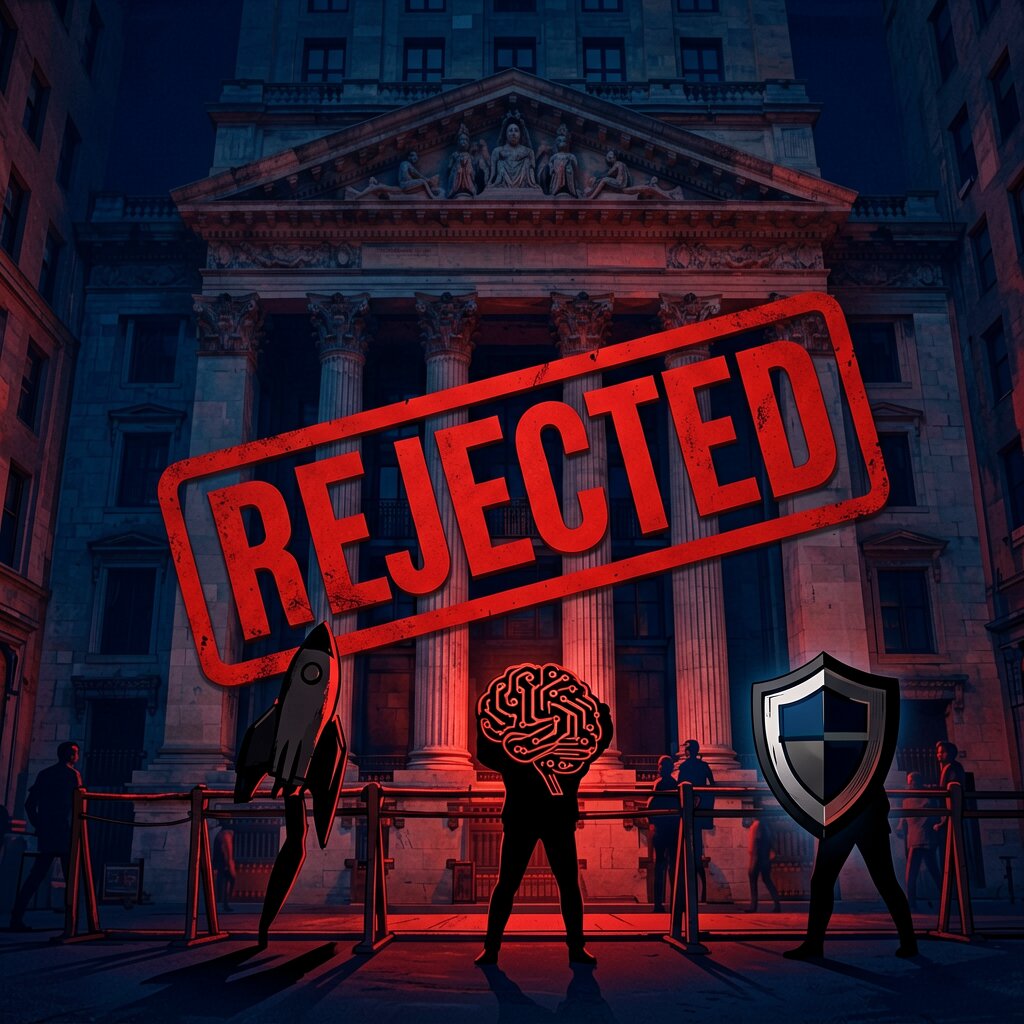
The S&P 500 — the benchmark index that governs the flow of trillions in passive investment capital — has effectively shut the door on SpaceX, OpenAI, and Anthropic. In a move that signals the limits of Wall Street's patience with the AI boom, the index's gatekeepers have made it clear they will not waive profitability requirements for the sector's most prominent names, no matter how large their valuations or how disruptive their technology. The decision reverberated through trading floors and venture capital offices alike, reminding everyone that even the most transformative companies must eventually face the cold arithmetic of profit and loss.
For SpaceX, the timing could not be worse. The Elon Musk-led aerospace and satellite giant is targeting a record-setting $75 billion IPO, a deal that would rank among the largest public offerings in history. Starlink, its satellite internet division, has seen revenue surge as it blankets the globe with low-earth orbit coverage, connecting remote villages and maritime vessels alike. Yet the company as a whole remains unprofitable. The cost of launching rockets, building satellite constellations, and developing next-generation spacecraft continues to outpace the revenue generated by its commercial and government contracts. Without S&P 500 inclusion, SpaceX will be locked out of the passive investment ecosystem that funnels billions into index-tracking funds and ETFs — the same ecosystem that has turbocharged the valuations of Apple, Microsoft, and Nvidia for decades. It is a structural handicap that no amount of Musk's Twitter hype can overcome.
OpenAI and Anthropic face the same wall, and in some ways their predicament is even more precarious. Both companies are actively pursuing IPOs, riding waves of investor enthusiasm for generative AI that have pushed private valuations to stratospheric levels. OpenAI has reportedly reached a $3.4 billion annual revenue run rate, a staggering figure for a company that did not exist in its current form a few years ago. ChatGPT's subscription revenue, API usage, and enterprise licensing deals have created genuine commercial traction. But beneath that headline number lies a cash furnace. The company is burning through capital at a pace that makes its revenue growth look almost modest by comparison. Training frontier models costs hundreds of millions per iteration. The compute bills alone would make a Fortune 500 CFO weep. Anthropic, valued at roughly $65 billion, is in a similar position — heavily loss-making despite its technical prowess, constitutional AI approach, and the backing of major investors including Amazon and Google. The Claude chatbot may be beloved by developers, but beloved does not pay the bills.
The Profitability Red Line
The S&P 500's inclusion criteria are not secret, but they are strict and deliberately so. A company must be profitable on a GAAP basis over the most recent quarter and over the sum of the most recent four consecutive quarters. It must also be a U.S. company with sufficient liquidity, a minimum market capitalization, and a track record of positive earnings. These rules have been in place for years, refined through multiple market cycles, and they have served the index well as a filter against speculative excess. The committee that oversees inclusion has survived the dot-com bubble, the 2008 financial crisis, and the meme-stock mania of 2021. It does not bend easily.
What has changed is the scale and significance of the companies now being excluded. SpaceX, OpenAI, and Anthropic are not niche startups chasing niche markets. They are among the most consequential technology companies of the decade, shaping everything from how humanity accesses the internet to how software is written. Their exclusion from the S&P 500 means that the trillions of dollars parked in passive index funds — retirement accounts, pension funds, endowments, and broad-market ETFs — will not flow into their shares. That is a structural headwind that no marketing campaign, no product demo, and no TED talk can overcome. When a company enters the S&P 500, it is effectively canonized by the American financial system. These three are being left outside the cathedral.
Passive investors represent the single largest pool of capital in global markets, and their influence has only grown with the rise of target-date funds, robo-advisors, and ETF platforms. When a company joins the S&P 500, index funds are effectively forced to buy its shares, creating a guaranteed bid regardless of market sentiment or analyst opinion. This "index inclusion effect" has been documented by academic researchers for decades, with studies showing abnormal returns around announcement dates as arbitrageurs front-run the inevitable index buying. Without this inclusion boost, these AI giants must rely on active managers and retail investors to absorb their public floats — a much more volatile, opinionated, and uncertain proposition. Active managers can say no. Index funds cannot.
A Credibility Blow at the Worst Moment
The S&P 500 decision lands at a precarious moment for the AI industry, when the so-called "Tokenpocalypse" — the relentless cost pressure from training and inference at scale — is already squeezing margins across the sector. Cloud providers are quietly raising prices for GPU clusters. AI startups are folding or being acquired for pennies on the dollar. Even the well-funded unicorns are being forced to justify their burn rates with actual revenue, not just user growth metrics and demo videos. The free-money era of zero interest rates is over, and capital now demands returns. The S&P 500 committee's decision is the institutional seal on that new reality.
For SpaceX, the exclusion is particularly sharp given the scale of its IPO ambitions. The company has long been valued on the promise of eventual profitability, with Starlink often cited as the path to sustainable cash flow. Satellite internet is a real business with real customers, and the addressable market is enormous. But the S&P 500 committee is not in the business of pricing future potential or discounted cash flow models stretching to 2035. It deals in reported earnings, audited financial statements, and the cold reality of GAAP net income. SpaceX's books still show red ink, and no amount of Mars colonization rhetoric changes that. A $75 billion IPO without index inclusion means the company will need to find buyers willing to bet on fundamentals alone — a tougher sell in a market that has grown accustomed to the passive bid cushioning every new entrant.
OpenAI's situation is arguably even more delicate because its corporate structure is in flux. The company is in the middle of a complex restructuring, transitioning from a capped-profit subsidiary under a nonprofit board to a more conventional for-profit corporate structure. Its IPO ambitions are central to that transition, providing liquidity for early employees and investors who have been waiting years for an exit. But if the S&P 500 will not admit it, OpenAI's public-market valuation may struggle to match the private-market hype that has pushed its worth past $150 billion in secondary transactions. The same venture capitalists who piled in at nosebleed valuations may find that public-market discipline is harsher and less sentimental than the Silicon Valley optimism they are used to. Public investors ask different questions than Y Combinator partners.
Anthropic, meanwhile, has built its reputation on safety research, constitutional AI, and a more cautious approach to capability development. The $65 billion valuation reflects investor confidence in that differentiated positioning. But the S&P 500 does not award points for ethical alignment, technical sophistication, or responsible scaling policies. It asks a simple, brutal question: are you making money? Anthropic's answer, for now, is no. The company's focus on safety and long-term research has come at the cost of near-term monetization, and while that may be the right strategic choice for building trustworthy AI, it is the wrong financial profile for index inclusion. Claude may refuse to write harmful content, but it also refuses to generate profits.
What This Means for the AI Market
The S&P 500's refusal to bend could force a strategic pivot across the entire AI sector. Companies that have prioritized growth above all else — scaling models, hiring researchers, acquiring compute, burning cash — may now face pressure to show profitability sooner than their roadmaps anticipated. The index inclusion carrot has been removed. The stick of public-market scrutiny is about to arrive with force. Wall Street has a way of concentrating minds that no boardroom strategy session can match.
This is not necessarily bad for the industry long-term. A focus on sustainable economics over growth-at-all-costs could lead to healthier business models, more disciplined capital allocation, and fewer speculative bubbles that end in spectacular crashes. The dot-com era produced genuine transformation, but it also produced Pets.com. The AI era risks similar casualties if economics are ignored. The S&P 500's stance may accelerate the winnowing process, separating companies with real business models from those that are essentially research projects with marketing teams. But the transition will be painful, and not every current unicorn will survive it.
For investors, the S&P 500 decision is a reminder that not all technology revolutions translate immediately into investable profits. The internet boom of the late 1990s produced transformative companies that changed how humanity communicates, shops, and entertains itself. But many of the most hyped names — Webvan, Kozmo, Excite — never made it into the index and never made money at all. They were footnotes, not foundations. The AI boom may follow a similar arc: enormous real value created, but with a long and messy sorting process before the winners are clear and the losers are forgotten. Patience, as always, is the scarcest commodity in technology investing.
The broader signal here is about market maturity. For years, AI has been treated as a special case — a sector so transformative that normal rules of economics could be suspended. The S&P 500 just said otherwise. AI is not special. It is a technology industry like any other, subject to the same laws of supply, demand, and profit. Companies that build sustainable businesses will thrive. Companies that burn cash indefinitely will not. The index committee has spoken, and its verdict carries more weight than any venture capitalist's blog post.
🔥 Hot Takes
1. The AI bubble just got its first official pinprick from the establishment. For years, VCs and private markets have been valuing AI companies on vibes and compute budgets. The S&P 500 just said "nah, show me the money." This is the moment the grown-ups entered the room. If you cannot turn a profit with a $3.4 billion revenue run rate, maybe the problem is not the market - maybe it is your business model.
2. SpaceX's $75 billion IPO is now a $75 billion question mark. Without the passive bid from index funds, SpaceX needs active managers and retail investors to carry a valuation larger than most Fortune 500 companies. Good luck with that when the company is still losing money and Elon Musk is already running four other companies. The IPO might still happen, but the price discovery is going to be brutal.
3. The "Tokenpocalypse" is about to become a profitability apocalypse. AI companies have been burning cash like it is infinite because, until recently, capital was infinite. The S&P 500 just signaled that the free money era is over. Expect layoffs, price hikes, and a lot of "pivot to enterprise" announcements in the next six months. The companies that survive will be the ones that can make a dollar of revenue cost less than a dollar to generate.
4. This is the best thing that could happen to actual AI innovation. Harsh? Maybe. But the last thing the world needs is another wave of zombie AI companies propped up by index fund inflows. By keeping the unprofitable out, the S&P 500 is forcing the industry to grow up. The companies that figure out how to make money from AI will be stronger for it. The ones that do not were never going to last anyway.
5. Passive investors just dodged a bullet. Imagine if the S&P 500 had waived the rules and let these cash-burning giants in. Every 401(k) and pension fund in America would have been forced to buy shares in companies that lose money faster than they make it. The committee did its job - protecting the integrity of the index, even if it means disappointing the AI hype machine.
The Bottom Line
The S&P 500's message is clear: profitability still matters. For SpaceX, OpenAI, and Anthropic, the exclusion is a short-term blow to credibility and a long-term challenge to valuation. For the AI industry, it is a wake-up call that growth without economics is not enough. And for investors, it is a reminder that the most powerful force in markets - the passive bid - answers to rules that no amount of hype can rewrite.