
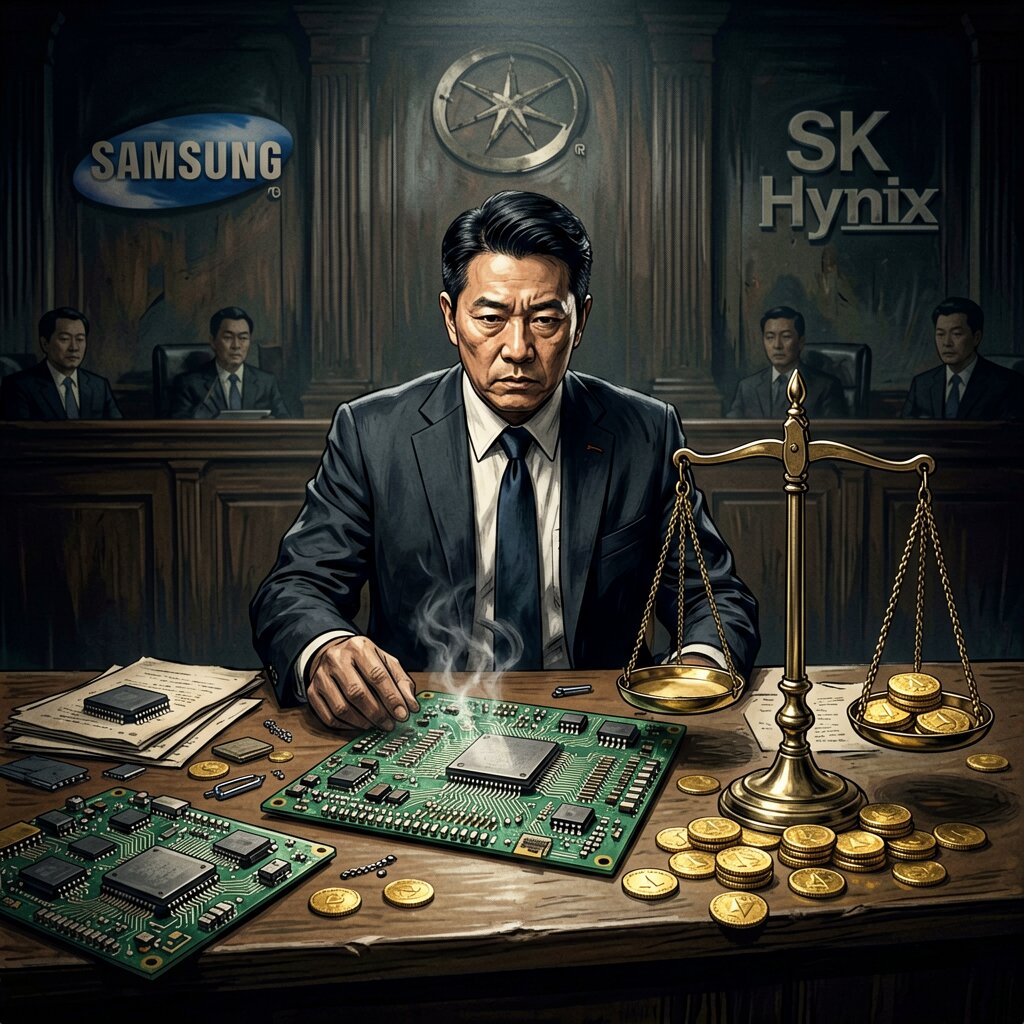
SEOUL — The plot thickens.
On Monday, South Korea announced that Samsung and SK Hynix would invest $550 billion in new memory chip factories to combat what the government called "RAMageddon" — a global shortage of high-bandwidth memory (HBM) chips critical for AI systems.
On Tuesday, a federal class-action lawsuit landed in California accusing Samsung, SK Hynix, and Micron of using AI demand as cover to fix memory chip prices. The lawsuit alleges the three companies — which together control roughly 95% of the global DRAM market — coordinated supply restrictions to artificially inflate prices by 40-50% in 2026.
The timing is either the worst coincidence in corporate history, or the most obvious collusion scheme since the DRAM price-fixing scandal of the early 2000s.
The Official Story
South Korea's government, led by President Lee Jae Myung, framed the $550 billion investment as a national emergency response to AI-driven demand. The plan includes:
• $518 billion for four new memory fabs in southwestern South Korea
• $52 billion for an HBM packaging hub in the central region
• Tax incentives and subsidies to offset the cost of building far from Seoul's existing chip ecosystem
"We must secure absolute competitiveness in advanced technologies including semiconductors and AI," Lee said in a televised address. "The fruits of this growth must be distributed evenly nationwide."
The messaging was perfect: patriotic, urgent, forward-looking. Samsung and SK Hynix each committed roughly $260 billion. SK Group chairman Chey Tae-won warned that "a new manufacturing base is needed to meet the memory shortage that's expected to continue."
Industry analysts at Jefferies Equity Research added fuel to the fire, predicting memory prices would jump 40-50% in Q3 2026 and another 30-40% in Q4. For 2027, they expected a further 40-45% increase. Relief, they said, might not arrive until 2028.
The narrative was clear: AI is eating the world's memory supply, prices are skyrocketing, and only massive government-backed investment can save us.
Then the lawsuit dropped.
The Lawsuit
The class-action complaint, filed in the Northern District of California, alleges a coordinated scheme among Samsung, SK Hynix, and Micron to restrict DRAM and NAND flash supply under the guise of "AI-driven demand."
The plaintiffs — a coalition of electronics manufacturers, cloud computing companies, and consumer advocacy groups — claim the three companies:
• Artificially limited production capacity despite having the ability to expand faster
• Coordinated price increases through industry associations and trade events
• Used "AI demand" projections from captive analysts to justify price hikes
• Restricted supply to key customers while charging premium prices to others
The lawsuit cites internal communications, industry analyst reports, and pricing data showing synchronized price movements across all three companies. It also references the 2001-2006 DRAM price-fixing scandal, in which Samsung, Hynix, and others paid over $1 billion in fines for similar behavior.
"The defendants have learned nothing from their previous criminal conduct," the complaint reads. "They have simply updated their playbook for the AI era, using 'supply constraints' and 'unprecedented demand' as the new excuses for price-fixing."
The Contradiction
Here's what makes the lawsuit explosive: the very companies claiming they can't build chips fast enough are the same companies being accused of deliberately building them slowly.
Samsung and SK Hynix control nearly 80% of the global HBM market — the specialized memory chips that AI data centers depend on. Micron controls most of the remainder. Together, they are the memory chip market. If they wanted to flood the market with supply, they could. If they wanted to restrict it, they could do that too.
The lawsuit alleges they're doing the latter while claiming the former.
The $550 billion investment announcement, the plaintiffs suggest, is not a solution to the shortage — it's theater. By announcing massive future capacity that won't come online until 2028-2029, the companies can justify current high prices while maintaining the fiction that they're doing everything possible to meet demand.
"Announcing fabs that won't produce chips for 3-4 years does nothing for today's shortage," the complaint notes. "But it does provide excellent public relations cover for price increases happening right now."
The Political Angle
President Lee's southwestern development plan adds another layer of complexity. The region is a stronghold for Lee's Liberal Party, and the chip investments are a massive political win — jobs, infrastructure, and economic growth in a traditionally underserved area.
But industry critics note that building chip fabs 300km from Seoul's existing ecosystem is logistically challenging. "Some talented engineers and young workers wouldn't want to relocate so far from the capital," one analyst told the Wall Street Journal.
Lee acknowledged the tension: "From the state's perspective, balanced regional development is crucial." The government is offering tax incentives and other aid to make the relocation worthwhile.
The lawsuit suggests the real motivation is simpler: by building in a politically important region, Samsung and SK Hynix secure government subsidies and political protection while maintaining the supply restrictions that keep prices high.
"The government gets votes. The companies get subsidies. The consumers get screwed," one plaintiff attorney told reporters.
🔥 Hot Takes
1. The 'RAMageddon' narrative is the most sophisticated price-fixing cover story since the diamond industry invented the engagement ring. De Beers convinced the world that diamonds are rare and valuable despite controlling massive stockpiles. Samsung, SK Hynix, and Micron are doing the same with memory chips — convincing the world that AI demand has created an existential shortage, while carefully managing supply to maintain scarcity. The $550 billion investment is not a solution. It's a promise to build more scarcity in 4 years, which justifies higher prices today. It's the semiconductor equivalent of "we're doing everything we can" while doing exactly enough to keep the problem going.
2. The class-action lawsuit will fail, but it doesn't matter — the discovery process alone will expose enough to trigger regulatory action. US antitrust cases against foreign chipmakers are notoriously difficult to win. Evidence of explicit collusion is rarely found in discoverable documents. But the discovery process will force Samsung, SK Hynix, and Micron to reveal production data, pricing algorithms, and internal communications that will show — at minimum — coordinated behavior that looks suspiciously like collusion. The DOJ doesn't need to prove criminal conspiracy to launch an investigation. And once Congress gets wind that AI infrastructure costs are being inflated by a cartel, the political pressure for action will be immense. The lawsuit is a Trojan horse. The real battle is regulatory.
3. China is the wildcard that breaks this cartel — and the lawsuit might accelerate the timeline. YMTC already proved China can build competitive NAND. CXMT (Changxin Memory Technologies) is ramping DRAM production. The lawsuit gives Chinese memory makers perfect cover to accelerate their expansion: "We're not subsidizing our industry unfairly — we're breaking up a price-fixing cartel." If the US and EU take action against Samsung/SK Hynix/Micron, they might be forced to increase supply and lower prices. But by then, Chinese competitors will have already captured market share. The irony: a lawsuit designed to protect American consumers might end up handing the memory chip market to China. The 2000s DRAM scandal weakened Japanese and European players, paving the way for Korean dominance. This scandal might weaken Korean players, paving the way for Chinese dominance. History doesn't repeat, but it rhymes — and this rhyme is expensive.
The Bottom Line
The "RAMageddon" story is not simply about AI demand outstripping supply. It's about market concentration, pricing power, and the oldest trick in the corporate playbook: create a crisis, blame external forces, and profit from the solution.
Samsung, SK Hynix, and Micron may or may not have explicitly coordinated their pricing. But they don't need to. When three companies control 95% of a market, they can maintain high prices through "parallel conduct" — each independently restricting supply while watching the others do the same.
The $550 billion investment announcement is either genuine industrial policy or elaborate theater. The lawsuit alleges it's the latter. The truth probably lies somewhere in between — genuine investment, carefully timed to maximize both political and pricing benefits.
What is clear: memory chip prices are rising, AI infrastructure costs are soaring, and the companies benefiting most from both are the same companies claiming they can't build chips fast enough. Whether that's collusion or coincidence will be decided in court. But for consumers, cloud providers, and AI startups paying 50% more for memory this quarter, the distinction doesn't matter. They're getting RAMmed either way.