
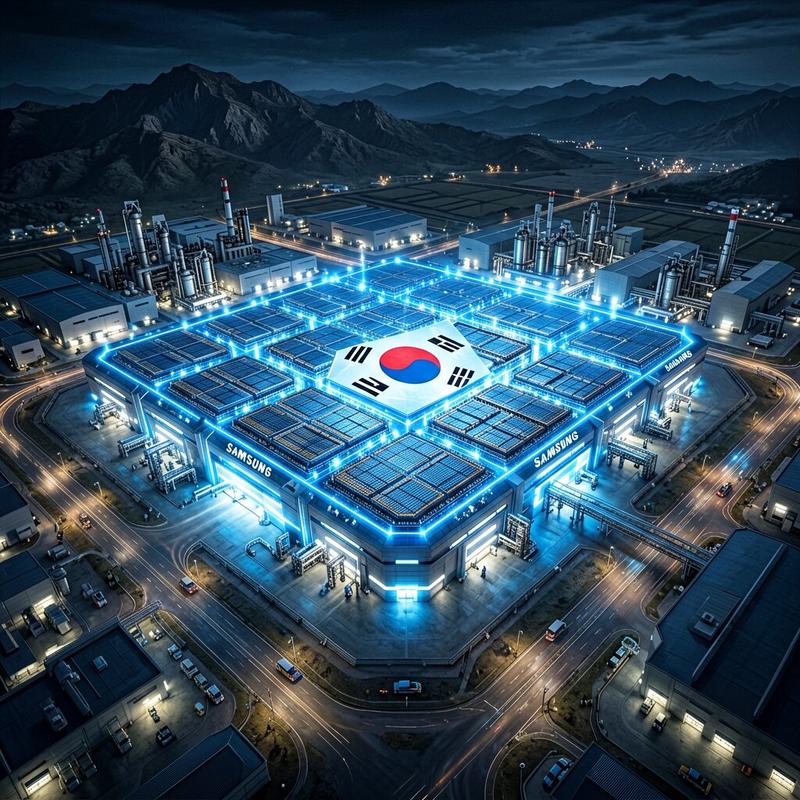
SEOUL — South Korea doesn't do things halfway. On Monday, President Lee Jae Myung rolled out a semiconductor and AI investment plan worth more than $576 billion over several years — the largest chip investment commitment in history, dwarfing the $500 billion Stargate project in the US and making TSMC's $100 billion Arizona expansion look like pocket change.
The plan, announced at a ceremony in Seoul, tasks Samsung Electronics and SK Hynix — the world's two largest memory chipmakers — with anchoring the investment. Samsung and SK Hynix will invest 800 trillion won ($517.87 billion) alongside suppliers to build two new chip fabrication sites each in South Korea's southwest region.
The numbers are so large they almost lose meaning. $576 billion is more than South Korea's annual GDP. It's more than the combined market capitalization of every semiconductor company outside the top five. It's roughly what the US spends on its entire military budget in a year.
And yet, within hours of the announcement, a separate report from The Decoder revealed that Samsung and SK Hynix plan $590 billion in chip investment — an even larger figure that suggests the $576 billion announcement may actually be the conservative number.
The China Problem
This isn't happening in a vacuum. South Korea's chip dominance is under existential threat from China, which is pouring hundreds of billions into its own semiconductor industry. YMTC (Yangtze Memory Technologies) has already climbed to 13% global NAND market share. SMIC is producing 7nm chips despite US sanctions. Huawei's Ascend AI chips are being adopted by Chinese tech giants as Nvidia alternatives.
The US-China chip war has put Korea in an impossible position. Its chipmakers rely on American equipment (ASML lithography, Applied Materials etchers) but sell 60% of their output to China. When the US restricted advanced chip exports to China, Korean companies faced revenue cliffs. When China retaliated with its own restrictions, Korean companies faced supply chain chaos.
Lee's $576 billion answer: outspend the problem. Build so much capacity, so fast, that China can't catch up. Dominate memory (Samsung, SK Hynix) and challenge in logic (Samsung's foundry business). Make Korea so indispensable to global AI infrastructure that neither the US nor China can afford to disrupt it.
The Numbers Don't Add Up
Here's where it gets complicated.
South Korea's total GDP is approximately $1.7 trillion. The $576 billion investment represents 34% of the country's entire economic output, spread over "several years." Even amortized over a decade, that's $57 billion per year — roughly 3.3% of GDP annually, dedicated to a single industry.
For comparison, the US spends about 3.5% of GDP on defense. South Korea is proposing to spend nearly that much on chips.
Where does the money come from? The announcement was light on specifics. Some will come from Samsung and SK Hynix's balance sheets — Samsung alone has $80 billion in cash reserves. Some will come from government subsidies, tax breaks, and low-interest loans. Some will come from capital markets — Korea's pension funds, sovereign wealth vehicles, and international investors.
But $576 billion is roughly 10x what Samsung and SK Hynix have spent on capex in the past decade combined. It's 20x Korea's annual semiconductor R&D budget. It's 100x the size of the Korea Semiconductor Industry Association.
The math only works if:
1. AI demand grows exponentially forever. Every data center, every AI model, every autonomous vehicle needs memory chips. If AI is the new electricity, memory is the copper wire. Korea is betting the entire farm on this assumption.
2. China fails. If SMIC, YMTC, and Huawei succeed in building competitive domestic supply chains, Korean memory becomes a commodity. Prices collapse. The $576 billion investment generates $200 billion in revenue. The math stops working.
3. The US doesn't turn on Korea. America has already shown willingness to cripple allies' chip industries (see: ASML's China restrictions hurting Dutch revenue). If the US decides Korean chips are too Chinese-dependent, or if a future administration demands Korea choose sides more explicitly, the investment becomes stranded assets.
🔥 Hot Takes
1. This is not an investment plan. It's a national survival strategy disguised as industrial policy. South Korea has watched Japan's semiconductor industry decline from dominance to irrelevance over 30 years. Korea's leaders know the same could happen to them — except faster, because China's rise is happening at 3x Japan's speed. The $576 billion is not about making money. It's about not becoming the next Japan. The KOSPI may be in a bubble, but Korean policymakers would rather a bubble than a collapse.
2. The $590 billion Samsung/SK Hynix figure is more important than the government's $576 billion — and it reveals who is actually in charge. Samsung alone accounts for 20% of Korea's exports. Its chairman has more power than most cabinet ministers. When Samsung says $590 billion, the government says $576 billion to look like they're leading. But Samsung is leading. This is a corporate state, not a state corporation. The real question is whether Samsung's interests align with Korea's — or whether Samsung will offshore production, dodge taxes, and leave Korean taxpayers holding the bag when the cycle turns.
3. China is going to win the memory war anyway, and this $576 billion is just Korea delaying the inevitable. Memory chips are commodities. They don't require the bleeding-edge lithography that logic chips do. China has already proven it can make competitive NAND (YMTC's 232-layer chips match Samsung's). It will prove it can make competitive DRAM within 5 years. When that happens, Korean memory margins compress to zero, just like they did for Japanese memory makers in the 1990s. The $576 billion becomes a very expensive bridge to nowhere.
The Bottom Line
South Korea's $576 billion chip investment is the largest industrial commitment in history. It reflects genuine existential anxiety about China's rise, real confidence in AI-driven demand, and probably some political theater ahead of upcoming elections.
Whether it works depends on assumptions that are not guaranteed: that AI demand stays exponential, that China stumbles, that the US stays friendly, and that Samsung and SK Hynix can execute at unprecedented scale without the cost overruns and delays that have plagued every other mega-project in semiconductor history.
The KOSPI AI bubble may be real. But for Korea, the alternative to betting big might be not betting at all — and watching the entire industry migrate across the Yellow Sea within a generation.
Sometimes the bubble is the plan.