
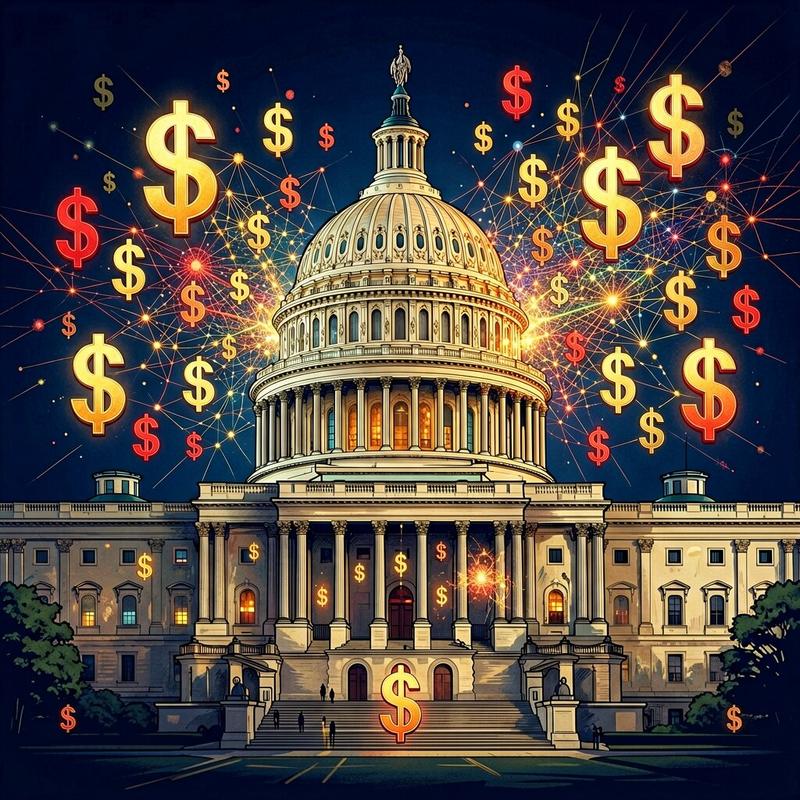
OpenAI has proposed handing the U.S. government a 5% stake in the company, according to a Financial Times report. At OpenAI's current $852 billion valuation, that stake is worth approximately $42.6 billion. And Sam Altman isn't stopping there — he wants the same arrangement for Anthropic, Google, and Meta.
The proposal, first pitched to the Trump administration in early 2025, has evolved from a vague concept into a concrete plan. Altman argues that giving the public a financial interest in AI companies is the best way to share the upside of artificial intelligence. The mechanism would be a government-owned sovereign wealth fund that holds stakes in leading American AI developers.
"A beautiful thing," President Trump called the idea. "Americans would be partners in this revolution."
The Numbers
OpenAI closed a record-breaking funding round in March at a $852 billion post-money valuation. A 5% stake at that valuation is worth $42.6 billion. But the actual value could be much higher — or much lower — depending on OpenAI's IPO performance.
The company has been discussing a government stake for more than a year. In April, OpenAI published a white paper proposing a "public wealth fund" that would capture growth in AI companies and distribute economic benefits to the public. The 5% stake proposal appears to be the first concrete step toward that vision.
But here's the catch: OpenAI's valuation is based on private market funding rounds, not public trading. The $852 billion figure assumes continued growth, successful commercialization, and no major regulatory setbacks. If OpenAI's IPO underperforms — as many tech IPOs have — the government's stake could be worth significantly less.
The Precedent
The Trump administration has already taken stakes in private companies. In August 2025, the government acquired a 10% stake in Intel after an $8.9 billion investment. In May 2026, Trump said he should have asked for a bigger stake.
The Intel deal was framed as strategic — securing domestic semiconductor manufacturing. The OpenAI proposal is different. It's not about securing supply chains or critical infrastructure. It's about capturing value from a technology that the government increasingly views as strategically important.
This represents a fundamental shift in how Washington treats AI. From 2022 to 2025, the government's approach was primarily regulatory — export controls, safety testing, antitrust scrutiny. Now it's moving toward ownership. The logic is simple: if AI is the most important technology of the century, America should own a piece of it.
The Reaction
Anthropic, the most direct competitor to OpenAI, has not discussed government stakes, according to a source familiar with the matter. This creates an awkward dynamic: OpenAI is proposing a deal that would give the government a vested interest in its success, while Anthropic is not.
Google and Meta have not publicly responded to the proposal. Both companies have their own AI divisions and their own relationships with Washington. Accepting a government stake would mean sharing ownership — and potentially control — with the administration. Rejecting it could mean falling behind OpenAI in the race for government favor.
Senator Bernie Sanders has pushed for a much larger government stake — reportedly targeting 20-30% of major AI companies. The 5% proposal is a compromise that gives Washington a meaningful position without triggering accusations of nationalization.
The Implications
A government stake in OpenAI creates several immediate concerns:
Conflict of interest: If the government owns 5% of OpenAI, it has a financial incentive to favor OpenAI in procurement decisions, regulatory approvals, and antitrust reviews. This could distort competition and create a de facto government-backed monopoly.
Political influence: Government shareholders typically expect board representation and voting rights. A 5% stake in OpenAI could come with a board seat, giving Washington direct influence over the company's strategic decisions. This is unprecedented for a technology company of OpenAI's scale.
Valuation risk: The government's stake would be valued at private market prices, not public market prices. If OpenAI's IPO underperforms, the government could be left holding an overvalued asset. This creates political risk for both parties — Democrats would blame Republicans for a bad deal, and vice versa.
International precedent: If the US government takes stakes in AI companies, other governments will follow. China already has state-owned AI enterprises. The EU is considering similar measures. A global trend toward government ownership of AI could fragment the industry along national lines.
🔥 Hot Takes
1. This is the privatization of government in reverse. For 40 years, the trend was government selling assets to the private sector — airlines, telecoms, utilities. Now the trend is reversing: the private sector is selling stakes to the government. AI is too important to leave to the market, and too profitable to leave to the government. The compromise is shared ownership. But shared ownership means shared control, and shared control means neither side can act decisively.
2. OpenAI is buying regulatory immunity. A 5% stake is cheap insurance against antitrust action, export control restrictions, and safety regulation. The government that owns a piece of OpenAI is less likely to break it up, restrict its exports, or mandate safety testing that slows development. Altman isn't sharing the upside — he's buying the downside protection. And $42.6 billion is a bargain if it prevents a $100 billion antitrust fine.
3. The real winner is neither OpenAI nor the government — it's the lawyers. The legal structure required to make this work is mind-boggling. How do you value a private company stake for government accounting? How do you prevent insider trading when government officials know OpenAI's strategic plans? How do you handle board representation without creating conflicts of interest? How do you divest if the government changes its mind? This deal will generate billions in legal fees and take years to structure. By the time it's finalized, the AI landscape will have changed completely.
What Happens Next
The Trump administration will likely accept the proposal in some form. The political benefits — "we're making Americans partners in the AI revolution" — are too good to pass up. The details will be negotiated over months, with lawyers and lobbyists fighting over every clause.
Anthropic will face pressure to match the offer. If OpenAI has a government stake and Anthropic doesn't, OpenAI gains a competitive advantage in Washington. Dario Amodei will have to decide whether to accept government ownership or risk being frozen out of the most lucrative government contracts.
The EU and China will respond with their own state ownership initiatives. The global AI industry is heading toward a model where every major AI company has a government shareholder. This isn't capitalism. It isn't socialism. It's something new — and nobody knows how it will work.
The bottom line: OpenAI's $42.6 billion offer isn't about sharing wealth. It's about securing power. The government gets a stake in the most important technology of the century. OpenAI gets regulatory immunity and political protection. And the rest of the AI industry gets a new playbook: if you want to survive, sell a piece of yourself to Washington.