
OPINION / ANALYSIS — This article presents a speculative interpretation of publicly available facts. The conclusions are the author's own.
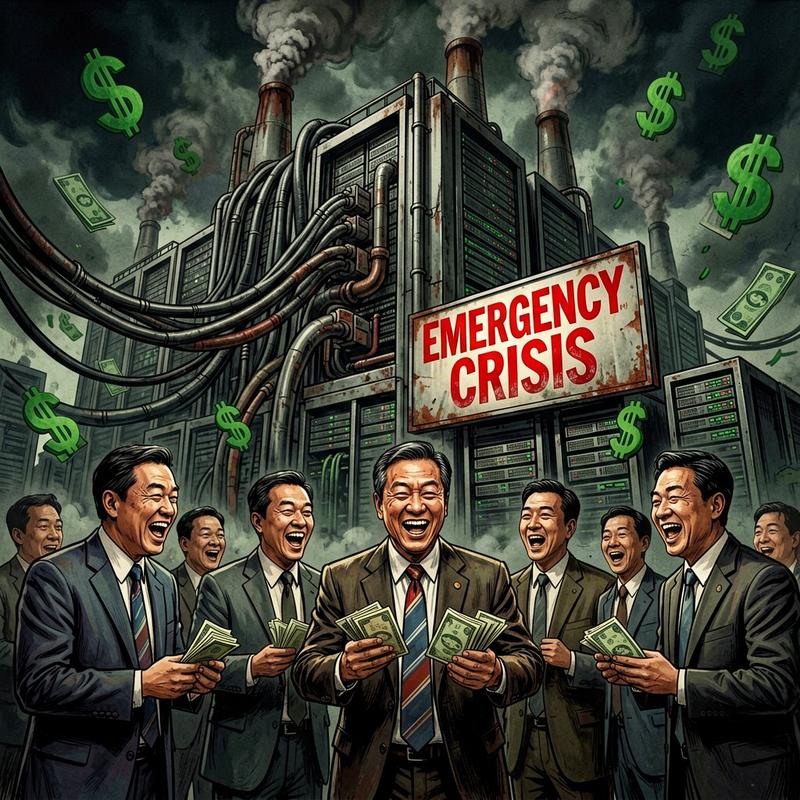
Every few years, a new technology creates an "existential infrastructure crisis" that just happens to require billions in government subsidies, emergency regulatory waivers, and taxpayer-funded expansion of private industry.
In the 1990s, it was the "Y2K bug" — planes would fall from the sky, banks would collapse, civilization would end unless we spent $300 billion fixing it. (Spoiler: nothing happened.)
In the 2000s, it was the "broadband gap" — America would fall behind unless telecoms got $200 billion in subsidies to build fiber networks. (They took the money. Many didn't build the networks.)
In the 2010s, it was "5G or bust" — China would dominate the future unless we let Huawei competitors bypass environmental reviews and zoning laws to build towers everywhere. (The towers got built. The promised economic revolution didn't.)
Now it's the "AI data center power crisis." And the playbook is identical.
The "Breaking Point" That Isn't Breaking
The South China Morning Post reports that "AI pushes data centres to breaking point" and Chinese chipmakers are "betting on silicon carbide (SiC) semiconductors to help solve the technology sector's power problem."
Let's look at what this actually means.
Data centers are not failing. They are not collapsing. They are not creating blackouts or grid failures. The article does not cite a single instance of a data center actually reaching a "breaking point." What it cites is projections — estimates that future AI demand will require more power than current infrastructure can provide.
This is not a crisis. This is a business plan.
Here's how the game works:
Step 1: Announce that your industry is facing an existential crisis that threatens national competitiveness. Use phrases like "breaking point," "existential threat," and "fall behind China."
Step 2: Demand emergency government action — subsidies, tax breaks, regulatory waivers, fast-track permitting. Frame it as a national security imperative, not a corporate handout.
Step 3: Receive billions in public money. Build capacity that was already planned. Claim the crisis was averted because of your heroic expansion.
Step 4: When the projected demand doesn't materialize, claim the crisis was averted because of your heroic expansion. If demand does materialize, raise prices and blame the remaining "capacity constraints."
This is not conspiracy theory. This is standard industrial policy, practiced by every major industry since the railroads.
The Silicon Carbide Gold Rush
The SCMP article highlights Shenzhen-based Basic Semiconductor, which "passed a listing hearing earlier this week in its path to an initial public offering (IPO) in Hong Kong." The company is "one of China's few fully integrated device manufacturers in the SiC space."
Notice the timing. The "crisis" narrative peaks exactly when a SiC chipmaker needs to go public. The IPO will value the company based on its projected role in solving the "data center power crisis." If the crisis is real, the valuation is justified. If the crisis is manufactured, the valuation is a bubble.
UBS analysts — cited in the article — note that "the global SiC market was currently oversupplied, largely due to aggressive capacity expansion by Chinese firms." Oversupplied. That means there is already more SiC chip capacity than current demand requires. The "crisis" is not a shortage. It is a surplus that needs new demand to justify the expansion.
Enter data centers. Nvidia's "800V Kyber rack configurations" are expected to use SiC chips for "10 to 15 per cent of the power semiconductor architecture" in 2027. This is not a crisis response. This is a market creation strategy — using projected future demand to absorb current oversupply and justify further expansion.
The Environmental Waiver Angle
Here's where the conspiracy gets darker.
Data centers are massive power consumers. A single hyperscale facility can use as much electricity as a small city. Building them requires environmental impact assessments, grid stability studies, zoning approvals, and public consultation. In democracies, this process takes years.
Unless there is a "crisis."
Emergency declarations bypass normal regulatory processes. When the government declares that AI competitiveness is a national security imperative, environmental reviews get fast-tracked. Public opposition is overridden. Zoning laws are waived. Taxpayers fund the grid upgrades that private companies would otherwise have to pay for themselves.
The "AI data center power crisis" is not just about selling chips. It is about building data centers without asking permission.
In China, this is straightforward — the government directs, companies comply. In the US and Europe, it requires more theater. You need think tanks publishing reports. You need industry associations lobbying. You need op-eds from former government officials warning that "we're falling behind." You need the media to repeat the crisis narrative until it becomes accepted fact.
And then you need the environmental groups to be too busy fighting other battles to notice that the "emergency" just waived the regulations they spent decades creating.
The SMIC Warning Everyone Ignored
In February 2026, Bloomberg reported that China's top chipmaker, SMIC, warned that "breakaway spending on artificial intelligence chips is bringing forward years of future demand, raising the risk that some data centers could sit idle."
This is not a fringe opinion. This is China's largest chipmaker saying, publicly, that the current expansion may be too much, too fast — and that the result could be idle capacity.
Idle capacity means buildings built, power allocated, subsidies spent, and no actual use. It means the "crisis" was solved before it existed, by building infrastructure that wasn't needed.
SMIC's warning was buried under the avalanche of "AI power crisis" headlines. Because a warning about oversupply doesn't serve the narrative. The narrative requires urgency, scarcity, and emergency. The narrative requires you to believe that without immediate, massive expansion, the future will be lost.
The narrative is not about solving a crisis. It is about creating a market for chips that are already oversupplied.
🔥 Hot Takes
1. The "AI data center crisis" is the Y2K bug of the 2020s — a real technical challenge that has been deliberately exaggerated to extract public money. Data centers need more power. This is not controversial. But the "breaking point" framing is a lobbying strategy, not a engineering assessment. The same companies warning about the crisis are the same companies that will profit from the solution. This is not a coincidence. It is the business model.
2. Silicon carbide chipmakers are using the crisis narrative to IPO at inflated valuations based on demand that may never materialize. Basic Semiconductor's Hong Kong IPO is timed perfectly with the "data center power crisis" narrative. UBS says the SiC market is already oversupplied. The IPO valuation assumes massive data center demand in 2027-2028. If that demand doesn't appear — if SMIC's warning about idle capacity proves correct — investors will be left holding chips (literally) that nobody needs. The crisis narrative is a pump-and-dump with government branding.
3. The real goal is not solving a power crisis — it is bypassing environmental regulations that would otherwise prevent rapid data center expansion. Every major data center project in the US and Europe faces opposition from local communities worried about grid stability, noise, water consumption, and land use. The "AI competitiveness emergency" framing turns these local concerns into national security threats. Opposing a data center becomes "helping China win." This is not policy. This is propaganda. And it is working.
The Bottom Line
Data centers need power. More data centers will need more power. This is a real infrastructure challenge that requires real planning, real investment, and real regulation.
But the "breaking point" framing is not about solving this challenge responsibly. It is about creating a sense of emergency that justifies shortcuts, subsidies, and deregulation that benefit specific companies at public expense.
The chipmakers warning about the crisis are the same chipmakers selling the solution. The analysts projecting massive demand are employed by banks underwriting the IPOs of companies selling the solution. The former government officials writing op-eds work for lobbying firms hired by companies selling the solution.
This is not a conspiracy. It is an industry. And it is very, very good at what it does.
The question is not whether data centers need more power. They do. The question is whether the "crisis" narrative is the best way to address that need — or whether it is a manufactured emergency designed to enrich specific companies while bypassing the democratic processes that would otherwise ensure the expansion happens responsibly, sustainably, and transparently.
History suggests we should be skeptical. The Y2K bug didn't crash civilization. The broadband subsidies didn't build fiber networks. The 5G revolution didn't transform the economy. And the "AI data center power crisis" will likely be remembered as another example of an industry crying wolf — while the wolves were actually the ones doing the crying.