
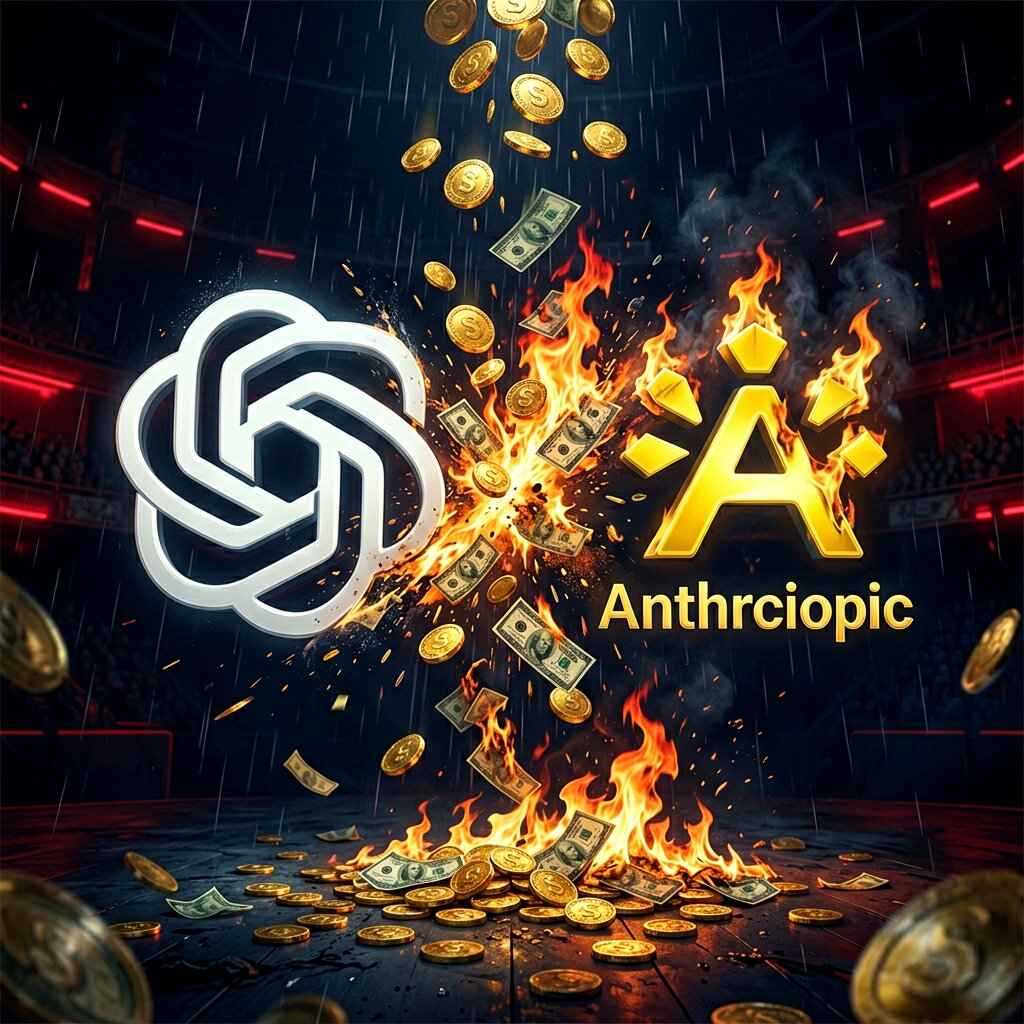
The AI industry's worst-kept secret is now official: OpenAI and Anthropic are in a price war. And both companies are already bleeding billions.
Sam Altman told a recent event that AI costs have become "a huge issue" for businesses. The Wall Street Journal reports OpenAI is weighing token price cuts to win customers from Anthropic. The expectation? Anthropic will match them move for move. This is how price wars start — not with announcements, but with quiet desperation.
How We Got Here: The Subscription-to-Usage Trap
For years, AI companies sold flat-rate subscriptions. $20/month for ChatGPT Pro. $200/month for enterprise teams. Users loved the predictability. Companies loved the margins. Everyone pretended that AI workloads were light enough to fit inside a monthly cap.
That fantasy died with AI agents.
Claude Code went viral among developers because it actually works — it reads entire codebases, writes production-ready code, and debugs autonomously. But that productivity comes at a cost. A single complex coding session can burn through millions of tokens. What used to cost $200/month under a flat-rate plan now costs "several thousand or even tens of thousands of dollars" under usage-based billing.
Most providers have shifted enterprise pricing to usage-based models. The same AI workload that fit inside a subscription now balloons to enterprise-scale bills. Some customers are already pulling back on AI spending. The token economy, which looked like a gold rush six months ago, is starting to look like a trap.
The Valuation Flip
Anthropic passed OpenAI in valuation for the first time this year. Let that sink in. The startup that was "OpenAI's safety-conscious competitor" is now worth more than the company that defined the generative AI era. Claude Code's viral success among developers is a major driver — it's the coding tool that actually delivers on the promise of AI-assisted development.
OpenAI's response? Cut prices. Win back customers. Hope that volume makes up for margin collapse. It's the classic playbook of a market leader under pressure from a faster, hungrier competitor.
But here's the problem: both companies are already losing billions. OpenAI burns through cash at a rate that makes WeWork look fiscally responsible. Anthropic, despite the valuation win, is still deeply unprofitable. A price war deepens losses for both sides. It's mutually assured destruction, but with API tokens instead of nuclear missiles.
The IPO Timing Disaster
Both companies filed IPO paperwork this week. OpenAI confidentially filed but likely won't go public until 2027. Anthropic filed its paperwork and plans to list later this year. The timing is almost comically bad.
Going public during a price war is like launching an IPO during a recession. Investors want growth and margins. A price war destroys margins. OpenAI's delay to 2027 makes sense — they're hoping to stabilize pricing before facing public market scrutiny. Anthropic's rush to list this year looks like they're trying to cash out before the war gets worse.
The irony? Both companies need IPO capital to fund the price war. OpenAI's $500 billion data center ambition, Anthropic's compute-intensive Fable and Mythos models — none of it is cheap. They need public market money to subsidize API prices that don't cover costs. It's a Ponzi scheme with better branding.
What Happens to Customers
In the short term, customers win. Lower API prices mean cheaper AI integrations, more experiments, broader adoption. Startups that couldn't afford frontier model APIs might now get access. Developers can build more ambitious projects without worrying about token budgets.
But the long-term picture is darker. If both companies are losing money on every API call, something has to give. Either prices go back up (destroying the projects built on cheap tokens), or one company goes under (destroying the projects built on their infrastructure), or both companies get acquired by giants who don't care about API margins (Google, Microsoft, Amazon).
The "token economy" was supposed to be the new unit of AI value. Instead, it's becoming a race to the bottom where the only winners are the cloud providers selling the compute underneath. Nvidia, AWS, and Google Cloud don't care who wins the API war — they sell the shovels.
The Enterprise Pullback
The most worrying signal isn't the price war itself — it's the enterprise pullback. Some customers are already reducing AI spending. That means the ROI isn't there yet. Companies tried AI agents, saw the bills, and quietly scaled back. The promise of "AI does the work of ten employees" runs into the reality of "AI costs as much as ten employees but makes different mistakes."
For the price war to work, both companies need enterprise customers to stick around and scale up. If customers are pulling back instead of doubling down, the entire growth narrative collapses. The IPO valuations assume exponential growth. A price war with shrinking enterprise demand is the opposite of that.
🔥 Hot Takes
1. The AI API business model is fundamentally broken. You can't sell intelligence by the sip and expect to build a profitable business. Either AI is so good it replaces human labor (in which case charge for outcomes, not tokens), or it's a productivity tool (in which case flat-rate subscriptions make sense). Usage-based pricing for generative AI is the worst of both worlds — unpredictable costs for customers, razor-thin margins for providers. The price war proves nobody has figured out the right model yet.
2. Anthropic's valuation lead is a trap, not a trophy. Being worth more than OpenAI means nothing if you're losing more money per dollar of revenue. Anthropic's Fable 5 costs $50 per million output tokens. OpenAI's GPT-5.5 is cheaper but less capable. The price war forces Anthropic to cut prices on their premium product, destroying the margin that justified the premium in the first place. This is how market leaders get disrupted — not by better products, but by price wars they can't afford to win.
3. The real winners are Nvidia and the cloud giants. OpenAI and Anthropic are fighting over who gets to lose more money selling API access to models that run on Nvidia chips in AWS/Azure/GCP data centers. The price war doesn't hurt the infrastructure layer — it helps them. More API calls at lower prices means more compute consumption. Nvidia's stock goes up whether OpenAI or Anthropic wins. Jeff Bezos and Satya Nadella are probably cheering this fight from the sidelines.
Bottom line: The API price war is the moment the AI industry's business model fiction finally collapsed. Both companies are losing billions, both filed for IPOs they can't afford to delay, and both are cutting prices to win customers who are already pulling back. The token economy isn't a revolution — it's a race to the bottom where the only guaranteed winners are the chipmakers and cloud providers selling the infrastructure. OpenAI and Anthropic are fighting over who gets to be the most unprofitable AI company in history. Place your bets accordingly.