
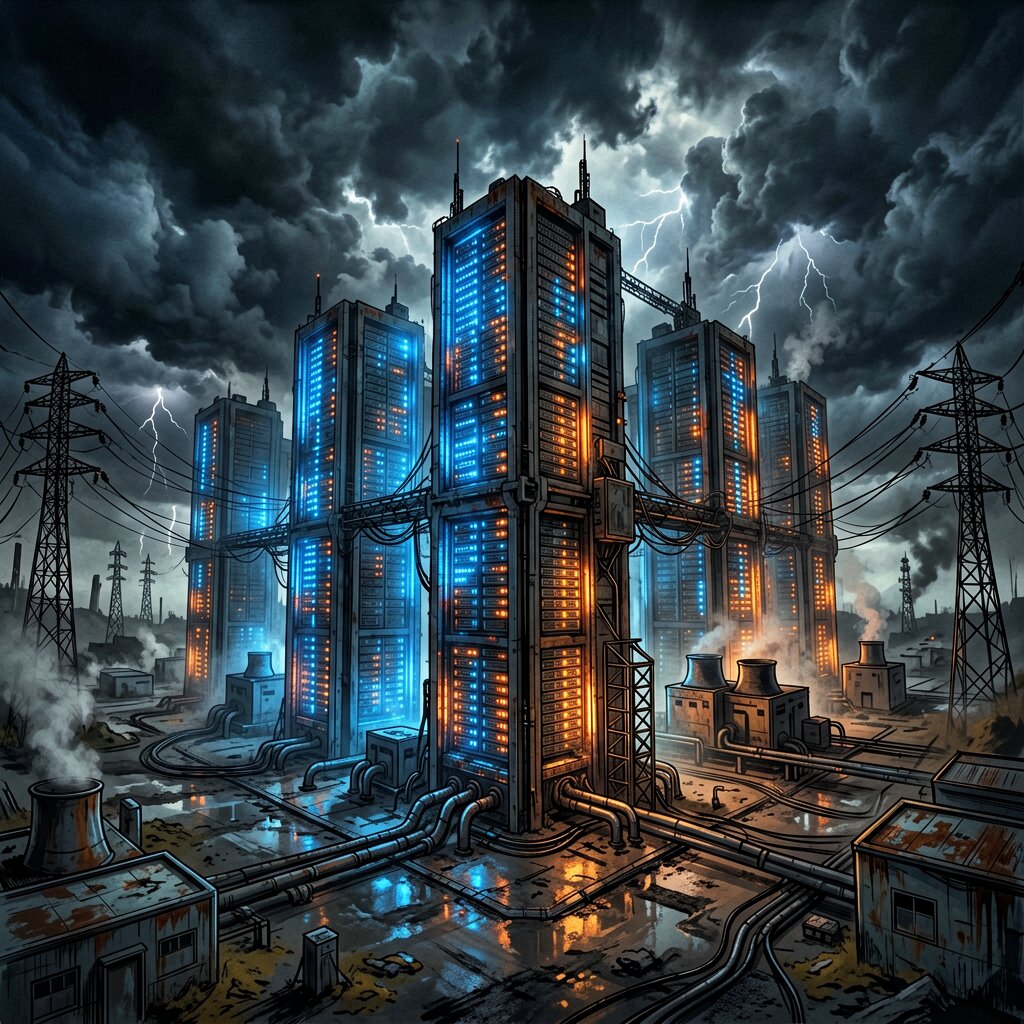
OpenAI is negotiating to lease a planned 10-gigawatt data center in Ohio — and Nvidia would back the bill. We're not talking about a server farm. We're talking about the largest AI infrastructure project in human history, on a site that used to enrich uranium for nuclear weapons.
The numbers are hallucinatory. At full buildout, costs would reach at least $500 billion. That's half a trillion dollars for a single data center complex. To put that in perspective, that's more than the GDP of Ireland, Portugal, and Vietnam combined. For one facility.
The Deal Structure
According to The Information, two people with direct knowledge of the talks shared the details. The site is being built on federal land in southern Ohio and developed by SB Energy, which is majority-owned by SoftBank — already an OpenAI investor.
OpenAI would sign a 20-year lease, its largest infrastructure commitment to date. But here's where it gets really interesting: Nvidia would serve as guarantor for both the lease and project financing, backing the payments with its balance sheet. This would be new territory for the chipmaker at this scale. Nvidia isn't just selling GPUs to OpenAI anymore. It's becoming a financial partner in the infrastructure itself.
Why would Nvidia do this? Because if OpenAI builds a 10-gigawatt facility, guess whose chips fill it? Nvidia isn't just guaranteeing a loan — they're guaranteeing a customer for the next two decades. It's vertical integration disguised as financial engineering. The GPU company becomes the bank, the landlord, and the supplier all at once.
The Stargate Ghost
This project echoes the Stargate initiative announced at the White House in January 2025 with Oracle and SoftBank. That project, which was supposed to be a $500 billion AI infrastructure buildout, ultimately made little progress due to unresolved disputes between the partners.
So what's different this time? Two things. First, the site is already federal land — a former uranium enrichment facility in Pike County — which simplifies permitting and land acquisition. Second, Nvidia's involvement as financial guarantor adds a level of credibility and capital backing that Oracle apparently couldn't provide.
The first phase at 800 megawatts is expected by 2028. That's still two years away, and negotiations are ongoing. Plans could change. But the ambition is staggering: 800 megawatts is just the warm-up act. The full 10-gigawatt vision is twelve times larger.
What 10 Gigawatts Actually Means
To understand the scale, consider this: the world's largest operational data center today is probably somewhere in the 100-200 megawatt range. OpenAI's current facilities are likely in the hundreds of megawatts. A 10-gigawatt facility would be 50 to 100 times larger than today's biggest data centers.
It would require roughly 5-7 million high-end GPUs. It would consume more electricity than many countries. The cooling requirements alone would be equivalent to a small city's water supply. The network infrastructure to connect that many GPUs would be unprecedented — we're talking about custom optical interconnects, specialized networking fabrics, and power distribution systems that don't exist yet at this scale.
And here's the kicker: OpenAI needs this. GPT-5.5 is already straining their existing infrastructure. GPT-5.6 is reportedly coming in June. The models are getting bigger, the training runs are getting longer, and the inference demands are exploding. If OpenAI wants to maintain its lead — or even keep pace with Anthropic's Fable 5 — it needs compute at a scale that makes today's facilities look like toy computers.
The IPO Timing
On Monday, OpenAI confidentially filed paperwork for an IPO. Sam Altman told employees via Slack he expects it "within the next year." The timing isn't accidental. A $500 billion infrastructure commitment requires capital markets access. You can't fund that with venture rounds and Microsoft partnerships alone.
But Altman also hedged: "technology and the world may change in surprising ways, and there might be good reasons to be a private company during that time." Translation: if AGI arrives sooner than expected, going public might be the worst decision in corporate history. A company that invents superintelligence doesn't need public markets — it needs secrecy and control.
The employee stock sale at $687.69 per share is also telling. OpenAI is letting employees cash out before the IPO, which suggests they're not entirely confident about the public valuation. Or they're trying to retain talent by offering liquidity without the regulatory headaches of going public.
The Geopolitical Angle
There's a national security dimension here that's impossible to ignore. A 10-gigawatt AI facility on federal land, backed by a Japanese conglomerate (SoftBank) and an American chipmaker (Nvidia), training models that the Pentagon is already interested in using. This isn't just a commercial project — it's strategic infrastructure.
The location matters too. Ohio is politically important (swing state), has cheap electricity from the Midwest grid, and offers federal land that bypasses local zoning fights. The former uranium enrichment site already has security clearances, hardened infrastructure, and isolation from population centers. It's perfect for a facility that will house some of the most valuable intellectual property on Earth.
🔥 Hot Takes
1. This is the AI infrastructure arms race going nuclear — literally. The uranium enrichment site symbolism is too perfect. The last technology that required this scale of government-backed, secretive, massively expensive infrastructure was the atomic bomb. Now it's AI training clusters. The Manhattan Project cost $2 billion in 1945 dollars (about $30 billion today). OpenAI wants $500 billion. The stakes are arguably higher.
2. Nvidia just became the most powerful company in tech. Not because they make the best chips — because they can guarantee half-trillion-dollar projects. When a GPU company has a balance sheet strong enough to back $500 billion in infrastructure financing, it's not a chip company anymore. It's a sovereign financial entity. The US government should be paying attention.
3. The Stargate failure was a feature, not a bug. OpenAI learned from the first attempt. Stargate failed because too many partners (Oracle, SoftBank, OpenAI) had conflicting interests. This new deal simplifies the structure: SoftBank provides the land and development, OpenAI provides the demand, Nvidia provides the financing and the chips. Three players, aligned incentives, no Oracle. Sometimes the best lesson from a failed project is who to leave out.
Bottom line: OpenAI isn't just building a bigger data center. It's building the infrastructure for the next phase of human civilization — and putting it on a nuclear site with a half-trillion-dollar price tag. The scale is so vast that it warps the entire tech industry around it. Every AI company will be competing for scraps of compute while OpenAI (maybe) monopolizes the largest training facility ever built. The question isn't whether they can build it. It's whether anyone else can afford to compete once they do.