
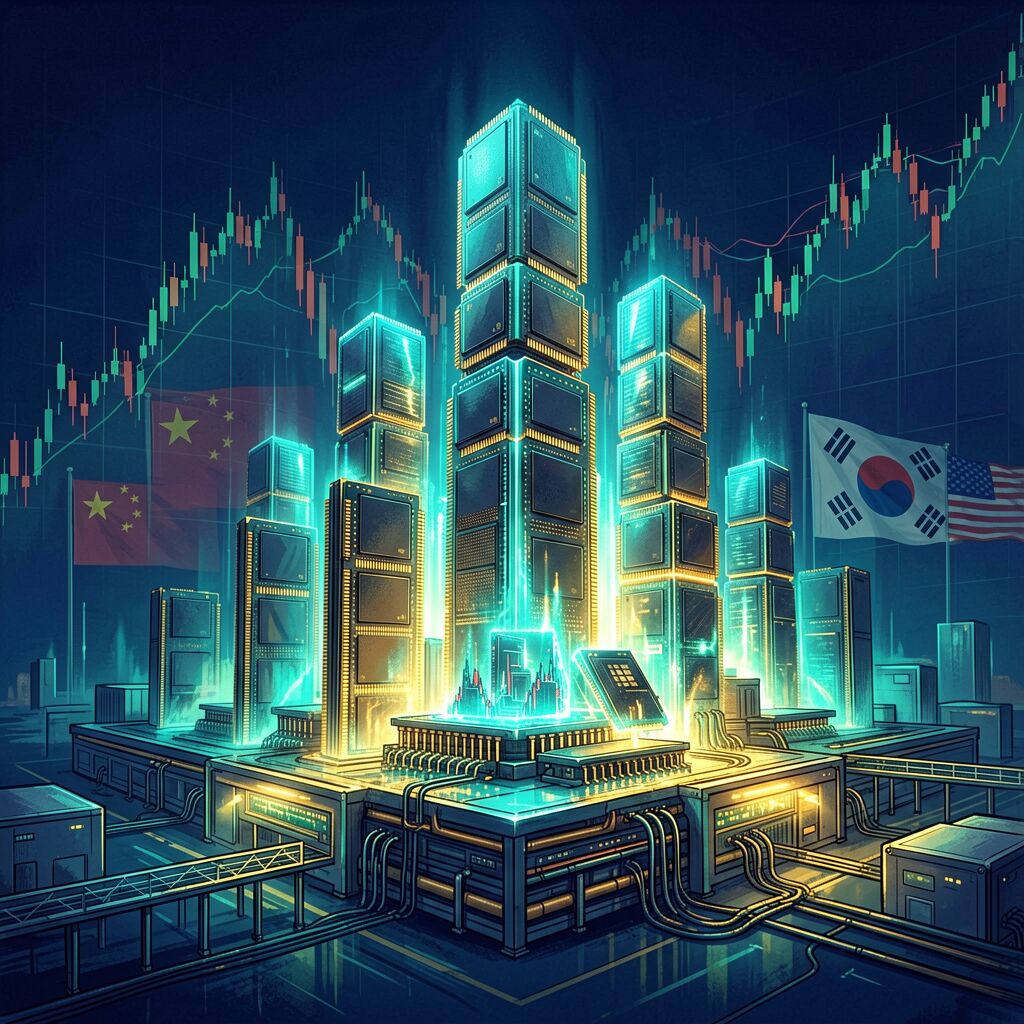
On Monday, a Chinese memory chip company most people outside Asia had never heard of became the most valuable listed company in the world's second-largest economy. ChangXin Memory Technologies, known as CXMT, saw its shares soar 466% on their debut on Shanghai's STAR Market, giving the Hefei-based DRAM maker a market capitalisation of roughly 3.3 trillion yuan — about US$489 billion. That valuation eclipses Industrial and Commercial Bank of China and places CXMT in the same league as the largest semiconductor companies on Earth.
The scale of the rally was so extreme that it rattled the entire memory industry. Shares of South Korea's SK Hynix and US-based Micron Technology tumbled. SanDisk sank 12%. The message from global investors was impossible to miss: a viable Chinese alternative in DRAM is no longer a theoretical threat. It is here, it is well-funded, and it is coming for market share.
The CXMT shock is about more than one stock. It is the moment the global AI memory trade stopped being a three-company oligopoly and started looking like a genuine contest. For years, Samsung Electronics, SK Hynix, and Micron Technology controlled the DRAM market that feeds everything from smartphones to AI servers. CXMT just raised 57.92 billion yuan, roughly $8.6 billion, in Asia's biggest IPO of the year to prove it can become the fourth player.
From Losses to a Near-$500 Billion Valuation
Founded in 2016 by Chairman Zhu Yiming, CXMT has moved fast by the standards of semiconductor manufacturing, an industry where fabs can take a decade to mature. According to its IPO prospectus, the company held a 7.67% share of the global DRAM market in the fourth quarter of 2025. That is still far behind Samsung, SK Hynix, and Micron. But it is no longer a rounding error.
The financial turnaround has been dramatic. In the first quarter of 2026, CXMT swung to an operating profit of 35.43 billion yuan, compared with an operating loss of 2.83 billion yuan in the same period a year earlier. The improvement came as AI-driven demand for computing power tightened memory supply, lifted prices, and gave every DRAM producer a tailwind. CXMT's gross margin reached 37.8% in fiscal year 2025, according to industry analysis — close to Samsung's 39.4% and Micron's 39.8%, though still well below SK Hynix's 60.4%, which benefits from a heavy mix of high-bandwidth memory used in AI accelerators.
The valuation surge on debut reflects a combination of factors that are distinctively Chinese. Retail investor demand was enormous. The IPO was reportedly more than 200 times oversubscribed. The relatively limited free float on day one amplified the price move. But the underlying appetite is not pure speculation. Beijing has made semiconductor self-sufficiency a national priority, and domestic internet giants building AI infrastructure need local suppliers that cannot be cut off by US export controls. CXMT is the clearest beneficiary of that industrial policy.
Why This Matters for the Global AI Race
DRAM is not the flashiest part of the AI hardware stack. It does not attract the headlines of Nvidia's GPUs or TSMC's most advanced nodes. But it is indispensable. Every AI server needs vast amounts of memory to hold model weights and training data. High-bandwidth memory, or HBM, has become one of the most constrained inputs in the entire AI supply chain. SK Hynix's dominance of HBM is a large part of why its margins have exploded.
China does not yet have a credible HBM challenger. CXMT's current strength is in commodity DRAM for smartphones, PCs, and mainstream servers. But the path from commodity DRAM to AI-grade memory is well understood, and the capital to fund it is now available. CXMT has said it will use IPO proceeds to boost memory wafer mass production and research and development. That means more capacity, more process improvements, and eventually a push into the higher-margin products that feed AI data centres.
The geopolitical dimension is impossible to separate from the commercial one. Morningstar noted in a recent report that as AI becomes an issue of national security for China, CXMT is likely to be a key beneficiary. Domestic cloud and internet companies spearheading AI development will prefer, and in some cases be required, to source memory from local suppliers. The US has already restricted China's access to the most advanced chipmaking equipment. China's response is to build an alternative supply chain at home and eventually sell into friendly markets abroad.
Apple's Interest Changes the Game
The most consequential detail in the CXMT story may be a single customer name: Apple. Earlier this month, reports surfaced that Apple had begun testing CXMT's DRAM chips for devices sold in China. Apple has not confirmed the tests, and the company has famously high quality standards. But the fact that the story is credible at all shows how far CXMT has come.
If Apple eventually qualifies CXMT for any portion of its China-bound iPhones or Macs, the implications would be enormous. Apple is one of the most demanding memory buyers in the world. Its approval would signal that CXMT's chips meet international quality and reliability standards, not just domestic ones. It would also give CXMT a path to scale, revenue stability, and brand credibility that would otherwise take years to build.
Even without Apple, the Chinese domestic market is large enough to fund a serious competitor. China consumes roughly half the world's semiconductors. If a meaningful share of that demand shifts to local DRAM, the global revenue pool available to Samsung, SK Hynix, and Micron shrinks. Margins compress. Pricing power weakens. The comfortable oligopoly that has defined memory for a decade begins to crack.
The DUV Shadow
Adding to the anxiety was a separate media report that China plans to deliver home-made immersion deep-ultraviolet lithography machines to domestic chipmakers this year. The equipment is not as advanced as ASML's most cutting-edge EUV systems, but it is sufficient for producing a wide range of mature and semi-advanced chips at scale. If Chinese manufacturers can build their own lithography tools, they reduce their dependence on Dutch and Japanese suppliers and gain more control over capacity expansion.
ASML investors reacted as if this were a direct threat. The stock sold off on the news, though analysts were quick to argue that home-grown DUV is still far from matching ASML's performance, reliability, and service network. The longer-term risk is not that China matches ASML tomorrow. It is that China creates enough domestic supply to satisfy its own needs for mature nodes, shrinking ASML's addressable market in the world's largest semiconductor buyer.
This is the pattern of AI nationalism. Every major power is trying to build domestic capability across the full stack: design, memory, manufacturing equipment, packaging, and talent. The result is not complete independence for anyone. It is a fragmentation of the global supply chain into competing blocs, with companies caught in the middle forced to choose sides or build parallel operations.
🔥 Hot Takes
1. CXMT's valuation is insane, but that does not mean the threat is fake. A 466% first-day pop makes for easy mockery about bubbles, and some of the move is absolutely retail frenzy. But beneath the hype is a real company with real fabs, real profits, and real customers in the world's biggest semiconductor market. Dismissing CXMT because the stock went up too far is the same mistake Western investors made with BYD, CATL, and Huawei in earlier decades.
2. The memory oligopoly was never going to survive the AI era intact. Samsung, SK Hynix, and Micron had a great run because DRAM is brutally capital-intensive and nobody else could afford to compete. AI has changed the economics. Memory is now a strategic resource. Governments are willing to subsidise capacity. China has patient capital, captive demand, and a geopolitical reason to win. The three-player game is over.
3. Apple's reported testing is the real dagger. If Apple qualifies CXMT, the argument that Chinese memory is only good for low-end domestic markets collapses overnight. Apple's supply chain is the most scrutinised in consumer electronics. Its approval would be worth more than any government subsidy. The irony would be delicious: the most American consumer brand on Earth could be the validator that turns a Chinese state-backed chipmaker into a global contender.
The Bottom Line
ChangXin Memory Technologies has gone from a little-known domestic chipmaker to a nearly $500 billion company in a single trading session. The valuation will almost certainly be volatile, and the company still trails global leaders in technology and product mix. But the strategic direction is clear. China intends to build its own memory champion, and it now has the capital and market access to make a serious attempt.
For Nvidia, Micron, SK Hynix, and every other company that has benefited from the AI memory shortage, the message is the same: the supply crunch that created record margins is also creating the incentives for a new competitor. CXMT may not displace the incumbents tomorrow. But it has already changed the assumptions behind their stock prices. The era of the untouchable memory oligopoly is ending. The era of AI nationalism in semiconductors is just getting started.