
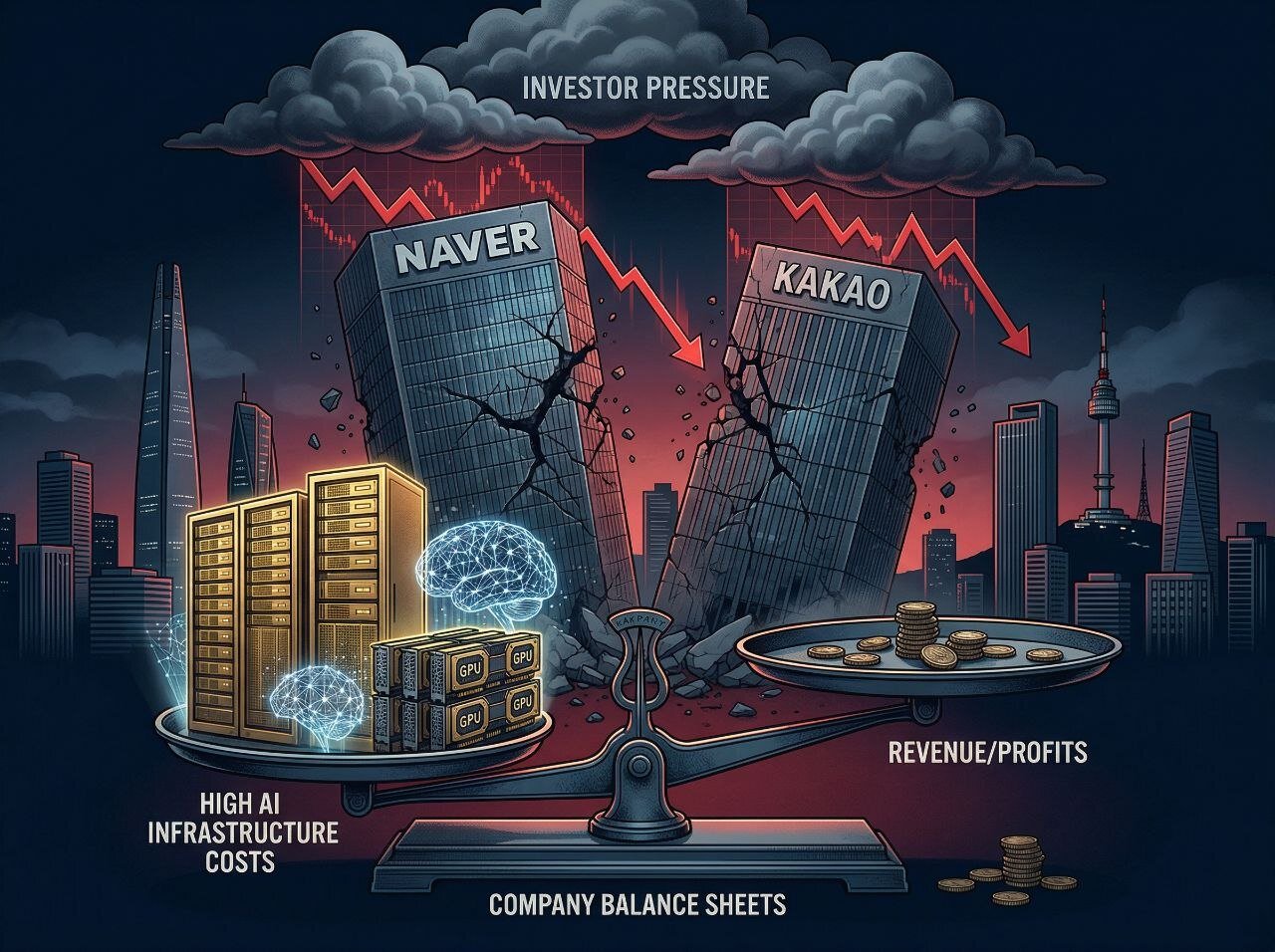
They bet big on AI. Now investors want answers. South Korea's two internet giants — Naver and Kakao — are facing a brutal reality check. Despite pouring nearly $700 million into AI infrastructure and launching ambitious models like HyperCLOVA X and Kanana, both companies are watching their stock prices crater and analyst expectations collapse. In April 2026 alone, 12% of all target price cuts across the entire KOSPI market hit just these two stocks.
The message from investors is brutally clear: Show us the money, or stop burning cash.
This isn't just a Korean story. It's a global warning shot for the AI industry. The era of "build it and they will come" is ending. The era of "show me the ROI" has begun.
The Numbers Don't Lie
Let's talk about the damage. Year-to-date, Naver has plunged 16.7% and Kakao has cratered 20.6%. These aren't minor corrections — they're existential threats to two of Korea's most important tech companies.
According to FnGuide data from January 2026, 10 domestic brokerages slashed target prices for these companies. Six cuts for Naver, four for Kakao. Out of 81 total target price reductions across the entire KOSPI market that month, approximately 12% were concentrated on just these two stocks.
Why the sudden pessimism? Analysts are singing the same chorus: "Costs are being reflected before revenues."
Translation: These companies are spending like drunken sailors on AI infrastructure, but the revenue isn't showing up yet. And investors are running out of patience.
Naver's $691 Million Gamble
Naver isn't messing around when it comes to AI investment. The company has committed more than 1 trillion won ($691 million) to GPU and AI infrastructure in 2026 alone. They're building testbeds connecting their Seongnam headquarters to expanded data center capacity. They're training massive models. They're hiring top talent.
The crown jewel is HyperCLOVA X, Naver's answer to GPT-4 and Claude. It's a formidable piece of technology — 204+ billion parameters, trained on 6,500 times more Korean data than ChatGPT, with multiple variants optimized for different use cases:
- THINK — For precise reasoning tasks
- DASH — Lightweight, fast responses
- SEED — Open-source for real-world applications
On paper, it's impressive. In practice? The monetization remains murky.
Naver has integrated HyperCLOVA X across its services — search, shopping, content creation. They've launched AI-powered features for their Smart Store e-commerce platform. But the revenue impact hasn't moved the needle enough to justify the massive infrastructure spend.
As one analyst put it: "We're seeing the costs now. The revenues might come later. But 'later' isn't good enough when you're burning nearly $700 million a year."
Kakao's Kanana Problem
Kakao's AI strategy centers on Kanana, an on-device AI model designed to integrate with the company's dominant messaging platform, KakaoTalk. With over 50 million monthly active users in Korea alone, Kakao has distribution that Naver can only dream of.
The vision is compelling: An AI assistant embedded in the app where Koreans already spend hours every day. Kanana would handle everything from scheduling to shopping to customer service, all within the familiar KakaoTalk interface.
But execution has been... complicated.
Kakao's AI business monetization is still in "early stages" — corporate speak for "we're not making meaningful money yet." The company is betting that Kanana's utility will eventually drive transactions, which will eventually drive revenue. But that timeline keeps getting pushed back.
Analyst Jung Ho-yoon from Korea Investment & Securities summed it up: "While it will take time, if Kanana's utility increases, it is highly likely to lead directly to monetization."
The key phrase there is "it will take time." Time is exactly what investors are unwilling to give.
The Retail Investor Trap
Here's where this story gets really painful. Naver and Kakao aren't just any stocks — they're retail investor darlings.
As of end-2025, the combined shareholder base for both companies reached approximately 2.75 million people. That's nearly 3 million Korean retail investors who bought into the AI dream.
To put this in perspective: Samsung Electronics leads with 4.61 million shareholders. But after that, it's Kakao with 1.6 million, and Naver with 1.15 million. These are the stocks that Korean grandmothers, office workers, and college students own in their retirement accounts and investment apps.
When these stocks drop 16-20% in a few months, it's not just hedge funds feeling pain. It's ordinary Koreans watching their savings evaporate.
The psychological impact is massive. These were supposed to be safe bets — Korea's answer to Google and Tencent. Instead, they're becoming cautionary tales about the risks of AI hype.
Why Analysts Still Say "Buy"
Here's the weird part: Despite all the doom and gloom, brokerages are still recommending these stocks. Uniformly maintaining "buy" ratings, even as they slash target prices.
Why the cognitive dissonance?
Because beneath the AI investment chaos, both companies have solid core businesses.
Naver's commerce business is thriving. The Smart Store commission increases are driving revenue growth. The company is well-positioned to benefit from any weakness at rival Coupang. As Hana Securities analyst Lee Jun-ho noted: "With stable profit growth assured this year, a forward 12-month price-to-earnings ratio of 14 times represents excessive undervaluation."
Kakao's platform business is growing. Talk Biz revenue — the core messaging monetization engine — continues to expand. KakaoPay and Kakao Mobility are showing clear growth trajectories. The company has multiple revenue streams beyond AI.
The bull case is simple: Buy these stocks for the core businesses, get the AI upside as a free option. If HyperCLOVA X or Kanana actually monetize, you'll look like a genius. If they don't, you still own profitable companies at depressed valuations.
It's not a bad argument. But it requires faith. And faith is in short supply right now.
The Global Context: AI's Revenue Problem
Naver and Kakao aren't alone in this struggle. The entire AI industry is grappling with the same challenge: How do you turn amazing technology into actual profits?
OpenAI is reportedly burning through cash faster than it can raise it. Anthropic is dependent on Google and Amazon's deep pockets. Even Microsoft, with all its Azure scale, is carefully managing AI investments to avoid margin destruction.
The pattern is clear: AI is expensive to build, expensive to run, and surprisingly difficult to monetize at scale.
For Korean companies, there's an added challenge: They're competing against American giants with deeper pockets and global reach. Naver's HyperCLOVA X is impressive, but it's primarily a Korean-language model. That limits its total addressable market. Kakao's Kanana has distribution, but only in Korea.
Meanwhile, OpenAI and Anthropic are building global platforms with hundreds of millions of users. The scale advantage is brutal.
The Agentic AI Pivot
Both companies are betting that AI agents will be their salvation.
Naver is pushing "agentic AI" — autonomous systems that can complete tasks on behalf of users. SK Securities analyst Nam Hyo-ji identified AI agent adoption as a "key point" for stock price reversal: "If transaction volume increases through agent advancement this year, the stock price should continue to rise."
Kakao's strategy is similar. Integrate external services with Kanana, drive transactions, capture value from the ecosystem. The company is building what it hopes will be a "mega fintech" platform — combining messaging, payments, mobility, and AI into one seamless experience.
The logic makes sense. If AI agents can actually handle complex tasks — booking flights, managing expenses, handling customer service — the value proposition becomes clear. Users save time. Businesses save money. Platform owners capture a slice of every transaction.
But here's the problem: Everyone is betting on agents. OpenAI has its Agents SDK. Anthropic has Claude with computer use. Microsoft is building agents into everything. Google has Gemini agents. Even startups like Emergent are launching agent platforms.
The agent space is going to be a bloodbath. And it's not obvious that Korean companies have any particular advantage.
🔥 Our Hot Take: The Reckoning Is Real
Let's be blunt: Naver and Kakao are learning the hard lesson that Silicon Valley has been teaching for years — AI is a feature, not a product.
The companies that will win in AI aren't necessarily the ones with the best models. They're the ones with the best distribution, the best data, and the most compelling user experiences. OpenAI has ChatGPT's mindshare. Google has Search. Microsoft has Office. Meta has WhatsApp and Instagram.
What do Naver and Kakao have? Strong positions in Korea... and not much else.
The $691 million investment in HyperCLOVA X is impressive. But without global distribution, it's a very expensive science project. The Kanana integration with KakaoTalk is clever. But if it doesn't drive measurable revenue soon, it's just a cost center.
The investor pressure we're seeing isn't irrational. It's a rational response to a fundamental question: What's the path to profitability?
For now, neither company has a convincing answer. They're both hoping that "agentic AI" will be the magic bullet. Maybe it will be. But maybe they'll find themselves in the same position a year from now — having spent another $700 million, with revenues still lagging costs, and investors even more impatient.
The Korean AI dream isn't dead. But it's on life support. And the next few quarters will determine whether these companies can deliver on their promises — or become cautionary tales about the dangers of AI hype.
Time's running out. Show us the money, or stop burning it.