
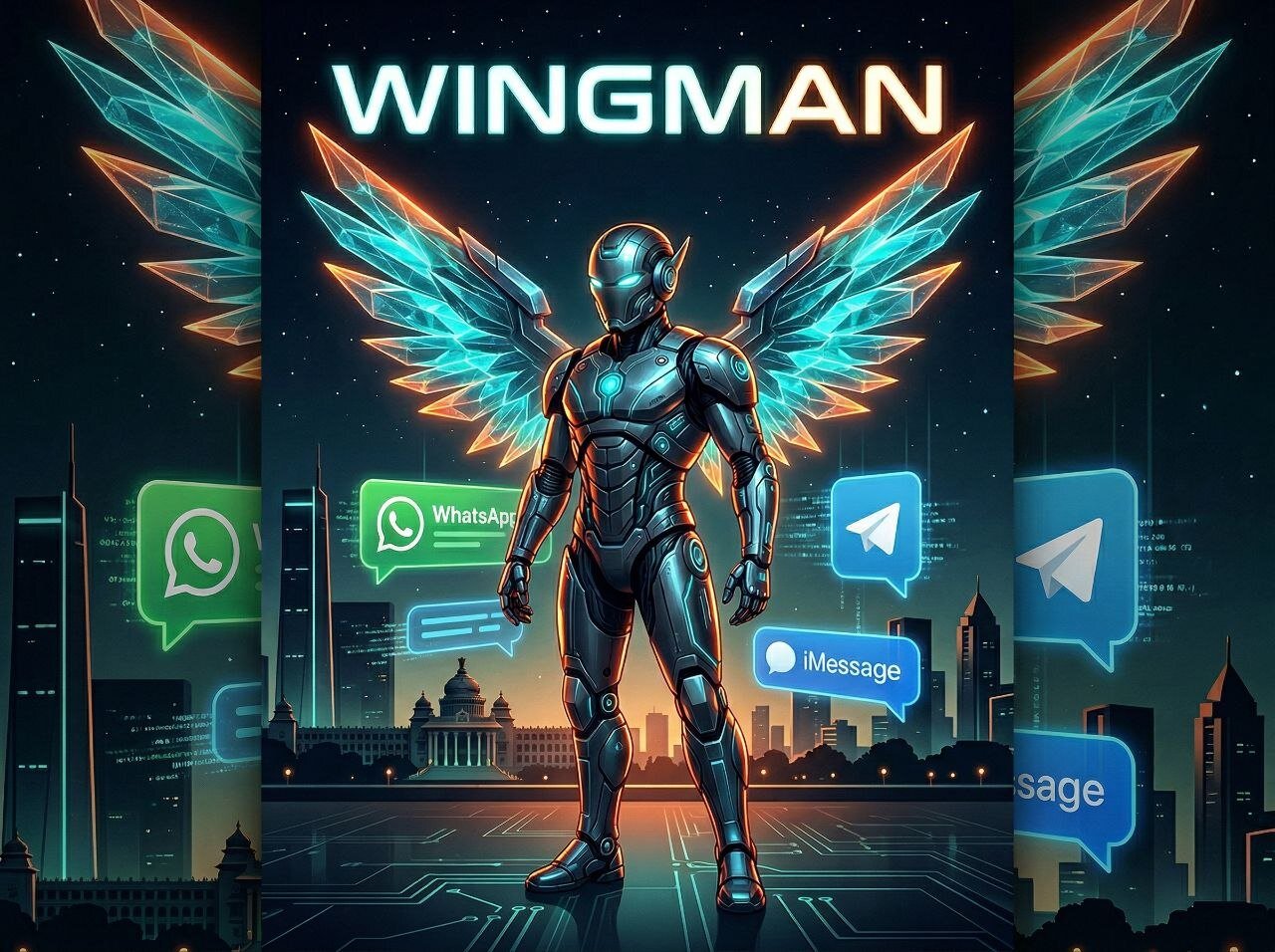
Eight million builders. $100M ARR in eight months. And now, a direct shot at OpenClaw. Bengaluru-based Emergent just launched Wingman, a messaging-first autonomous AI agent that lets anyone deploy an "always-on team" through WhatsApp, Telegram, and iMessage. The kicker? This Indian startup is already valued at $300 million and counts SoftBank and Khosla Ventures among its backers.
In a market obsessed with Silicon Valley's latest agent offerings, Emergent's rise signals something bigger: the global AI agent race is officially multinational, and India is playing to win.
From Vibe-Coding to Agent Execution
Emergent didn't start as an AI agent company. Founded in 2025, the startup first made waves with a "vibe-coding" platform that let non-technical users build full-stack applications through natural language prompts. Think Cursor or Replit, but designed for founders who've never written a line of code.
The numbers are staggering: 8 million builders from 190 countries have used Emergent's platform to create and ship software. 1.5 million monthly active users are actively building on it. And in just eight months since launch, the company hit $100 million in annual recurring revenue.
But CEO Mukund Jha saw the obvious next step. "Can we help them not just build the software, but actually operate more autonomously through it?" he told TechCrunch. "You move from software that supports the business to software that can actively help run it."
Enter Wingman.
What Makes Wingman Different
The AI agent space is getting crowded fast. Microsoft is developing its own OpenClaw-inspired agent. Anthropic has Claude. OpenClaw itself has gained serious traction among early adopters. So why does Emergent think it can compete?
The answer is messaging.
Wingman doesn't ask users to learn a new interface or download another app. It lives where people already work: WhatsApp, Telegram, iMessage. Users assign tasks through chat, and the agent executes in the background across connected tools like email, calendars, CRMs, and GitHub.
"A lot of real work already happens through chat, voice, and email — asking for something, following up, sharing context, making a decision," Jha explained. "Increasingly, they'll be the main ways we work with agents too."
This isn't just a UX choice. It's a distribution strategy. In markets like India, Southeast Asia, and Latin America, WhatsApp isn't just a messaging app — it's the operating system for business. By embedding directly into these platforms, Wingman sidesteps the adoption friction that kills most productivity tools.
The "Trust Boundaries" Innovation
Here's where Emergent gets clever. Wingman uses what the company calls "trust boundaries" — a tiered permission system that determines what the agent can do autonomously versus what requires human approval.
Routine tasks? Wingman handles them silently. But try to modify a database, delete customer records, or send messages to groups? The agent pauses and asks for explicit approval.
This addresses one of the biggest concerns around autonomous AI: the fear of agents running amok. By building guardrails directly into the architecture, Emergent is trying to thread the needle between useful automation and catastrophic mistakes.
It's a pragmatic approach that enterprise customers will appreciate. As our coverage of PwC's AI study showed, 74% of AI's economic value is captured by just 20% of companies — mostly because the other 80% are terrified of AI making decisions without oversight.
The Funding Story: SoftBank Bets on India
Emergent's $70 million funding round in January 2026 wasn't just another AI startup raise. It was a statement.
The round was jointly led by SoftBank Vision Fund 2 and Khosla Ventures, with participation from Lightspeed Venture Partners. The valuation: $300 million. For a company founded in 2025, that's extraordinary.
But SoftBank's involvement is particularly telling. Masayoshi Son has been hunting for the next Alibaba for years, and he's increasingly looking to India. With China's AI rise challenging US dominance, India represents a third pole in the global AI race — one with massive technical talent, English-language advantages, and a growing domestic market.
Emergent is positioning itself as that bet.
The Reality Check: What Wingman Can't Do (Yet)
Jha is refreshingly honest about Wingman's limitations. The system struggles, he admits, "around consistency in really ambiguous situations, messy edge cases, unclear goals, or workflows where a lot of human judgment is needed."
This is the dirty secret of the AI agent space: everyone's demo is impressive, but production deployments are messy. Agents that work beautifully in controlled environments often fall apart when faced with the chaos of real business workflows.
Wingman's "trust boundaries" help, but they're not a panacea. The company is essentially betting that users will tolerate some friction — having to approve certain actions — in exchange for the convenience of automation.
It's a reasonable bet, but it also opens the door for competitors. If someone cracks fully autonomous agents that don't make catastrophic mistakes, Wingman's approval-gating could feel like training wheels.
The Pricing Play: Accessible AI for Everyone
Wingman is launching with a limited free trial, then moving to paid tiers: $20 or $200 per month. That's significantly cheaper than enterprise AI agent solutions, and it's priced to appeal to the same non-technical founders who built their businesses on Emergent's vibe-coding platform.
The strategy is clear: own the citizen developer market. While OpenClaw, Anthropic, and Microsoft fight over enterprise contracts, Emergent is going after the millions of small business owners who need AI help but can't afford six-figure implementation deals.
It's the same playbook that made Emergent's vibe-coding platform explode: democratize access to technology that was previously reserved for technical elites.
🔥 Our Hot Take: The Agent Wars Go Global
Here's what makes Emergent's launch genuinely significant: it's proof that the AI agent race isn't just a Silicon Valley story anymore.
For years, the narrative has been US vs. China. OpenAI vs. DeepSeek. Google vs. Baidu. But Emergent's rise — backed by SoftBank, built in India, targeting global markets — shows there's room for a third force.
India has the engineering talent. It has the English-language advantage for global markets. And increasingly, it has the capital. With China's open-source AI models challenging US dominance and Moonshot AI pushing coding model boundaries, the global AI landscape is fragmenting in interesting ways.
Wingman's messaging-first approach is also smarter than it might seem. In emerging markets, WhatsApp isn't just a chat app — it's infrastructure. By meeting users where they already are, Emergent sidesteps the adoption problem that plagues most AI tools.
But the real question is execution. Can Wingman deliver on its promise of autonomous task completion without the constant need for human oversight? The "trust boundaries" are a good start, but they're also a crutch. If Emergent can gradually expand what Wingman can do autonomously — without catastrophic failures — they have a shot at serious market share.
The $100M ARR in eight months suggests they're onto something. The $300M valuation suggests investors agree. And the OpenClaw comparison? That's not just marketing — it's a declaration of intent.
Game on.