
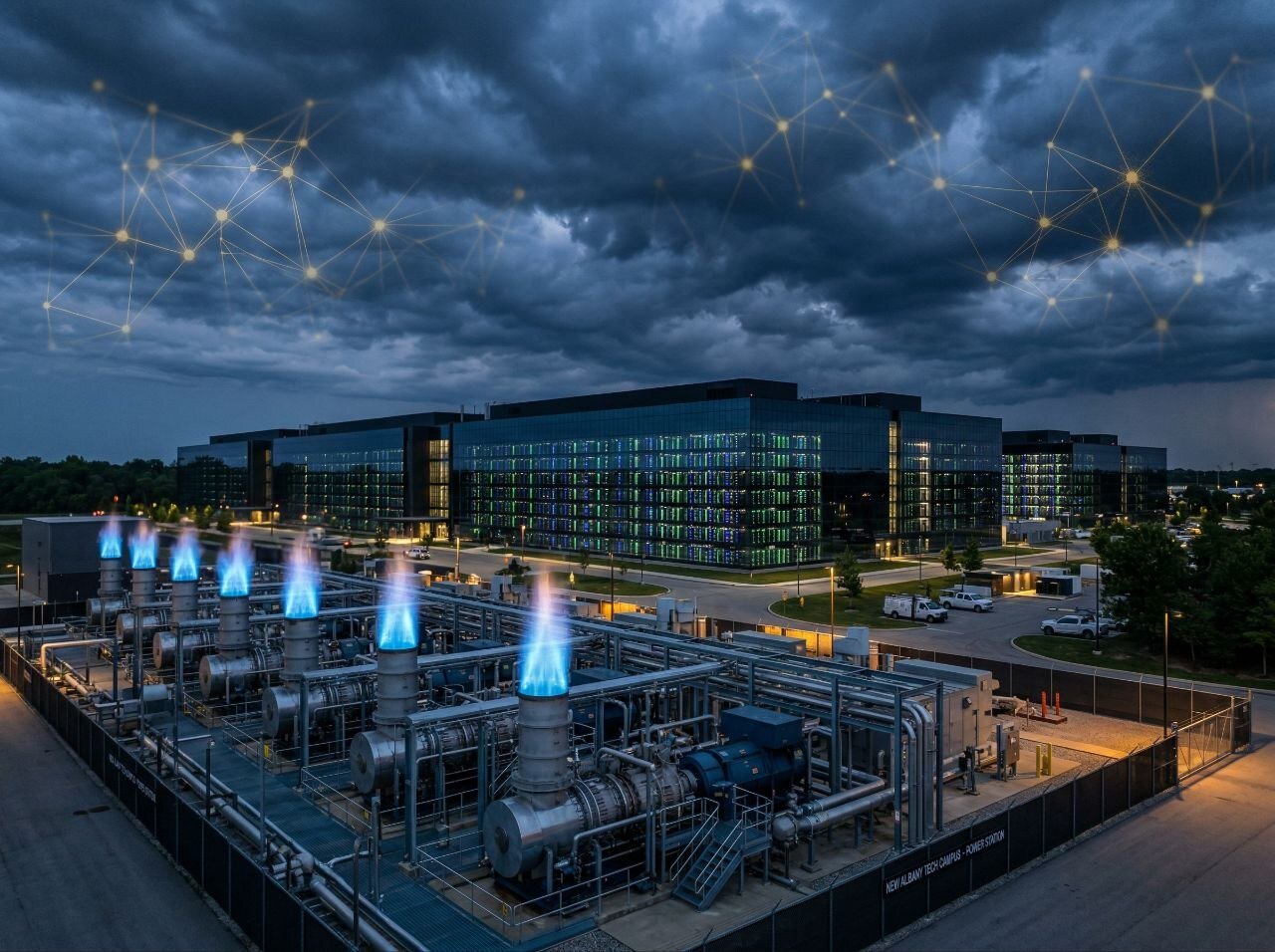
The controversial Ohio facility represents Big Tech's most audacious wager yet — that fossil fuels are the only way to feed the insatiable appetite of artificial intelligence.
What Happened
On April 5, 2026, Meta Platforms did something that would have been unthinkable just five years ago. The company that once proudly touted its commitment to 100% renewable energy announced a $3 billion data center in Ohio powered by an on-site natural gas plant with 813 generators. The facility, codenamed "Prometheus," represents the largest direct fossil fuel investment by a major technology company in over a decade — and it signals a dramatic shift in how Big Tech plans to power the AI revolution.
The numbers are staggering. When fully operational in 2028, the Prometheus facility will consume 1 gigawatt of power — roughly equivalent to the electricity needs of 750,000 homes. To put that in perspective, that's more power than the entire city of Seattle uses on a typical day. And Meta is building all of this power generation capacity on-site, bypassing the traditional electrical grid entirely.
The Financial Architecture
The $3 billion price tag breaks down into two major components: approximately $1.8 billion for the data center infrastructure itself, and $1.2 billion for the dedicated natural gas power plant. But what's particularly interesting is how Meta structured the financing. Rather than funding the entire project from its considerable cash reserves, Meta secured a $3 billion green bond — a financial instrument typically reserved for environmentally sustainable projects.
Yes, you read that correctly. Meta is financing a natural gas power plant with green bonds.
The bond offering, underwritten by Goldman Sachs and JPMorgan Chase, was oversubscribed by 340%, indicating that institutional investors are more than willing to look past the fossil fuel component if the returns are right. The bonds carry a 4.2% coupon rate — attractive in the current interest rate environment — and mature in 2036.
This financial innovation hasn't gone unnoticed. Environmental groups have cried foul, arguing that labeling natural gas infrastructure as "green" represents a dangerous form of greenwashing. But Meta's lawyers have an answer ready: the facility will use carbon capture technology (still in development) and the power will exclusively serve AI workloads that displace even more carbon-intensive activities elsewhere.
It's a legal argument that stretches the definition of "green" to its breaking point, but Wall Street doesn't seem to care. The bonds trade at a premium.
The Power Plant: 813 Generators of Controversy
The heart of the Prometheus facility is its on-site power generation complex. Meta has contracted with EQT Corporation, America's largest natural gas producer, to supply fuel for what will become one of the largest private power plants in the United States. The plant will feature 813 natural gas generators — massive turbine systems capable of producing 1.2 gigawatts of electricity, with the excess capacity ensuring redundancy for Meta's critical AI infrastructure.
The generators will operate in what engineers call "island mode" — completely disconnected from the regional electrical grid. This independence is by design. Meta's AI training clusters require uninterrupted power; even a few seconds of outage can corrupt weeks of training runs worth tens of millions of dollars. Traditional grid power, with its occasional outages and voltage fluctuations, simply isn't reliable enough for Meta's purposes.
But island mode operation also means Meta won't be paying utility rates or contributing to grid maintenance costs. The company will drill its own wells, pump its own gas, and generate its own power. It's vertical integration taken to its logical extreme.
EdgeConneX, a leading data center infrastructure provider, has been brought in to manage the physical facility construction and ongoing operations. Their involvement signals Meta's intent to treat Prometheus as a template for future projects — a repeatable blueprint for AI infrastructure that can be deployed anywhere with sufficient natural gas reserves.
Location, Location, Location
Meta selected a 2,400-acre site in rural southeastern Ohio for Prometheus, specifically in Monroe County near the Ohio River. The location offers three critical advantages: proximity to the Marcellus and Utica shale formations (some of the most productive natural gas fields in North America), abundant water access for cooling, and a politically favorable regulatory environment.
Ohio state officials have rolled out the red carpet. Governor Mike DeWine called the project "a transformative investment in Ohio's future" when announcing $400 million in tax incentives. State legislators passed a fast-track permitting process specifically for the project, reducing approval timelines from 18 months to just 90 days.
Local residents have mixed feelings. The project will create an estimated 2,800 construction jobs and 450 permanent positions — significant for a county with a population of just 14,000. But environmental groups and some landowners have raised concerns about air quality, water consumption, and the long-term climate impact.
"We're trading our grandchildren's future for a few years of tax revenue," said Mary Chen, a local environmental activist who has organized protests against the project. "Meta calls this innovation. I call it pollution with better marketing."
The facility is expected to consume 2.3 million gallons of water daily for cooling — roughly equivalent to the water usage of a small city. Meta has committed to building a water recycling system and funding $50 million in local infrastructure improvements, including a new water treatment plant.
Why It Matters
The Prometheus facility isn't just another data center. It represents a fundamental inflection point in how the technology industry approaches infrastructure at scale. To understand why this matters, we need to examine three converging forces: the AI arms race, the failure of electrical grids to keep pace, and the uncomfortable collision between environmental commitments and business reality.
The AI Arms Race Has Become an Energy War
Artificial intelligence training has always been power-hungry. GPT-4, OpenAI's flagship model, reportedly required the equivalent of 50 gigawatt-hours of electricity to train — enough to power 40,000 American homes for a year. But the latest generation of models makes GPT-4 look economical.
Meta's own AI ambitions are enormous. The company is building models to compete with GPT-4, Gemini, and Claude across multiple domains: text, image, video, and the multimodal systems that combine all three. Each training run requires thousands of specialized AI chips running at maximum capacity for weeks or months. Meta's previous data center in DeKalb, Illinois — already one of the largest in the world — is operating at 94% capacity, severely constraining the company's AI development timeline.
The competitive dynamics are brutal. Every month of delay in training a new model can mean the difference between market leadership and irrelevance. Meta watched as OpenAI captured the public imagination with ChatGPT, as Google raced to catch up with Bard (now Gemini), as Microsoft integrated AI across its entire product stack. The company that once dominated social media found itself playing catch-up in the most important technology shift since the smartphone.
Mark Zuckerberg has made it clear: AI is existential for Meta. In internal meetings leaked to the press, he's reportedly told executives that the company's future depends on leading in AI, not just participating. And leadership requires compute — massive, uninterrupted, instantly scalable compute.
The traditional approach of building data centers and connecting them to the grid simply can't deliver what's needed. Grid interconnection queues — the waiting list for new power hookups — stretch to 5+ years in many regions. Even when connections are available, utilities can't guarantee the reliability that AI training demands. The grid wasn't designed for the power density that modern AI clusters require.
Prometheus is Meta's solution: bypass the grid entirely. Generate power on-site, control every variable, scale as needed. If it works, expect every major AI company to follow suit.
The Grid Can't Keep Up
America's electrical grid is in crisis. Decades of underinvestment, combined with the accelerating electrification of transportation and heating, has created a system that's struggling to meet existing demand — let alone the exponential growth that AI represents.
According to the Lawrence Berkeley National Laboratory, over 2,000 gigawatts of clean energy and storage projects are currently stuck in interconnection queues across the United States. That's nearly twice the capacity of the entire existing grid. Projects routinely wait 3-5 years for approval, and many are ultimately rejected due to insufficient transmission infrastructure.
The fundamental problem is physics. Electricity can't be stored economically at grid scale, so supply must match demand in real-time. Adding massive new loads — like gigawatt-scale data centers — requires corresponding generation capacity and transmission lines to move power where it's needed. Building that infrastructure takes years and faces intense local opposition.
Meta tried the traditional route. The company explored sites in Iowa, Nebraska, and Texas where renewable energy was abundant. But in every case, utility partners couldn't guarantee the power delivery timeline that Meta's AI roadmap required. The company faced a choice: wait for the grid to catch up (and fall behind in AI) or find another way.
Natural gas offered an immediate solution. Wells can be drilled in months, not years. Pipelines can be laid while construction proceeds. And natural gas turbines can ramp up to full power almost instantly — perfect for the variable demands of AI training workloads.
This isn't just Meta's problem. Google, Microsoft, Amazon, and every other major AI player face the same constraints. The difference is that Meta blinked first, abandoning its renewable commitments in favor of fossil fuel pragmatism. Whether others follow will determine whether the AI revolution accelerates climate catastrophe or forces a grid transformation.
Environmental Concerns and Corporate Hypocrisy
Meta's announcement triggered immediate backlash from environmental groups, and for good reason. The company has spent years cultivating a green image, promising to achieve net-zero emissions across its value chain by 2030. Just eighteen months ago, Meta's sustainability report boasted that the company had achieved "100% renewable energy for our global operations."
That claim requires some creative accounting. Meta purchased renewable energy credits (RECs) to offset its non-renewable consumption, a practice that critics argue obscures the true environmental impact. But even that fig leaf is gone with Prometheus. You can't buy enough RECs to offset 1 gigawatt of natural gas generation.
The facility will emit an estimated 4.2 million tons of CO2 annually — equivalent to adding 900,000 cars to the road. Meta has pledged to install carbon capture technology "as soon as commercially viable," but that technology remains unproven at scale. Even optimistic projections suggest carbon capture might reduce emissions by 10-30%, leaving the facility as a massive new source of greenhouse gases.
Local air quality impacts are equally concerning. Natural gas plants emit nitrogen oxides and particulate matter, both of which contribute to respiratory illness. The Ohio Valley already suffers from poor air quality due to legacy coal and steel operations. Adding 813 gas turbines to the mix will make things worse.
Meta's response has been carefully calibrated. The company emphasizes job creation, economic development, and the long-term benefits of AI technology. Executives point out that AI itself could help solve climate change — optimizing energy systems, discovering new materials, accelerating clean technology deployment. The implicit argument is that a little short-term environmental damage is worth the long-term benefits.
It's the same argument the fossil fuel industry has made for decades. The irony isn't lost on Meta's critics.
🔥 Our Hot Take
Let's cut through the PR spin and call this what it is: Meta just admitted that its climate commitments were incompatible with its AI ambitions, and it chose AI.
This isn't a failure of imagination or a lack of alternatives. It's a calculated business decision that reveals where Meta's true priorities lie. The company had options. It could have invested in grid-scale battery storage. It could have funded transmission infrastructure to bring renewable energy from where it's generated to where it's needed. It could have simply built smaller facilities and accepted slower AI development timelines.
Instead, Meta took the fastest, cheapest path to massive compute power — and that path runs through 813 natural gas generators.
The green bond financing is perhaps the most cynical aspect of this entire project. By labeling natural gas infrastructure as "green," Meta isn't just greenwashing its own operations — it's corrupting the entire sustainable finance ecosystem. Green bonds were created to fund genuinely clean projects: wind farms, solar installations, energy efficiency retrofits. When natural gas plants qualify, the label becomes meaningless.
Wall Street's enthusiastic participation in this charade shows that ESG investing remains fundamentally about marketing, not impact. Institutional investors bought Meta's green bonds not because they believed in the environmental story, but because the yield was attractive and the credit risk was low. The "green" label provided plausible deniability.
But here's the uncomfortable truth: Meta might be right about the tradeoffs.
The AI race is winner-take-most. The companies that develop the most capable models will capture disproportionate value across every industry that AI touches. Falling behind doesn't just mean slower growth — it could mean irrelevance. In that context, a few million tons of CO2 starts to look like an acceptable price for survival.
This is the calculation every major technology company is making right now. Google, Microsoft, Amazon — they're all watching Prometheus closely. If Meta's facility operates reliably and delivers the compute capacity needed for next-generation AI models, the floodgates will open. We could see dozens of similar projects announced within months.
The environmental implications are staggering. If every major AI company follows Meta's lead, we're looking at tens of gigawatts of new fossil fuel generation just for data centers. That's enough to wipe out the emissions reductions from a decade of renewable energy deployment.
There is a possible optimistic scenario. Perhaps Prometheus creates such obvious environmental damage that it forces regulatory action. Perhaps the backlash is so severe that Meta's competitors decide the reputational cost isn't worth the competitive benefit. Perhaps this is the wake-up call that finally accelerates grid investment and clean energy deployment.
But history suggests otherwise. Once a major player breaks ranks on environmental commitments, others follow. The competitive dynamics are too strong, the AI race too urgent, the financial incentives too aligned.
Prometheus isn't just a data center. It's a statement of priorities. And that statement says: artificial intelligence matters more than climate stability. The machines we're building to think like humans are being powered by the same fossil fuels that are making the planet uninhabitable for humans.
Meta could have been the company that proved AI and sustainability were compatible. Instead, they chose to be the company that proved they aren't.
The fire Prometheus brings isn't just powering AI — it's burning through whatever remained of Big Tech's environmental credibility.
And we haven't even talked about what happens when the gas runs out, when the carbon budget is spent, when the bill comes due. Because it will come due. The only question is whether we'll still have the resources to pay it.
📍 Location: Monroe County, Ohio
💰 Investment: $3 billion ($1.8B data center + $1.2B power plant)
⚡ Power: 1.2 GW generation capacity (1 GW for data center)
🏭 Generators: 813 natural gas turbines
👷 Jobs: 2,800 construction, 450 permanent
🗓️ Timeline: Operational 2028
💵 Financing: $3B green bond (4.2% coupon, 2036 maturity)
🌱 Emissions: ~4.2M tons CO2/year (equivalent to 900,000 cars)