
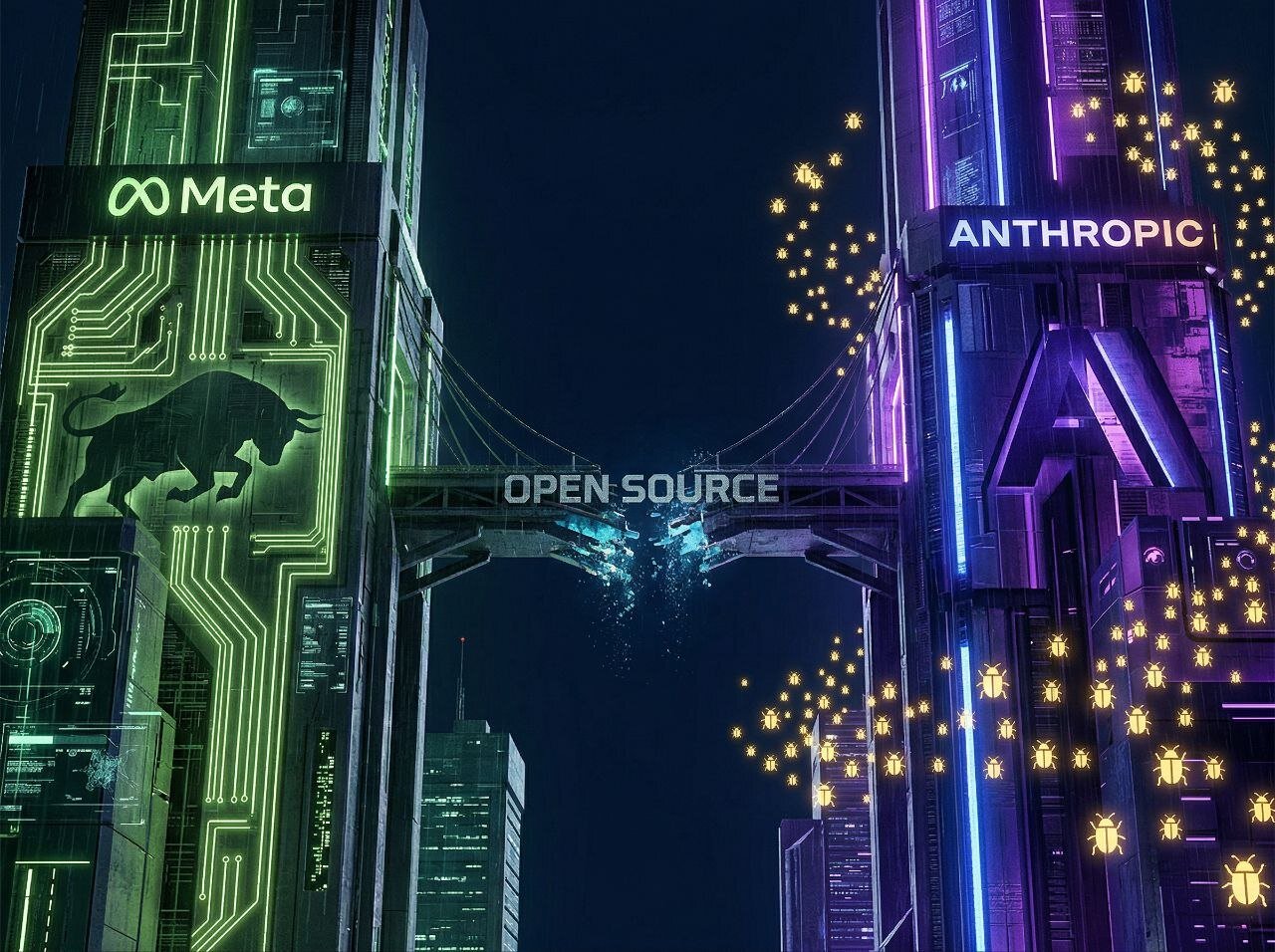
The hot take. The open-source AI party is officially over. In a dramatic reversal that would have seemed heretical just months ago, two of Silicon Valley's most influential AI labs have slammed the door on their open models and gone full proprietary. Meta—yes, the same Meta that built an empire on freely giving away Llama—just dropped Muse Spark, a completely closed-source superintelligence model born from a $14.3 billion bet on Alexandr Wang and Scale AI. Meanwhile, Anthropic, fresh off leaking their own source code twice in as many months, is now claiming their new Mythos model is "too dangerous to release" and locking it behind a velvet rope accessible only to 12 elite partners. The irony is thick enough to cut with a knife: the companies that once preached AI democratization are now building digital fortresses around their most powerful creations. Whether this is smart business or desperate damage control, one thing is clear—the age of AI openness has officially ended, and the age of AI walled gardens has begun.
What Happened
Meta's Muse Spark: The $14.3 Billion Avocado
On April 8, 2026, Meta unveiled Muse Spark—the inaugural model from the company's newly formed Meta Superintelligence Labs, and the first major AI release since Mark Zuckerberg's controversial $14.3 billion investment in Scale AI to recruit its 29-year-old co-founder and CEO, Alexandr Wang. Internally code-named "Avocado" during its nine-month development cycle, Muse Spark represents nothing less than a fundamental strategic pivot for the social media giant.
The deal that brought Wang to Meta was staggering even by Silicon Valley standards. Meta acquired a 49% stake in Scale AI, the data labeling powerhouse, effectively making Wang the company's Chief AI Officer and giving him carte blanche to rebuild Meta's AI division from the ground up. The investment was part of Meta's broader capital expenditure spree, with the company guiding for between $115 billion and $135 billion in capex for 2026—nearly double the $72.22 billion spent in 2025.
Muse Spark isn't just another incremental improvement over Llama 4. Meta executives have described it as a "ground-up overhaul" and a "major upgrade" that places the company back in serious contention with OpenAI, Google, and Anthropic. Unlike the Llama family of models, which Meta famously open-sourced to the developer community, Muse Spark is entirely proprietary. The model is now available through Meta's standalone AI app and will soon roll out across WhatsApp, Instagram, and Facebook Messenger.
The market responded enthusiastically to the announcement. Meta shares surged between 7% and 9% following the Muse Spark debut, with analysts at Bank of America and other firms raising their price targets and citing "significant monetization potential." The stock pop represented a vote of confidence from investors who had grown increasingly concerned about Meta's massive AI spending without corresponding revenue generation.
Behind the proprietary pivot lies a strategic response to the rise of Chinese AI competitors, particularly DeepSeek. Meta's open-source approach with Llama had been exploited by foreign competitors who used the freely available models to train their own systems—systems that could then undercut American companies on price while potentially stripping away safety guardrails. The decision to close-source Muse Spark reflects a growing consensus among U.S. AI giants that unfettered openness is a strategic liability in an increasingly competitive geopolitical landscape.
Anthropic's Mythos: Too Dangerous for the Masses
Just days before Meta's announcement, Anthropic made waves of its own with the unveiling of Claude Mythos Preview—a model so powerful at cybersecurity tasks that the company declared it too dangerous for general release. The announcement came via Project Glasswing, a restricted initiative that grants access to just 12 partner organizations for "defensive security work."
The Project Glasswing consortium reads like a who's who of tech and finance: Amazon Web Services, Apple, Broadcom, Cisco, CrowdStrike, Google, JPMorgan Chase, the Linux Foundation, Microsoft, Nvidia, and Palo Alto Networks. These select partners will pay premium rates—$25 per million input tokens and $125 per million output tokens—to access Mythos Preview through the Claude API, Amazon Bedrock, Google Cloud's Vertex AI, and Microsoft Foundry.
What makes Mythos so special? According to Anthropic, the model has already identified thousands of zero-day vulnerabilities—critical security flaws previously unknown to developers—across every major operating system and web browser. The company claims Mythos discovered these vulnerabilities not because it was specifically trained for cybersecurity, but because its advanced coding and reasoning capabilities naturally extend to understanding and exploiting complex software systems.
The restricted rollout comes against a backdrop of embarrassing security lapses at Anthropic itself. In late March 2026, the company accidentally leaked portions of Claude Code's internal source code through a packaging error on npm—the second such incident in just over a year following a similar breach in February 2025. While Anthropic insists these were "human error" incidents rather than malicious breaches, the irony of a cybersecurity-focused AI company repeatedly leaking its own code has not been lost on observers.
Adding to the company's recent security woes, Anthropic also inadvertently exposed details of an unreleased model and an exclusive CEO event through a misconfigured content management system. These repeated slip-ups have raised questions about whether Anthropic's dramatic warnings about Mythos's dangers are genuine caution or convenient marketing.
Why It Matters
The End of the Open Source Era
The simultaneous proprietary pivots by Meta and Anthropic represent a watershed moment for the AI industry. For years, the narrative around large language models was dominated by the tension between OpenAI's closed, API-gated approach and Meta's open-source evangelism. Llama became the de facto foundation for countless startups and research projects precisely because it was freely available. Now, that equation has changed.
Meta's decision to close-source Muse Spark signals that the strategic calculus around openness has fundamentally shifted. The company explicitly cited the need to maintain competitive advantage in the face of Chinese competitors who had been "free-riding" on Llama's open architecture. DeepSeek and other Chinese AI firms had built competitive models by training on Llama's outputs, effectively letting Meta subsidize their R&D. The Muse Spark pivot is Meta's declaration that the free ride is over.
This shift has profound implications for the AI ecosystem. Startups that built their products on Llama's open weights will now face a stark choice: continue with the increasingly outdated Llama 4 architecture, pay for API access to Muse Spark, or migrate to alternative open models from smaller players. The democratization of AI that Meta once championed is being replaced by a tiered system where cutting-edge capabilities are reserved for those with deep pockets.
The Geopolitical AI Race
Both Meta's and Anthropic's moves must be understood within the broader context of the U.S.-China AI competition. The Biden administration's export controls on advanced AI chips to China have created a bifurcated global AI landscape, with Chinese companies increasingly forced to innovate on efficiency and algorithmic improvements rather than brute-force scaling.
DeepSeek's rise demonstrated that Chinese firms could build highly competitive models at a fraction of the cost of their American counterparts—precisely by leveraging open-source models like Llama as training data. Meta's proprietary pivot is a direct response to this dynamic, an attempt to close the knowledge gap that Chinese competitors had been exploiting. The $14.3 billion Scale AI investment and the封闭 of Muse Spark are as much geopolitical moves as they are business decisions.
Anthropic's restricted Mythos rollout reflects a similar calculus. By limiting access to a trusted circle of Western tech giants and financial institutions, Anthropic is attempting to ensure that the model's offensive cyber capabilities don't fall into the wrong hands. Whether this approach is effective—or merely creates a two-tier system where elite organizations have access to capabilities denied to everyone else—remains to be seen.
The Monetization Imperative
Beneath the strategic and geopolitical rhetoric lies a more prosaic reality: AI companies need to start making money. Meta's $115-135 billion capex guidance represents an astronomical sum that cannot be justified by vague promises of future revenue. The Muse Spark launch, with its proprietary licensing and integration into Meta's existing product ecosystem, is clearly designed to generate measurable returns.
Anthropic's premium pricing for Mythos—$25/$125 per million tokens compared to Claude's standard rates—similarly reflects a push toward profitability. The company has raised billions in funding but faces the same pressure as its competitors to demonstrate a viable business model. Project Glasswing's exclusive partnerships represent a high-value customer base willing to pay premium prices for capabilities they can't get elsewhere.
🔥 Our Hot Take
Let's call this what it is: a massive, industry-wide retreat from the idealistic promises of AI openness. Meta didn't spend $14.3 billion on Alexandr Wang and Scale AI so they could give away the crown jewels for free. They did it because they watched DeepSeek and other Chinese competitors eat their lunch while they were busy playing the role of AI Santa Claus.
The "open source AI" era was always a bit of a fiction—Meta's Llama models came with increasingly restrictive commercial licenses, and the truly massive models were never fully released anyway. But the symbolism mattered. Meta positioned itself as the champion of AI democratization, the counterweight to OpenAI's closed approach. Now that positioning has been unceremoniously dumped because, surprise surprise, giving away your competitive advantage turns out to be a bad business strategy.
Anthropic's "too dangerous to release" framing for Mythos is even more suspect. This is a company that has now leaked its own source code twice in fourteen months. They're going to tell us they're the responsible stewards of dangerous AI capabilities? Please. The restricted 12-partner rollout looks a lot less like genuine safety concern and a lot more like a high-margin enterprise sales strategy dressed up in security theater.
Here's the uncomfortable truth: the AI industry is consolidating around a handful of players who will control the most powerful models, and everyone else will pay rent to access them. The open-source interlude was nice while it lasted, but the economics of training frontier models at billion-dollar scale simply don't support continued generosity. Meta's proprietary pivot isn't a betrayal—it's an acknowledgment of reality.
What comes next is predictable. The gap between the capabilities available to elite partners (governments, Fortune 500 companies, defense contractors) and what regular developers can access will widen. The AI capabilities that shape elections, markets, and geopolitical conflicts will be concentrated in fewer hands. And the utopian promises of AI democratization will be remembered as early-stage marketing before the industry figured out how to actually make money.
The proprietary pivot is here. The walls are going up. And if you're not one of the twelve chosen partners—or a shareholder in the companies building the walls—you're on the outside looking in.
📚 Related Reading
- China's Chipmakers Just Posted Record Revenue — And Proved US Sanctions Spectacularly Wrong — How Chinese AI and chip companies are thriving despite restrictions
- Anthropic's Shock Move: Why the AI Giant Just Cut Off OpenClaw — Anthropic's recent restrictions and what they signal
- OpenAI Leadership Exodus 2026: Three Top Executives Resign — The leadership changes shaking up the AI industry