
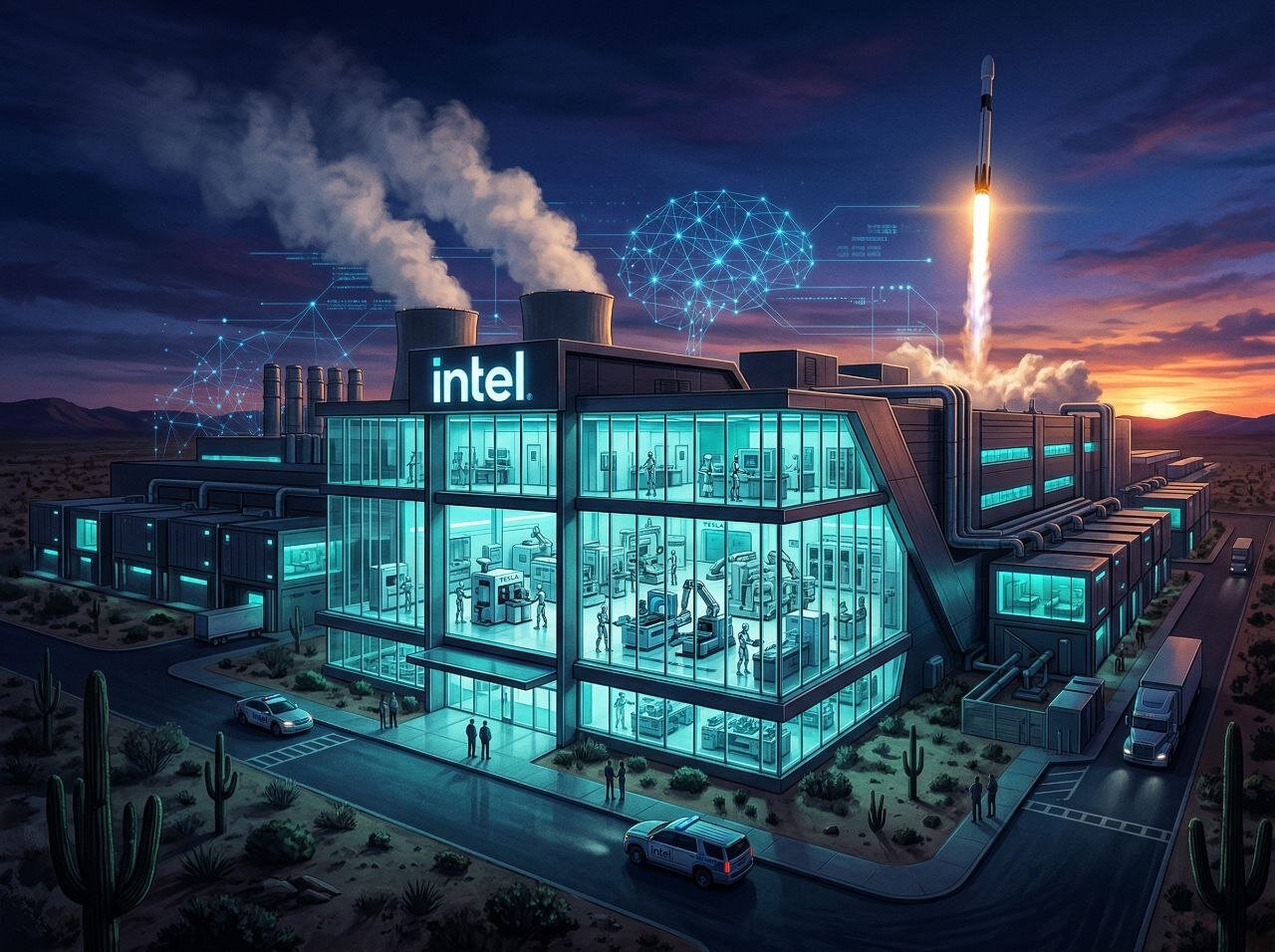
The unthinkable alliance. In a move that sent shockwaves through the semiconductor industry, Intel announced on April 7, 2026, that it would join forces with Elon Musk's TeraFab project—the most ambitious chip manufacturing endeavor in human history. The struggling American chipmaker, desperate for a turnaround, has bet its future on the world's most controversial billionaire.
TeraFab, Musk's $20 billion (at minimum) venture to build AI chips for Tesla, SpaceX, and xAI, just gained a crucial partner with decades of fabrication expertise. But this isn't just about building another chip factory. This is about reimagining the entire semiconductor industry from the ground up—and potentially reshaping the global balance of AI compute power.
Welcome to the most consequential marriage in tech since Microsoft invested in OpenAI. And like that deal, this one could change everything.
The Announcement That Shook Silicon Valley
Intel's announcement came via X (formerly Twitter), the platform Musk owns. In a post that was characteristically light on details but heavy on ambition, Intel declared: "Intel is proud to join the Terafab project with SpaceX, xAI, and Tesla to help refactor silicon fab technology."
The statement continued: "Our ability to design, fabricate, and package ultra-high-performance chips at scale will help accelerate Terafab's aim to produce 1 TW/year of compute to power future advances in AI and robotics."
One terawatt per year. Let that sink in. That's enough power to run five New York Cities simultaneously. It's an order of magnitude beyond anything the semiconductor industry has ever contemplated. And Intel just volunteered to help build it.
Intel CEO Lip-Bu Tan doubled down in his own X post: "Elon has a proven track record of reimagining entire industries. This is exactly what is needed in semiconductor manufacturing today. Terafab represents a step change in how silicon logic, memory and packaging will get built in the future."
What Exactly Is TeraFab?
TeraFab is Musk's answer to the AI chip shortage that has constrained his ambitions for years. Officially unveiled as a $20 billion project, it's designed to be the "most epic chip-building effort ever"—combining logic, memory, and advanced packaging under one roof in Austin, Texas.
The project's website declares its mission with characteristic Muskian audacity: "Terafab will close the gap between today's chip production and the future's demand—a future among the stars."
The chips produced at TeraFab will power everything Musk is building: the "robot army" of self-driving Teslas, the Optimus humanoid robots, the Dojo supercomputer training xAI's models, and eventually the data centers Musk plans to launch into space aboard SpaceX's Starship.
Musk has been increasingly vocal about his chip desperation. During a Tesla earnings call earlier this year, he pleaded: "Can someone else build these things? I mean, it's very hard to build these things." He questioned whether the existing chip industry could possibly keep up with AI's exponential demand curve.
Now, with Intel on board, he doesn't have to wait for someone else. He's building his own supply chain.
Why Intel? Why Now?
Intel's participation in TeraFab is a Hail Mary pass from a company in crisis. After losing its manufacturing edge to Taiwan's TSMC and reporting a $600 million net loss in recent quarters, Intel is betting that Musk's vision—and his checkbook—can save America's last major chipmaker.
The partnership makes sense on paper. Intel brings:
- Decades of fabrication expertise: Intel knows how to build and operate fabs at scale, even if it's been struggling lately.
- Advanced packaging capabilities: Intel's Foveros 3D stacking technology is genuinely cutting-edge.
- US-based infrastructure: Intel is already building two fabs in Arizona as part of a $20 billion investment.
- Custom silicon services: Intel officially offers custom chip design for clients—a service Tesla, SpaceX, and xAI will almost certainly use.
In return, Intel gets what it desperately needs: a marquee customer with virtually unlimited demand, massive capital resources, and the willingness to think bigger than anyone else in the industry. If TeraFab succeeds, Intel could go from laggard to leader in the AI chip era.
But the partnership raises as many questions as it answers. The announcement lacked press releases, SEC filings, or concrete financial details. How exactly will the collaboration work? Will Intel build dedicated TeraFab lines, or will this be a traditional foundry relationship? Will Intel share its process technology, or will TeraFab develop its own?
The vagueness suggests either extreme early-stage negotiations—or extreme strategic ambiguity. With Musk, it's often hard to tell which.
The Scale Problem: Can Anyone Build 1 TW of Compute?
TeraFab's stated goal—producing 1 terawatt of compute annually—sounds like science fiction because it essentially is. Current global data center power consumption is estimated at roughly 200-400 gigawatts total. Musk wants to build infrastructure that could power the entire current internet five times over.
Analysts at Bernstein have estimated that building TeraFab to its full vision could cost $5 trillion—more than 70% of the entire yearly US federal budget. Even the $20 billion initial investment is widely seen as just the beginning.
But here's the thing about Elon Musk: he has a habit of delivering on impossible timelines. Tesla's Gigafactory seemed absurd until it wasn't. SpaceX's reusable rockets were science fiction until they landed. The Boring Company's tunnels looked like a joke until Vegas built them.
If anyone can scale chip manufacturing exponentially, it's the guy who scaled rocket manufacturing exponentially. Intel is betting its future that Musk's magic touch extends to semiconductors.
The Geopolitical Dimension
Beyond the business implications, TeraFab represents a strategic shift in the global semiconductor landscape. Currently, the majority of advanced chips are manufactured in Taiwan by TSMC—a vulnerability that keeps Pentagon planners awake at night.
The CHIPS Act poured billions into reshoring semiconductor manufacturing, but progress has been slow. TSMC's Arizona facility keeps facing delays. Intel's turnaround has been painful. American chipmaking supremacy that existed in the 1990s feels like a distant memory.
TeraFab could accelerate that reshoring dramatically. With Intel's expertise and Musk's capital, the US could build domestic AI chip capacity at a scale that rivals TSMC within a decade. For a country increasingly worried about AI supply chain security, that's a strategic imperative.
But there's a darker interpretation too. If TeraFab succeeds, it creates a vertically integrated AI empire controlled by one man. Musk would own the rockets (SpaceX), the robots (Tesla), the AI models (xAI), and now the chips that power them all. That's concentration of power that would make the robber barons blush.
What This Means for the AI Industry
For companies competing with Musk, TeraFab is a nightmare scenario. OpenAI, Anthropic, Google DeepMind—they all rely on Nvidia GPUs or custom silicon from TSMC. They don't control their own supply chains.
If Musk builds his own chip factory, he gains something his competitors can't match: unlimited compute at marginal cost. While they're negotiating allocations with Nvidia and waiting for TSMC production slots, Musk can just build more.
The implications for AI development are profound. Compute is the primary constraint on model capabilities right now. The companies with the most chips train the best models. If Musk controls his own chip supply, he can iterate faster, train larger models, and deploy more inference capacity than anyone else.
It's the ultimate moat. And he's building it in Texas.
Our Hot Take: This Changes Everything—or Nothing
Let's be real: this partnership could go either way spectacularly.
The bull case: Musk's track record of industrializing the impossible is unmatched. Tesla built a battery supply chain from scratch. SpaceX built reusable rockets when NASA said it couldn't be done. If anyone can revolutionize chip manufacturing, it's him. Intel provides the expertise; Musk provides the audacity. Together, they build TeraFab, reshore American chipmaking, and create the infrastructure for an AI-powered future.
The bear case: Chip manufacturing is different. It requires decades of accumulated expertise, massive capital discipline, and supply chain relationships that can't be rushed. Musk's "move fast and break things" approach that worked for software and rockets might fail catastrophically with semiconductors. Intel, already struggling, could be distracted by TeraFab just when it needs to focus on its own turnaround. The partnership fizzles, billions are wasted, and American chipmaking falls further behind.
Here's what we know for sure: the stakes couldn't be higher. If TeraFab succeeds, it reshapes the global AI landscape. If it fails, it's a $20+ billion cautionary tale about hubris.
But that's the thing about Elon Musk. He doesn't bet small. And now, neither does Intel.
The chip wars just entered a new phase. The only question is who comes out alive.
Sources: Tom's Hardware, The Verge, Tech Industry Reports