
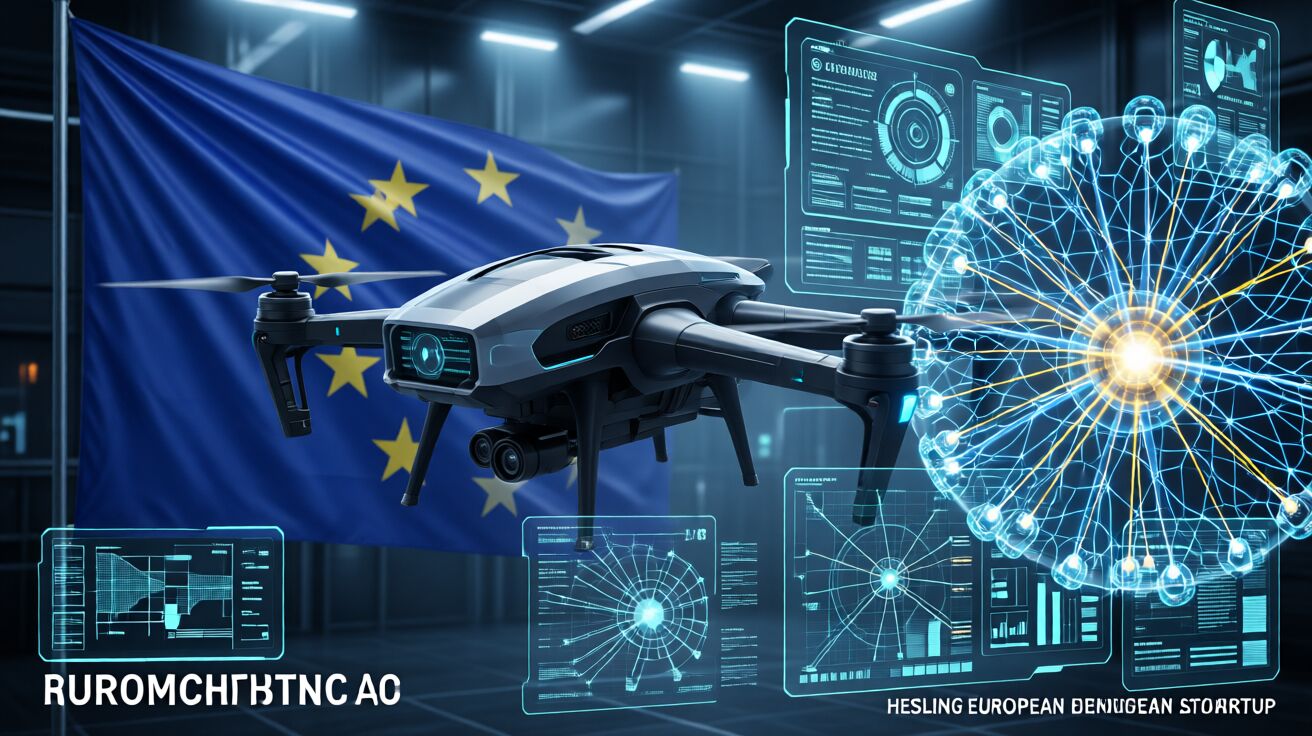
Europe just witnessed its largest defense technology funding round in history, and the implications stretch far beyond the balance sheets of a single Munich startup.
In July 2026, Helsing — the Munich-based defense AI company building autonomous drones and battlefield-intelligence software — closed a $1.8 billion Series E round at an $18 billion valuation. The round was oversubscribed, led by US investors Dragoneer Investment Group and Lightspeed Venture Partners, with new participation from Goldman Sachs Alternatives, CPP Investments (Canada's largest pension fund), and JPMorgan Chase. It marks the single largest defense-tech funding round ever completed in Europe.
From Battlefield Lesson to Procurement Line Item
The proximate cause is straightforward: war has changed, and Europe has been watching it happen next door. Russia's invasion of Ukraine, combined with Iran's use of inexpensive Shahed-type drones in Middle East conflicts, has demonstrated that cheap, AI-enabled unmanned systems can extend the reach of conventional forces, gather intelligence continuously, and increasingly operate with minimal human input.
NATO Secretary General Mark Rutte has framed this shift starkly, saying the alliance must become "drone-ready," and describing drones as a decisive factor in the character of modern warfare. Allies have now committed to investing more than $40 billion in counter-drone capabilities over five years under NATO's new initiative.
The United Kingdom's five billion pound "drone transformation" programme, part of its "Defence Investment Plan" published in late June, follows the same logic: cheap, attritable, software-defined systems are being treated not as a niche capability but as a core pillar of force structure.
Germany's decision to fund 50,000 drones for Ukraine — a 90-million-euro order built around operating software from Zurich-based Auterion and hardware from Ukrainian manufacturer Skyfall — illustrates how quickly procurement cycles are compressing when the underlying technology is proven in combat rather than in a lab.
The Money Behind the Shift
The scale of capital now moving into this space is difficult to overstate. Core defense spending among European NATO members has roughly doubled since 2019, and under NATO's new 3.5% of GDP target agreed at the 2025 Hague summit, McKinsey estimates European defense outlays could approach €800 billion by 2030 — around 2.9% of GDP.
Public markets have already priced in much of that shift: An equally weighted index of large, listed European defense companies has returned roughly 400% since 2022, with most of that outperformance concentrated since early 2025.
Venture capital has followed. According to Dealroom data cited in industry analysis, European defense, security, and resilience startups raised roughly $8.7 billion in 2025 — up 55% year-over-year, and nearly four times the level of five years earlier.
Helsing's Valhalla Platform: The AI Core
At the center of Helsing's offering is its Valhalla combat management system — an AI-powered platform that fuses data from multiple drone types, sensors, and ground units into a single operational picture. The system is designed to let a single operator control multiple drones simultaneously, make targeting decisions in contested electronic warfare environments, and adapt to jamming and interference that would ground conventional UAVs.
The company's flagship product, the HX-2 strike drone, is a high-precision, medium-range system that combines speed, good flight characteristics, autonomous terminal guidance, and on-board AI. Real combat footage from Ukraine has confirmed the system works as advertised: a human locks the target, and the machine takes over in the jamming-vulnerable final seconds, guided by AI rather than GPS or radio control.
Thousands of HX-2 drones have already been delivered to Ukrainian forces, and the company reports that its systems have completed tens of thousands of missions. The AI-powered terminal guidance has proven particularly effective against Russian electronic warfare systems that have degraded the performance of older Ukrainian drone models.
The European Defense AI Ecosystem
Helsing is not alone. The funding round cements it as Europe's best-capitalized pure-play defense-tech company, but peers are also reaching unicorn status on the strength of drones and reconnaissance systems tested in Ukraine and now moving into NATO procurement pipelines.
Munich-based Quantum Systems and Portugal's Tekever have both reached unicorn valuations in the past year, while Zurich-based Auterion — whose operating system keeps drones locked onto targets even when signals are jammed — is preparing for its own public offering. The trend signals a broader shift: Europe is no longer just buying American and Israeli defense technology. It is building its own sovereign capability.
For context, the US defense-tech sector has seen similarly massive rounds — Anduril raised $2.5 billion at a $30.5 billion valuation in 2025 — but Europe's ecosystem is now moving at comparable speed, backed by institutional capital that previously would not have touched weapons technology.
Why This Matters Beyond Europe
Helsing's round is significant for several reasons:
1. It proves Europe can build frontier defense AI. The $18 billion valuation places Helsing in the same conversation as Anduril and other US defense-tech giants. The technology is competitive, the combat record is proven, and the capital markets are responding.
2. It signals a structural shift in European security policy. Three years ago, most European VCs would not take a meeting about weapons technology. Today, defense is arguably the hottest vertical on the continent's cap tables. The Ukraine war has fundamentally changed how Europe thinks about sovereignty, security, and industrial policy.
3. It creates a counterweight to American defense-tech dominance. While US companies like Anduril and Palantir dominate headlines, European startups are building sovereign capabilities that answer to European governments, not just American ones. That matters for allies who want access to advanced defense technology without ceding strategic autonomy.
4. It accelerates the militarization of AI. The same AI techniques powering ChatGPT and Claude are now being applied to target recognition, swarm coordination, and autonomous weapons systems. Helsing's success proves that the commercial AI boom is directly feeding the defense AI boom — and that the two will increasingly share the same talent pool, research pipeline, and investment community.
🔥 Hot Takes
1. The Ukraine war is the most effective defense-tech focus group in history. Every drone, every sensor, every AI system deployed in Ukraine is being stress-tested against real adversaries with real electronic warfare capabilities. The data coming back is invaluable — and it's making European defense companies significantly more competitive than they were before 2022.
2. Europe's defense AI boom is happening because America is America. European governments and investors are realizing that relying on US defense technology creates strategic vulnerabilities. Helsing's round isn't just about Ukraine — it's about building sovereign capability that answers to European interests, not just NATO alignment with Washington.
3. The line between commercial AI and defense AI is dissolving. The same foundation models, reinforcement learning techniques, and sensor-fusion architectures powering consumer AI products are being adapted for military use. Helsing's Valhalla platform shares more DNA with OpenAI's models than people realize — and that convergence will only accelerate.
4. $1.8 billion sounds like a lot until you compare it to American defense-tech rounds. Anduril raised $2.5 billion at a $30.5 billion valuation in 2025. Helsing's round is impressive for Europe, but it's still smaller than what American defense startups are raising. The gap is closing, but Europe still has catching up to do.
The Bottom Line
Helsing's $1.8 billion Series E is a milestone for European defense technology — but it's also a symptom of a much larger shift. The Ukraine war has proven that AI-enabled drones are decisive on the modern battlefield. European governments are responding with unprecedented spending. And venture capital, once reluctant to touch weapons technology, is now flowing into defense startups at a pace that would have been unimaginable five years ago.
The question isn't whether Europe will become a major defense-tech power. It's whether it can move fast enough to build the capability its allies need — and whether the commercial AI boom will continue to feed the defense AI boom at the same pace.
For Helsing, the $18 billion valuation is both a reward and a responsibility. The company now has the capital to scale, but also the expectation to deliver. The next few years will tell whether European defense AI can move from promising startup to indispensable ally — or whether it remains a regional player in a global market dominated by American giants.